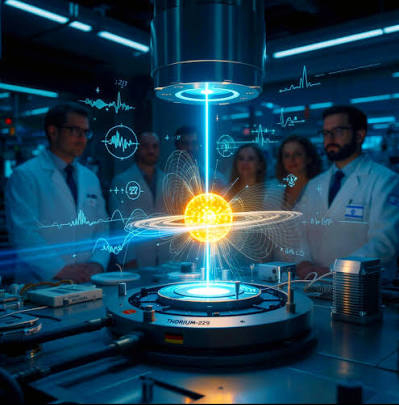
Two rival teams in Europe and China have independently switched on the world's first true "nuclear clocks" — ultra-precise timekeepers that tick to the rhythm of an atomic nucleus, not its electrons, and could finally help physicists catch dark matter in the act.
VIENNA / BEIJING
For over sixty years, the most precise clocks have worked the same way: watching electrons hop between energy levels. This week, two independent teams announced they have smashed that paradigm — by building the first working clocks that tick using an atom's nucleus instead of its electrons.
Scientists have chased this idea for nearly two decades. Now, with results arriving almost simultaneously from a European collaboration in Vienna and a separate effort at Tsinghua University in China, the age of the nuclear clock has begun.
The Atom Nobody Else Wanted
The hero is thorium-229, an obscure isotope notable for having the lowest-energy nuclear transition ever discovered — so low that physicists realized in 2003 it might be reachable with laser light rather than X-rays.
That theoretical possibility became experimental reality in 2024, when a landmark collaboration achieved the first precise measurement of the thorium-229 transition. But they didn't produce a working clock that could tick continuously.
This week's breakthrough closes that gap. Both teams built their devices around the same recipe: thorium-229 atoms embedded in calcium fluoride crystals, illuminated by ultra-precise vacuum-ultraviolet lasers. When the laser hits the right frequency, the nucleus locks the laser frequency in place — effectively using the nucleus itself as the timekeeping reference.
Two Teams, Two Philosophies
The European team built a complete, stand-alone clock where the thorium nucleus continuously stabilizes the laser in a closed loop. Crucially, they tested two separately manufactured crystals and found both produced nearly identical frequencies — addressing a worry that microscopic differences in crystals might make unreliable timekeepers.
The Chinese team took a different road, using a more powerful laser system for raw signal strength. Having two independently verified, technically distinct paths arrive at success simultaneously gives the physics community built-in replication.
Thorsten Schumm, a member of the European team who has spent nearly two decades chasing this result, called it "a dream come true."

Why a Nucleus Beats an Electron
Atomic clocks already keep absurdly precise time — accurate to a second over tens of billions of years. Why does the world need more?
First, robustness. Electrons are exposed to stray fields and temperature fluctuations. A nucleus is tucked away behind electron shielding, largely insulated from noise — meaning nuclear clocks could be sturdier and more portable, operating where room-sized atomic clock setups can't go.
Second, fundamental physics. A nucleus is sensitive to three of the four fundamental forces — strong, weak, and electromagnetic — in ways electron transitions aren't. If fundamental constants are drifting over time, a nuclear clock would notice. And because leading theories suggest dark matter might interact with these constants, nuclear clocks have become one of the most promising tools for finally detecting dark matter directly.
A Long Road to Get Here
Researchers first proposed thorium-229 in the early 2000s, but finding the transition eluded physicists for twenty years. The 2024 Nature paper finally located it. A 2025 study mapped how the transition responds to temperature, finding a stability sweet spot. That groundwork made this week's leap possible.
Expert Perspective
Physicists have compared the moment to the original development of the cesium atomic clock in the 1950s — a technology that went on to underpin GPS, telecommunications, and the definition of time itself. Nuclear clocks remain years away from outperforming the best atomic clocks on raw precision, but the real prize is opening an entirely new category of measurement atomic clocks can't make.
What This Means for You
None of this will change your phone or GPS tomorrow. Nuclear clocks live in specialized labs. But atomic clocks themselves spent decades as curiosities before becoming the backbone of modern navigation and communications. Nuclear clocks — rugged and portable — could follow a faster path into next-generation satellites, secure networks, and fundamental physics experiments.
More immediately, this matters for anyone curious about dark matter. Every new tool increases the odds that someone finally catches a real signal of what dark matter actually is.
The Bottom Line
For nearly two decades, building a nuclear clock lived mostly in theoretical papers. This week, two competing teams on opposite sides of the planet both got there — independently, almost simultaneously, using different engineering approaches that cross-validate each other. It's a quiet, technical milestone that could reshape how humanity measures time, tests the laws of physics, and hunts for the invisible substance that makes up most of the universe. As Thorsten Schumm put it: a dream come true.
Published By | Tech Wiz