SCIENCE & TECH
Somewhere inside your own cells sits the fossilized wreckage of a genetic collision that happened before the first backbone ever existed. This week, a team of researchers in Vienna unveiled the most detailed map of that ancient wreckage ever built — a sprawling atlas that traces the DNA of jellyfish, elephants, beetles, sharks and nearly 4,500 other species back to a common starting point hundreds of millions of years in the past.
The study, published August 20, 2026, in the journal Science Advances, is being called the largest-ever comparison of chromosome-scale genomes across the animal kingdom. Its headline finding sounds almost like a plot from a science-fiction novel: the genomes of Earth's wildly different animals did not evolve at random. Instead, they moved along a limited number of fixed, one-way "evolutionary highways" — and once a species' genome merges onto one of those highways, it can never take an exit back to where it started.
The Biggest Genome Road Trip Ever Taken
For the new study, a team led by researcher Darrin Schultz — who did the work as a postdoctoral fellow at the University of Vienna and has since become an assistant professor at Lehigh University — pulled together more than 5,800 publicly available chromosome-scale genomes representing 4,454 species spread across 19 major animal phyla. That is a mind-bending sample size: everything from sponges and comb jellies to insects, mollusks, fish, reptiles, birds and mammals got folded into a single, searchable map.
"For the first time, we can see thousands of genomes on a single map and trace the unique paths along which animals' DNA evolved," Schultz said of the project. "Viewing the map as a whole gives us a picture of the patterns by which animal genomes have changed over time."
Assembling that map required comparing the order and grouping of genes across species separated by hundreds of millions of years of independent evolution — a computational undertaking that would have been essentially impossible even a decade ago, before genome sequencing became fast and cheap enough to generate chromosome-level assemblies for thousands of non-model organisms.
What Exactly Is a "Fusion-With-Mixing"?
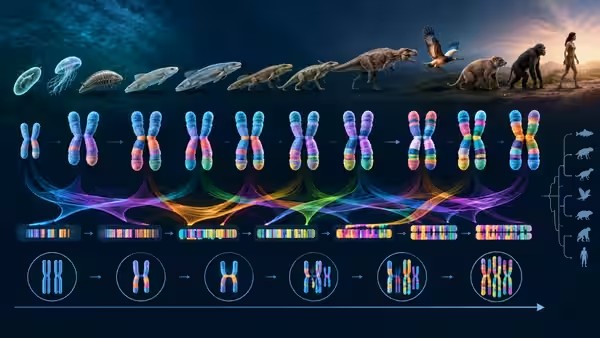
At the heart of the discovery is a process the research team calls "fusion-with-mixing." Every animal's genome is broken up into chromosomes — bundles of tightly coiled DNA. Occasionally, over evolutionary time, two separate chromosomes will collide and fuse into one. That alone isn't unusual; biologists have known about chromosome fusions for decades.
What's new here is the "mixing" part. When two chromosomes fuse, the genes that were sitting on each of the original chromosomes don't just stay in two neat, separate blocks glued end to end. Over subsequent generations, the genes get shuffled and interleaved with one another, like two decks of cards riffled together. Once that shuffling happens, there is no way for evolution to "un-riffle" the deck and separate the two original chromosomes back out. The genetic record of the fusion becomes permanent — a scar that gets passed down, essentially unchanged, for hundreds of millions of years.
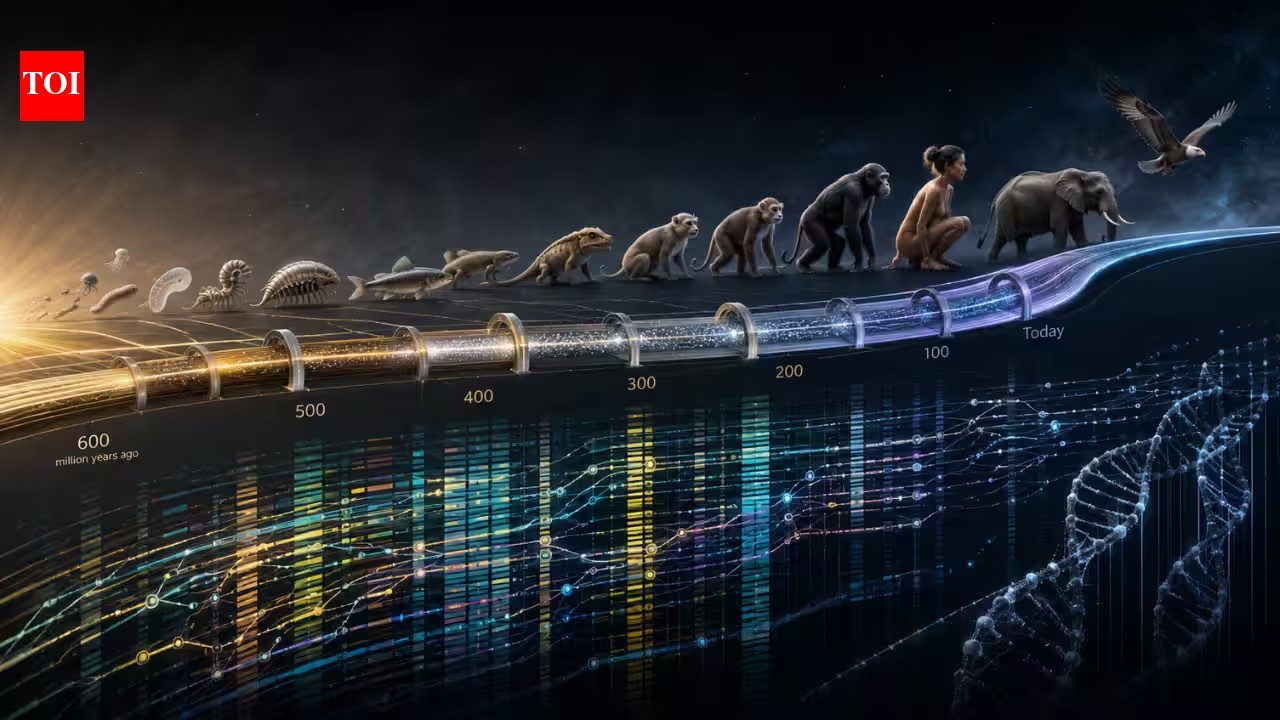
By tracking where those permanent scars show up across the 4,454 species in their dataset, Schultz and his colleagues — including co-authors Arno Blümel, Dalila Destanović and Fatih Sarigol, working under senior researcher Oleg Simakov's lab at the University of Vienna — were able to reconstruct which fusion-with-mixing events happened first, which happened later, and which lineages share a fusion inherited from a common ancestor. Some of those shared fusion "fingerprints" trace all the way back to an ancestor that lived more than 600 million years ago, before sponges split off from the rest of the animal family tree.
One-Way Streets, Written in Blood and Bone
Here's where the "highway" metaphor comes in. Because fusion-with-mixing events are irreversible, they act like on-ramps to a highway system with no U-turns. Once a lineage's genome undergoes a particular fusion, every descendant species is stuck traveling forward from that point. Different lineages can take different exits, drift down different side routes, or merge back onto shared highways at later fusion events — but they can never backtrack to an earlier configuration.
Mapped out across the entire animal kingdom, that produces something the researchers describe as a genuine roadmap of animal biodiversity: a branching, one-directional network showing exactly how chromosome structure has evolved, phylum by phylum, since the earliest animals appeared on Earth. Crucially, the map shows that genome evolution isn't a free-for-all. Instead of an essentially unlimited number of ways chromosomes could theoretically rearrange themselves, real animal genomes have overwhelmingly clustered onto a comparatively small number of these highways — suggesting there are hidden rules, not yet fully understood, that constrain how genomes are allowed to change.
Why a Jellyfish's Chromosomes Matter to You
It's tempting to file this away as an obscure academic curiosity — interesting to biologists, irrelevant to everyone else. But the research team argues the opposite. Because fusion-with-mixing events are permanent and traceable, they function as an extraordinarily reliable evolutionary clock and fingerprinting system, arguably more reliable than traditional DNA sequence comparisons, which can be muddied by convergent evolution or rapid mutation rates.
That reliability has immediate, practical stakes. Conservation biologists already use genomic tools to figure out which populations of an endangered species are most distinct and therefore most valuable to protect, to detect harmful inbreeding, and to understand whether two closely related populations can safely interbreed. A "highway map" of how chromosomes are allowed to evolve gives conservationists a new, more precise tool for all of that work — one that can flag genuinely unusual lineages that may carry irreplaceable evolutionary information found nowhere else in the animal kingdom.
There's a biomedical angle too. Chromosome fusions and rearrangements aren't just a story about jellyfish and beetles — they happen in the human genome as well, and disruptions to normal chromosome structure are linked to developmental disorders and cancer. A clearer picture of the "rules of the road" for how chromosomes are permitted to reorganize themselves could eventually help researchers understand which rearrangements in human cells are relatively benign and which are more likely to cause disease.
Expert Perspective
The Vienna team has been explicit about where they see this research heading next. In materials accompanying the study, the researchers wrote that the new atlas "lets us ask where genome evolution might go next and enables us to identify key measures for the conservation of animal biodiversity." In other words, the map isn't just a look backward at 600 million years of evolutionary history — the team believes it can help predict, at least in broad strokes, which kinds of chromosome changes are more or less likely to appear in a given lineage going forward, and which populations most urgently need protecting before those unique genomic configurations are lost for good.
Outside researchers who study genome evolution have generally welcomed the sheer scale of the dataset, noting that comparisons of this size — nearly 6,000 genomes across 19 phyla — simply weren't possible before the recent explosion in low-cost, high-quality genome sequencing. Some caution that the "highway" framework, while a useful organizing metaphor, will need to be stress-tested against odd exceptions: rapidly evolving lineages, ancient hybridization events, and groups where fossil and genomic timelines don't neatly line up. Debates of this kind have simmered for years in the field, particularly around fundamental questions like whether sponges or comb jellies split off first from the rest of the animal family tree — a controversy this same "ancestral linkage group" methodology has previously been used to weigh in on.
What This Means for You
You don't need to care about chromosome biology to have a stake in this discovery. Every cell in your body carries the genetic residue of ancient fusion-with-mixing events, meaning your own DNA is, in a very literal sense, a fossil record of collisions that happened deep in the evolutionary past — a fact that reframes the human genome as less of a blueprint and more of a well-traveled highway system with a documented history of pileups.
More practically, the tools built for this study are already being positioned as a resource for zoos, wildlife agencies and conservation nonprofits trying to make hard triage decisions about which endangered species and populations to prioritize with limited funding. As habitat loss and climate pressures accelerate biodiversity loss worldwide, having a rigorous, genome-based way to identify which lineages are genetically irreplaceable — rather than relying on guesswork or public appeal alone — could meaningfully change how conservation dollars get spent in the years ahead. And for the biomedical world, a better understanding of "permitted" versus "disruptive" chromosome rearrangements could, over time, feed into research on genetic disorders linked to chromosome abnormalities in humans.
The Bottom Line
Six hundred million years ago, long before dinosaurs, long before trees, long before anything resembling a modern animal crawled or swam across the planet, a handful of chromosomes fused together in some soft-bodied ancestor and left a mark that has never been erased. Thanks to the largest genomic road map ever assembled, scientists can now trace that mark — and thousands like it — across the entire animal kingdom, mapping out exactly which evolutionary highways life on Earth has traveled, and which ones it can never travel again. It's a discovery that turns your own DNA into a kind of ancient travel diary, written in a language scientists are only now learning to read fluently — and one they hope will help decide which chapters of that diary get to survive into the future.
Published By | Tech Wiz