No clock. No calendar. Just 24,000 atoms colder than deep space, sealed off from the outside world. A British physicist used them to answer one of the strangest questions in science: if nothing is ticking, does time even exist?
BIRMINGHAM, England
The Question That Breaks Physics
Here's a question that sounds simple until you actually try to answer it: what is time? Not what time is it — what IS time? Where does it come from? Why does it only run one direction, from past to future, when almost every fundamental law of physics works exactly the same whether you run it forwards or backwards?
For most of us, this is a stoner-dorm-room question. For physicists working on quantum gravity — the still-unfinished project of merging Einstein's theory of gravity with quantum mechanics — it's a career-defining crisis known bluntly as "the problem of time." Some of the leading mathematical descriptions of the universe as a whole, including a famous equation called the Wheeler–DeWitt equation, describe a cosmos that has no time in it at all. Not "time moves slowly" — no time, period. A single, frozen, unchanging quantum state. And yet here we all are, aging, watching sunsets, missing deadlines. Something has to explain the gap between a timeless equation and a universe that clearly, undeniably, ticks.
This month, a physicist in England built a machine small enough to sit on a lab bench that might finally let scientists test that gap directly — not with more math, but with actual atoms, in an actual lab, in the actual United Kingdom.

Building a Universe You Can Hold in a Magnet
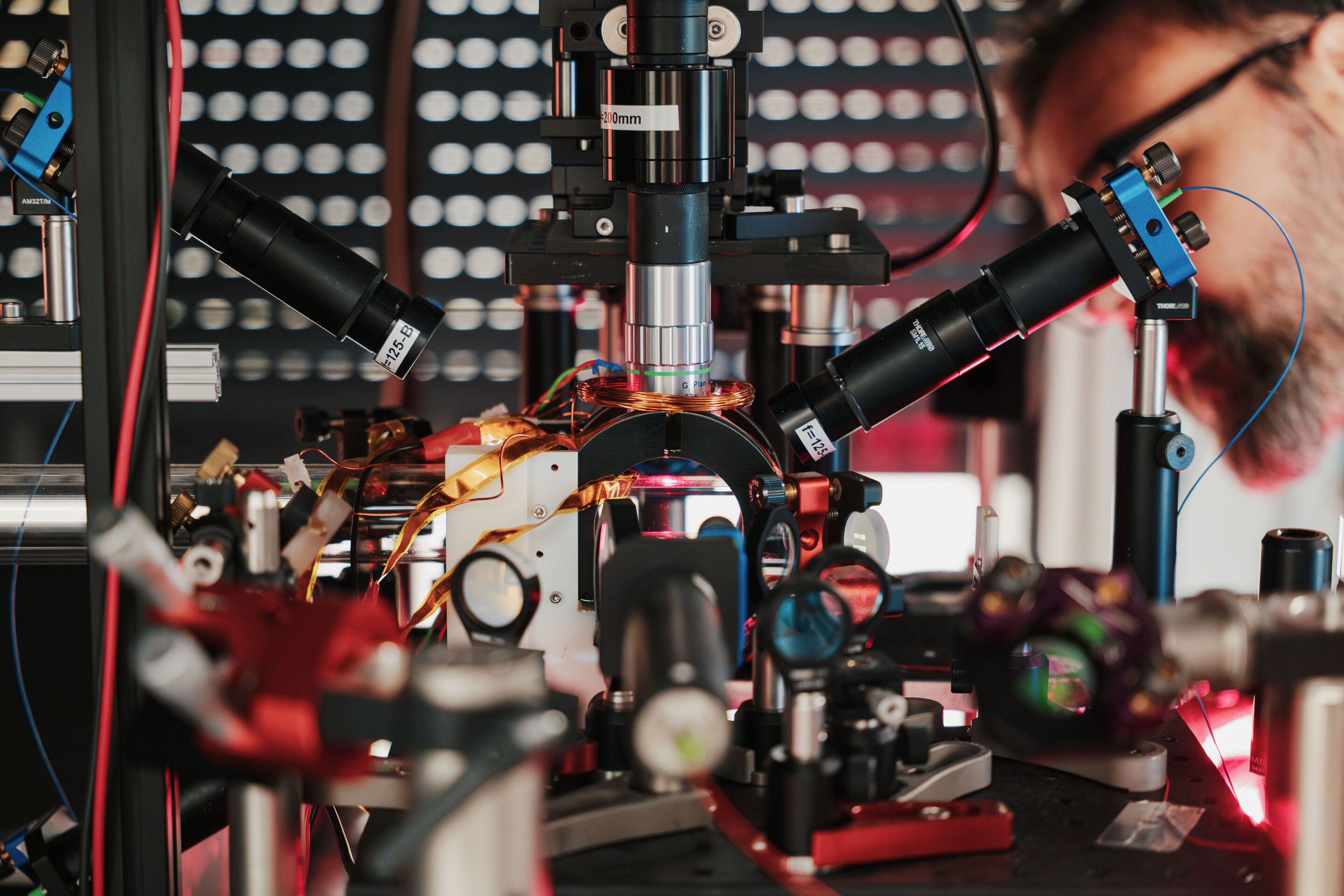
Professor Giovanni Barontini, a physicist at the University of Birmingham, has spent his career trapping and manipulating clouds of ultracold atoms — matter chilled to within a few billionths of a degree of absolute zero, the theoretical coldest temperature in existence, where atoms move so sluggishly they start behaving less like billiard balls and more like fuzzy quantum waves. For his latest experiment, published in the journal Physical Review Research, he used a cloud of exactly 24,000 rubidium atoms to build what he calls a "mini universe."
The setup itself sounds almost too simple to answer a question this deep. Barontini trapped his cloud of atoms using laser beams, then sliced it in two with a thin wall of light roughly eight micrometers wide — thinner than a human red blood cell. This split the system into two halves: a "bright" sector that instruments could observe and measure, and a "dark" sector that was deliberately, completely ignored, its contents left unmonitored. Crucially, the whole apparatus was isolated from the outside world as thoroughly as physically possible — no external reference clock, no outside signal, nothing ticking in from beyond the trap. Just like the universe itself is presumed to have nothing "outside" it to check the time against.
The bright half of the mini universe was made to expand and contract in repeating cycles — a miniature version of a Big Bang followed by a Big Crunch, the hypothetical scenario in cosmology where an expanding universe eventually reverses and collapses back in on itself. And because the system had no external clock to consult, the only way to know what was happening "when" was to look inside the system itself.
Time That Speeds Up, Slows Down, and Stops
What Barontini found is where the experiment gets genuinely strange. As atoms drifted between the bright and dark sectors, the amount of disorder — physicists call it entropy — in the bright, observable half kept changing. And that changing entropy, Barontini discovered, could be used as a working substitute for a clock. When entropy was flowing quickly between the two sectors, his home-built "clock" ran fast. When the flow slowed, so did time. And when the two halves settled into equilibrium, with no more entropy moving between them, the internal clock of the mini universe stopped completely — even though, from outside the lab, actual seconds kept ticking by on the wall.
"Time was speeding up or slowing down, or even stopping, depending on what the system was doing," Barontini told the science outlet Live Science, describing the strange rhythm of his lab-built cosmos. He calls this phenomenon "entropic time" — time defined not as an external river flowing past the universe, but as something generated from within, by the universe's own internal changes.
Crucially, this wasn't just a cute analogy. Barontini's entropic clock satisfied the actual mathematical requirements physicists demand of real time: it flowed in a single consistent direction, giving the system a genuine "arrow of time"; it correctly ordered events even as the mini universe expanded and contracted like an accordion; and the team showed that the central equation of quantum mechanics — the Schrödinger equation, which normally describes how quantum systems evolve moment to moment — could be rewritten using this internally generated entropic time and still make accurate predictions about how the system's "probability cloud" would change. In plain terms: the atoms didn't just behave as if time were passing. They generated a version of time that did everything real time is supposed to do.
Why This Matters for Black Holes and the Big Bang
This is where a table-top experiment involving rubidium atoms and laser beams reaches all the way out to the edge of the observable universe. The "problem of time" isn't an abstract philosophical puzzle to cosmologists — it's a genuine roadblock standing between physics and a full theory of quantum gravity, the long-sought framework that would finally explain what happens at the singularity inside a black hole, or in the first unimaginably brief fraction of a second after the Big Bang, when gravity and quantum mechanics both mattered and neither of our current theories can fully describe what was going on.
"In some theories of the universe, especially quantum gravity, time doesn't appear as a built-in feature," Barontini said in a statement released by the University of Birmingham. "Yet in everyday life, time flows from past to future — why is this so, when most basic laws of physics work the same way forwards and backwards? This study provides the first controlled experimental evidence that 'time' can be defined by changes within a system rather than as the external 'ticking clock' we think of as time. It offers new insight into the nature of time in quantum gravity that could be used to describe dynamics just as effectively as conventional time."
Until now, ideas like this — broadly related to a decades-old theoretical proposal in quantum cosmology for how time could emerge from correlations within an otherwise timeless universe — have lived almost entirely in chalkboard equations and peer-reviewed papers, tested only in the abstract. Barontini's mini universe is being described by physicists as the first controlled laboratory testbed where these ideas about quantum cosmology and gravity can actually be poked, prodded, and measured under real experimental conditions, rather than just argued about in seminar rooms. The university says the approach could eventually be scaled up to probe the physics of the actual Big Bang and a hypothetical Big Crunch, or even used to build lab-scale simulations of black holes — giving physicists an actual sandbox to test competing theories of how time itself comes into being.
Expert Perspective
Outside commentary on the study has focused on just how rare it is for an idea this deep in theoretical physics to get an actual laboratory demonstration. Coverage in Live Science and the science outlet Interesting Engineering noted that Barontini's 24,000-atom system is one of the first times researchers have shown, under controlled and repeatable conditions, that a functioning "arrow of time" can be manufactured from nothing but internal entropy — rather than assumed as a background feature of reality, the way virtually every other experiment in physics implicitly does. Barontini himself has been careful to frame the work as a first step rather than a final answer: the mini universe demonstrates that entropic time is mathematically and experimentally viable, not that it's definitely how time works in the actual, full-sized universe we live in. The next phase of research, according to the University of Birmingham's announcement, involves scaling the setup to more complex atomic systems to see whether entropic time continues to behave itself as the "universe" being modeled gets bigger and messier.
What This Means for You
You are not about to notice your kitchen clock behaving strangely because of this experiment — entropic time, at least for now, only shows up in an isolated cloud of atoms a few billionths of a degree above absolute zero, sealed inside a laser trap in a physics lab in the English Midlands. Nobody is claiming the clock on your phone is secretly powered by entropy rather than quartz crystals. But the experiment matters for a less flashy, more durable reason: it's a genuine crack in one of the oldest, thorniest walls in physics, and walls like that don't come down often.
If entropic time holds up under further testing and scaling, it could eventually reshape how physicists build the next generation of theories about black holes, the birth of the universe, and the ultimate unification of gravity and quantum mechanics — the kind of foundational physics that, historically, has had a habit of eventually trickling down into real technology decades later, the way quantum mechanics itself went from strange lab curiosities in the 1920s to the transistors inside every phone and computer today. For now, the honest takeaway is smaller but still remarkable: a scientist built a working miniature cosmos on a lab bench in Birmingham, and time, as far as anyone can tell, was born inside it exactly the way one of physics' strangest theories predicted it should be.
Somewhere in a physics building in the English Midlands, a cloud of 24,000 atoms colder than the space between stars is still sitting in its laser trap — a universe in miniature, with its own private arrow of time, ticking or not ticking entirely according to its own internal rules. Professor Barontini says this is only the beginning: bigger, messier versions of the same setup are next, aimed at probing the actual physics of the Big Bang and the insides of black holes. For a question that has stumped philosophers and physicists alike for as long as either discipline has existed, it turns out the next clue might have been sitting in a jar of very, very cold atoms all along.
Published By | Tech Wiz