GREENBELT, MARYLAND
A MONSTER WHERE IT SHOULDN'T BE
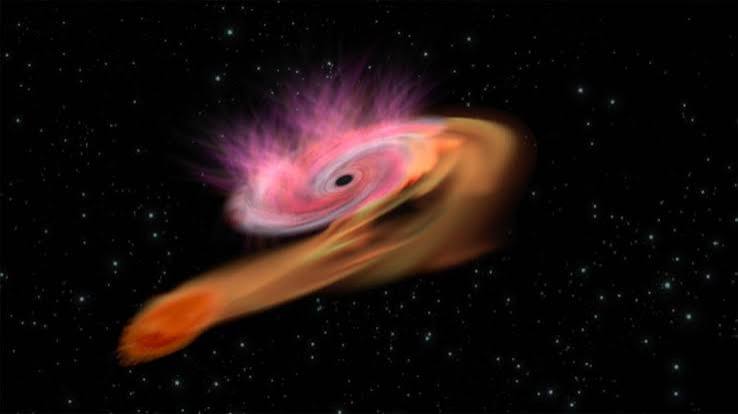
Somewhere in the constellation Cetus, 750 million light-years from Earth, something enormous just ate. NASA's Neil Gehrels Swift Observatory has confirmed one of the strangest cosmic crime scenes astronomers have ever documented: a supermassive black hole, weighing in at roughly a million times the mass of our sun, caught in the act of shredding a star to pieces — not at the center of its galaxy, where these monsters are supposed to live, but out on the ragged edge, more than 30,000 light-years from home.
Astronomers call this kind of black hole "wandering," and until very recently, most scientists doubted they could even find one this way. Every large galaxy is thought to be anchored by a supermassive black hole sitting dead center, like a spider at the middle of its web. This one isn't where it belongs — an orphan, cut loose from whatever galactic core it was born in, now drifting through the outskirts of a galaxy that isn't originally its own.
HOW YOU KILL A STAR
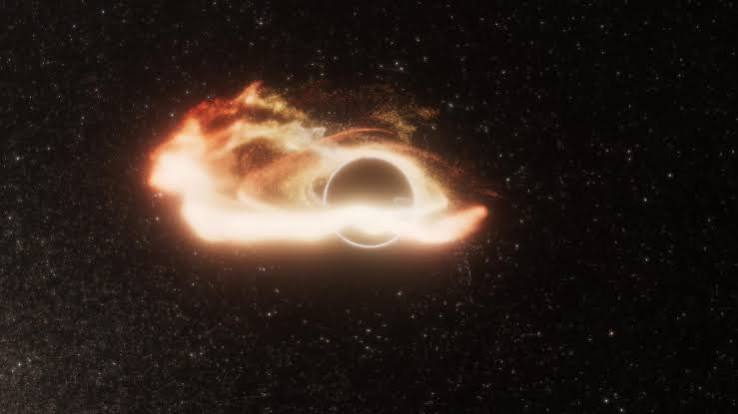
What Swift actually witnessed is called a tidal disruption event — astronomy's term for what happens when a star wanders too close to a black hole's gravity and gets torn apart, limb from limb, atom from atom. The star's own body becomes a river of debris spiraling into the black hole, heating up to blistering temperatures as it swirls toward oblivion and unleashing a flare of light bright enough to be seen across hundreds of millions of light-years.
This particular flare didn't just light up — it briefly outshone its entire host galaxy in ultraviolet light, blazing for a few months with the equivalent brightness of roughly 10 billion suns. NASA's Swift used its Ultraviolet/Optical Telescope to take the fireball's temperature and clocked it at approximately 54,000 degrees Fahrenheit (about 30,000 degrees Celsius) — hot enough to vaporize anything humanity has ever built, many times over.
HOW ASTRONOMERS CAUGHT IT
The story of how this thing was found is almost as wild as the discovery itself. It started in November 2025, when the Zwicky Transient Facility — a sky survey run out of the Palomar Observatory in Southern California — picked up an unusual burst of brightening in a distant galaxy. ZTF scans for roughly half a million flashes of light across the sky every single night, far too many for any human to sift through by hand. Instead, a newly built artificial intelligence algorithm flagged this particular flare as looking suspiciously like a tidal disruption event — despite the fact that its location, way out on a galaxy's outer edge, made almost no sense for where these events are supposed to happen.
"Out of the half million flashes ZTF detects each night, our new artificial intelligence algorithm automatically recognized a flare that looked a lot like a tidal disruption event, despite its unusual location in the outskirts of a galaxy," said Robert Stein, a research fellow at the University of Maryland, College Park, and NASA's Goddard Space Flight Center, who led the team behind the discovery.
Once the AI flagged the anomaly, a small army of telescopes went to work confirming it. The SOAR (Southern Astrophysical Research) telescope in Chile captured the event's spectrum — essentially its chemical fingerprint — which pointed strongly toward a tidal disruption event. Jonathan Carney, a doctoral student at the University of North Carolina at Chapel Hill, took the first spectra supporting that interpretation. Then NASA's Swift Observatory swooped in with ultraviolet and X-ray instruments no ground-based telescope can match, nailing down the temperature and ruling out every other explanation for the flare. The galaxy responsible for hosting this drama has an unglamorous catalog name — WISEA J014656.04-152214.7 — but the science coming out of it is anything but boring. The findings, led by Stein, were published this week in The Astrophysical Journal Letters.
HOW A BLACK HOLE ENDS UP EXILED
So how does a supermassive black hole end up 30,000 light-years from where it's supposed to be? Stein's team has two theories, and both involve cosmic violence on a scale that's hard to wrap your head around.
The first possibility: three or more galaxies collided and merged together at some point in the past, and during the ensuing gravitational tug-of-war between their central black holes, the lightest one got flung outward, like a marble launched off a spinning plate, eventually settling in the outskirts of the merged galaxy we see today.
The second possibility is messier and, frankly, more disturbing: a smaller dwarf galaxy could currently be in the middle of merging into the larger one. As the dwarf galaxy's stars get pulled into the bigger galaxy's gravity, one of them may have wandered too close to the dwarf's own black hole — its original, native black hole — and gotten shredded before the merger even finished.
"It must have originated in a galaxy's center, but not the one it's in the outskirts of now," Stein explained. "We think the host galaxy's supermassive black hole is still at its core, but the one eating the star could have started off in a small galaxy that merged with the big one we see today."
A RECORD-BREAKING FIND
This isn't the first time astronomers have caught a black hole misbehaving outside its home turf, but it is by far the most extreme example yet. Before 2024, every confirmed tidal disruption event had been observed happening squarely in a galaxy's core — partly because that's simply where astronomers were looking, since that's where every known supermassive black hole lived. Then scientists spotted the telltale signature of a star being shredded 2,600 light-years off-center, a discovery that flipped a switch in the astronomy community and sent researchers hunting for more off-center events. This new discovery obliterates that previous record more than tenfold, at over 30,000 light-years from its galaxy's center.
For context on just how rare this is: any single galaxy will only experience a tidal disruption event around once every 100,000 years. Across the millions of galaxies astronomers can observe, surveys typically catch roughly 30 of these star-shredding events happening somewhere in the universe each year. Finding one sitting in the wrong neighborhood entirely is a needle in a needle stack.
EXPERT PERSPECTIVE
"With this discovery, which is one of just a couple that have been confirmed so far, we've validated a new technique and can use it to hunt for more," Stein said. His team now wants to answer a much bigger question: just how common are these wandering black holes, really? If they're more common than expected, it could reshape how astronomers think about galaxy formation and the messy, violent history of mergers that built the universe we see today.
There's a wrinkle, though — Swift itself is temporarily benched. According to co-author S. Bradley Cenko, Swift's principal investigator at NASA Goddard, the spacecraft's pointed science observations are on hold while the mission prepares for an orbit boost planned for later this summer. Swift has been sinking slowly toward Earth due to atmospheric drag after more than two decades of continuous observations, far beyond what anyone expected when it first launched. "Once it resumes normal operations, Swift could continue searching for more examples of out-of-place black holes," Cenko said.
Help is already on the way. Scientists plan to apply this same AI-powered detection technique to data from the newly operational Vera C. Rubin Observatory in Chile and NASA's upcoming Nancy Grace Roman Space Telescope. "Rubin's wide, deep surveys will reveal a much larger sample of tidal disruption events than current observatories are capable of collecting, including ones that are off-center," said Carney. "And Roman's space-based surveys will extend the current search zone by seeing ones that are farther away, looking back through 9 billion years of cosmic history."
WHAT THIS MEANS FOR YOU
No, there is nothing to worry about here — this black hole is 750 million light-years away, a distance so vast that even light, the fastest thing in the universe, takes hundreds of millions of years to cross it. Nothing about this discovery poses any threat to Earth.
What it does offer is a genuinely rare glimpse into the hidden architecture of the universe. Every galaxy's growth story is tangled up with collisions, mergers, and the black holes that get flung around in the process, and most of that violent history is invisible to us — until, once in a great while, a black hole happens to snag a star and light up like a flare in the dark. Astronomers now have a validated technique — an AI trained to catch impossible-looking flickers among half a million nightly flashes — that could turn these once-in-a-blue-moon discoveries into a genuine census of the universe's most elusive black holes. Expect more headlines like this one over the next few years, as Rubin and Roman come fully online and start finding these cosmic exiles by the dozen rather than one at a time.
THE BOTTOM LINE
A supermassive black hole isn't supposed to be anywhere except the dead center of its galaxy. This one broke the rules, got caught red-handed 30,000 light-years from where it belongs, and in the process handed astronomers a working blueprint for finding every other black hole out there hiding in the dark. The universe, it turns out, has more fugitives than anyone realized.
Published By | Tech Wiz