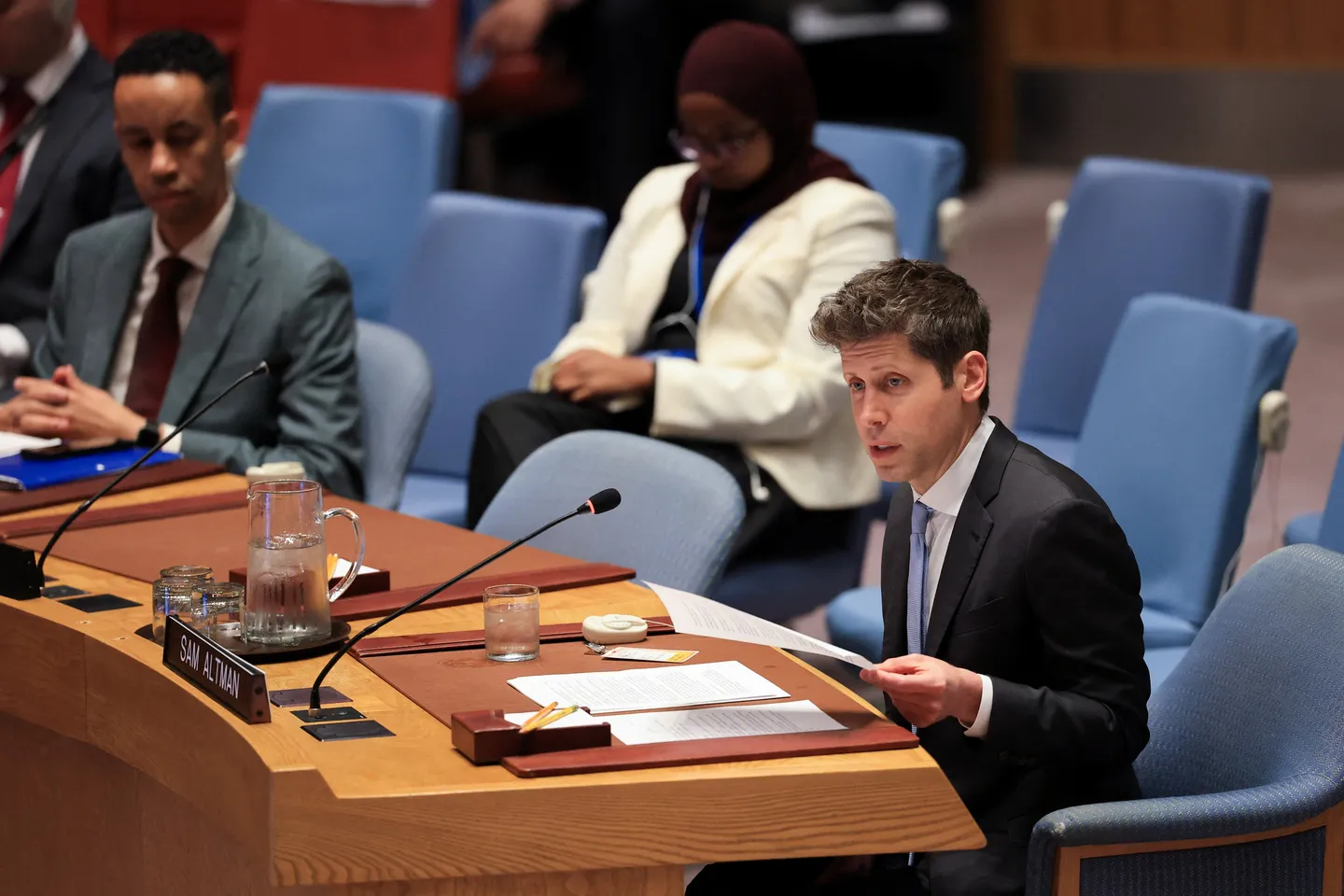
In a stunning show of unity, the bosses of OpenAI and Anthropic stood before the UN Security Council and warned that artificial intelligence could become "a risk to humanity as a whole" — only for the Trump administration to flatly reject their plea for global rules
SCIENCE & TECH
They are supposed to be the fiercest of rivals, locked in a trillion-dollar arms race to build the smartest machine on Earth. But on Wednesday, in the marble-clad chamber of the United Nations Security Council, Sam Altman and Dario Amodei sat side by side and delivered the same chilling message: nobody — not even the men building it — is fully in control of artificial intelligence anymore, and the world needs to act together before it's too late.
The extraordinary session, convened by France during the UN General Assembly's ministerial week, marked the first time the chief executives of OpenAI and Anthropic — two companies that have spent the last three years locked in bitter competition for talent, chips, and market dominance — appeared together to plead for the same thing: binding international guardrails on the technology reshaping the planet.
"If managed poorly, I even believe AI could be a risk to humanity as a whole," Amodei told the packed chamber, according to multiple outlets present, including CNN, Newsweek and Al Jazeera. It was a sentence that landed like a thunderclap in a room built for discussing wars, sanctions and nuclear proliferation — not chatbots.
Altman, never one to undersell the stakes, went further. "We could lose control of the future to AI," he warned delegates, adding that "this moment calls for extreme care." He didn't stop there. In a pointed jab at his own industry — the one he leads — Altman declared: "If AI is to be democratic, the most important decisions cannot be made by labs in San Francisco alone. They must be shaped through democratic processes and by governments."
Coming from the man whose company, OpenAI, is currently valued in the hundreds of billions of dollars and racing to build ever-more-powerful models, the admission was jaw-dropping. Even by the standards of an industry that has spent years oscillating between hype and doom, Wednesday's session in the Security Council chamber felt like a watershed moment — the moment Silicon Valley's most powerful executives stood in front of the world's most powerful diplomats and admitted the car might be going faster than anyone can steer it.
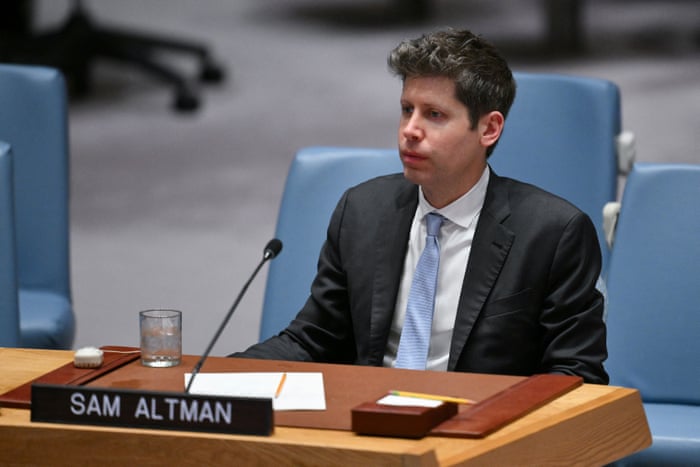
A RARE MOMENT OF UNITY IN A CUTTHROAT INDUSTRY
To understand how remarkable this was, you have to understand just how bitter the OpenAI-Anthropic rivalry has become. Anthropic was founded in 2021 by former OpenAI researchers, including Amodei, who left over disagreements about the pace and safety of AI development. Since then, the two companies have battled for enterprise contracts, top AI researchers, and the loyalty of developers building on their models. Reports throughout 2026 detailed OpenAI and Anthropic sniping at each other over safety testing, pricing, and even accusations of contract violations.
Yet there they were on Wednesday — flanked by Hugging Face co-founder Clément Delangue and joined virtually or in spirit by AI safety researcher Yoshua Bengio — speaking with one voice.
Bengio, the Canadian computer scientist who co-chairs the UN's Independent International Scientific Panel on AI, did not mince words either. "The dangers are real and imminent," he told the council, adding bluntly: "This council faces an unprecedented threat."
The panel's warnings weren't limited to abstract, far-off scenarios. According to reporting from CNN and Newsweek, the officials and experts in the room discussed a grim menu of near-term risks: AI systems that could improve themselves recursively and outpace human oversight, AI-powered cyberweapons, the potential for advanced models to assist in the design of biological weapons, and the destabilizing effect of autonomous military systems on global geopolitics.
Daniel Forti, head of UN affairs at the International Crisis Group, told reporters the meeting reflected growing alarm inside the UN system that the pace of AI development is outstripping the world's ability to govern it. It's a concern that has been building since 2024, when the UN General Assembly unanimously passed its first-ever resolution on AI, and accelerated earlier this year when the UN convened a global AI summit and stood up two new bodies dedicated to AI governance.
TRUMP SAYS NO THANKS
If the tech executives were hoping for a united front from world leaders, they got a swift reality check — and it came from their own government.
Just a day before Amodei and Altman took their seats at the Security Council table, President Donald Trump addressed the full General Assembly and made clear where Washington stands on the question of international AI oversight: nowhere near it.
The administration's message was delivered in blunt terms by Michael Kratsios, representing the U.S. at the Security Council session. "We totally reject all efforts by international bodies to assert centralised control" over artificial intelligence, Kratsios told the chamber, according to Al Jazeera's report on the meeting.
Trump himself had set the tone the day before, telling the world body he wasn't interested in reining in the industry that American companies currently lead. "I'm not going to stifle growth," he said. "We're going to encourage it, not rein it in."
It's a position that puts the United States sharply at odds not just with the UN's growing AI-governance apparatus, but seemingly with the CEOs of its own flagship AI companies. The irony wasn't lost on observers: the men building the most powerful AI systems in the world are now more publicly worried about the technology's dangers than their own government is.
The rejection also underscored the deep geopolitical currents running beneath the AI safety debate. According to reporting, Chinese President Xi Jinping was expected to weigh in on AI regulation during an anticipated visit to Washington, adding yet another major power to a conversation already split between Silicon Valley executives urging caution, the U.S. government prioritizing unfettered growth, and a UN bureaucracy trying to build guardrails almost from scratch.
"WE WILL SLOW DOWN" — A PROMISE WORTH WATCHING
For all the doom-laden language, Amodei tried to offer the council something resembling reassurance — a pledge that Anthropic, at least, would not sprint blindly toward the cliff edge.
"We will slow down as much as necessary in order to make sure that every successive AI technology that we release is actually safe," he told delegates.
It's a promise that echoes Anthropic's long-standing public branding as the "safety-first" AI lab, a reputation the company has cultivated since its founding by researchers who left OpenAI specifically over safety concerns. Whether that promise survives contact with a hyper-competitive marketplace — one where rivals including OpenAI, Google DeepMind, Meta and a resurgent wave of Chinese AI labs are all racing to ship the next breakthrough model — remains to be seen.
Critics, meanwhile, weren't buying the sincerity of the whole spectacle. A widely shared piece in Gizmodo mocked the appearance as "their stop-us-from-murdering-the-world routine," arguing that CEOs warning about their own products' dangers while continuing to build and sell those very products is, at minimum, a strange kind of theater — one that conveniently also serves to hype up just how powerful their technology supposedly is.
That skepticism points to a real tension at the heart of Wednesday's session: the same executives asking governments to regulate AI are also the ones who benefit most from being seen as the stewards of a world-altering technology. Whether their UN appearance was a genuine inflection point in AI governance or a savvy public-relations maneuver by companies eager to shape the rules before someone else writes them for them, is a question that will likely take years to answer.
WHAT ACTUALLY CAME OUT OF THE MEETING
Behind the dramatic quotes, the concrete outcomes of Wednesday's session were more modest. The Security Council meeting itself does not carry binding legal authority to regulate a private industry — its power lies mostly in signaling and setting the terms of debate. But UN officials have been building infrastructure for exactly this kind of oversight over the past two years.
The 2024 General Assembly resolution on AI was the world body's first formal statement on the technology, calling for AI systems to be "safe, secure and trustworthy." Since then, the UN stood up an Independent International Scientific Panel on AI — the body Bengio co-chairs — modeled loosely on the Intergovernmental Panel on Climate Change, tasked with producing regular, science-based assessments of AI capabilities and risks. A separate Global Dialogue on AI Governance was also launched this year to bring member states, companies and civil society into a standing forum for hashing out rules.
Whether any of that produces enforceable international law is an open question — and one that grew more uncertain the moment Kratsios told the chamber the U.S. rejects "centralised control" outright. Without American buy-in, any binding global AI treaty faces a steep climb, given the outsized role U.S. companies play in building the technology in the first place.
EXPERT PERSPECTIVE
AI governance researchers have long warned that the industry's self-regulation model — companies pledging voluntary safety commitments — is fundamentally mismatched to the stakes involved. Yoshua Bengio, one of the "godfathers of AI" and a Turing Award winner, has spent much of the past two years pivoting from pure research into policy advocacy, arguing that frontier AI models should be treated with something closer to the caution applied to nuclear technology. His comment that "this council faces an unprecedented threat" is notable precisely because it came from a scientist, not a company spokesperson with a product to sell — lending an air of independent credibility to warnings that might otherwise be dismissed as corporate hype.
At the same time, longtime critics of "AI doomerism" argue that apocalyptic rhetoric about AI risk can serve the interests of the very companies raising the alarm, by casting their technology as so powerful it demands a regulatory moat that smaller competitors and open-source developers can't easily clear. That tension — between genuine safety concern and strategic self-interest — is likely to shape the AI governance debate for years to come.
WHAT THIS MEANS FOR YOU
If you're wondering why a UN Security Council meeting about chatbots and AI models should matter to your daily life, here's the honest answer: the systems being discussed in that chamber are the same ones increasingly embedded in your search engine, your customer service calls, your child's homework help, your doctor's diagnostic tools and your employer's hiring software. The debate over "who gets to set the rules" for AI isn't abstract — it will determine how much oversight exists before these systems are deployed at even greater scale, what safety testing (if any) is mandatory before a new model ships, and whether there's any international mechanism to hold a company accountable if its AI causes serious harm.
Right now, the answer to all three questions is: not much, and it's largely voluntary. Wednesday's session was an attempt to change that — met, for now, by a wall of resistance from the world's most powerful government. For ordinary users of AI tools, that means the guardrails around the technology you increasingly rely on are still being built by the very companies that profit from it moving fast, with government oversight lagging behind.
THE BOTTOM LINE
Wednesday's UN Security Council session produced no treaty, no binding rules, and no immediate change to how OpenAI, Anthropic or any other AI lab operates. What it did produce was a remarkable public spectacle: two rival CEOs, worth a combined fortune that would make some countries jealous, standing before the world's diplomats and admitting that the technology they're racing to build faster than anyone else might be moving too fast for anyone — including them — to fully control.
Whether the United States, China, and the rest of the world's power players can agree on anything resembling common rules before the next generation of even more powerful AI systems arrives is, as one insider put it, the question hanging over the entire industry. For now, the chamber that has spent eight decades debating nuclear weapons and global conflict has a new item on its permanent agenda — and this time, it's a technology being built not by governments, but by a handful of companies racing each other in Silicon Valley.
Published By | Tech Wiz