Written By | Torch Media Africa
A satellite-to-mobile service launched in September lets ordinary smartphones send texts and use light data without towers. Its first weeks raise questions about price, reach and regulation.
A new satellite-to-mobile service is giving Ugandan smartphone users a way to stay connected beyond the reach of ground towers. Airtel Uganda launched Starlink Mobile on 24 September 2026 at the Marriott Hotel in Kampala, making Uganda the second commercial market in Africa for Airtel Africa after the Democratic Republic of the Congo, where it went live on 14 August. Roughly four weeks on, the launch is the most visible sign of a wider shift in how Uganda approaches connectivity, alongside a Starlink licence signed in May and a business-focused partnership aimed at enterprises.
What the service does
Compatible phones can send messages and use selected light-data applications where Airtel's terrestrial network has no signal. No dish, router or separate satellite handset is needed. The service runs on Starlink's direct-to-cell constellation of 650 launched satellites. Initial use cases are WhatsApp messaging, SMS, one-time passcodes, the MyAirtel app and Google Maps. Voice calls and high-bandwidth video are not included; ICT Minister Justine Kasule Lumumba said calls will come later, with no date given.
Users need a clear view of the sky. They opt in through the MyAirtel app by selecting the Airtel Starlink icon and turning on data roaming. The phone then connects automatically when it leaves ground coverage, with the satellite link activating when the handset shows "no service" or "emergency calls only". For now only compatible LTE Android phones work, with Apple support expected later, according to TechAfrica News.
Pricing and access
Customers can join a free 30-day trial. Afterwards they need an active Airtel data bundle of at least UGX 2,000 to keep using the service. No other pricing has been published. The cost after the trial is likely to shape adoption, as TechAfrica News notes, because the service is not broadband and capacity is shared.
Who it is for
Airtel says the service targets people in remote areas, including transport and logistics workers, humanitarian groups, health workers, farmers and miners, and communities with no terrestrial network, as well as areas such as national parks, mountains and remote lakeside settlements. It is also pitched as a resilience tool during emergencies, natural disasters and temporary network outages. Airtel Uganda ran a pilot in Murchison Falls National Park from 21 July, scheduled to end on 30 September, and the technology was tested in Kenya in March. The commercial rollout follows a December 2025 agreement between Airtel Africa and SpaceX to roll out Starlink's direct-to-cell service across 14 of the group's markets.
Airtel Uganda chief executive Soumendra Sahu framed the service as complementing terrestrial investment: "When the road ends, our responsibility still continues." Airtel says it will keep using its towers wherever available because they support a fuller range of services.
The regulatory frame
The Uganda Communications Commission (UCC) says licensed operators must cover 90 percent of the country's geographic area, regardless of technology, a requirement that includes islands, mountains and forests. Executive Director Nyombi Thembo praised the initiative for closing coverage gaps, and the minister described 100 percent coverage as a government ambition. Under a wholesale satellite-capacity model, Airtel keeps the customer relationship and responsibility for the service. The UCC has placed Airtel on a two-week reporting schedule covering quality, reliability and consumer protection, which suggests regulators intend to watch the early performance closely.
This sits within a broader Starlink story. A licence was signed on 15 May 2026 at State House Entebbe with President Museveni present, after months of negotiations with the UCC. Conditions include a local physical presence, a national gateway, registration of devices used in the country, and local technical and legal staff. Museveni said the government's interest is "security, revenue assurance and knowing exactly what is happening within the telecommunications ecosystem." Starlink's representative said the company expects better access and affordability and plans to work with government agencies to connect selected public institutions.
The enterprise track
Separately, Roke Telkom and Paratus Uganda will extend Starlink to businesses and institutions nationwide, launched at Roke Telkom's offices in Bugolobi. Residential customers can still buy Starlink directly, while the partners focus on tailored business solutions with local billing and technical support. Paratus country manager Edwin Kyambadde gave the example of a bank with 20 branches, where satellite could link two branches on a lake island while fibre serves the rest, and said "Our emphasis is on the business segment." Roke Telkom chief executive Peter Muhumuza argued that "Connectivity alone is not enough", suggesting that satellite links be paired with cybersecurity and cloud services. Sectors named include agriculture, construction, tourism, mining, education and health, with telemedicine and online learning as examples.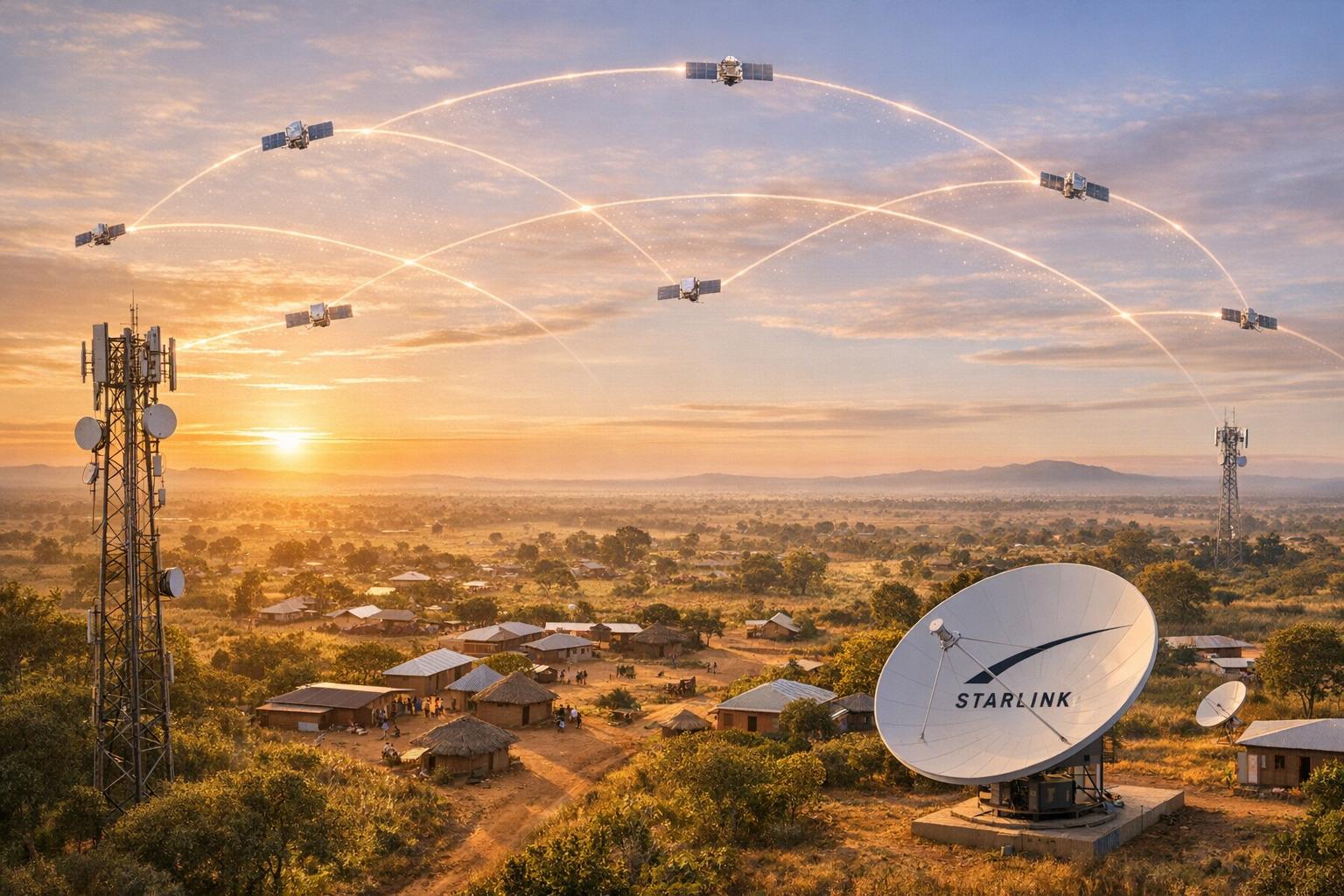
The digital divide
The UCC reported 17 million mobile internet subscriptions by the third quarter of 2025, yet rural and low-income communities still face barriers to reliable access. UNICEF found that over a third of surveyed schools have no internet access and only about 12 percent have connectivity across their whole campus. Those figures explain the appeal of satellite, but they also show its limits: a service that handles text and light apps does not address a school that needs video-capable bandwidth, and the first Airtel offering excludes voice and video.
Why it matters and what to watch
The practical value is greatest at the margins: boat crews, park rangers, farmers on remote plots and travellers on roads without coverage. TechAfrica News argues that towers and fibre remain necessary in dense areas and that satellite mainly extends coverage to the last hard-to-reach places. The economics are also notable, since operators can reach remote areas without building a tower for each site, though they still need spectrum arrangements, regulatory approval and commercial terms with Starlink.
Key things to watch: whether voice calling arrives and when; what pricing looks like beyond the UGX 2,000 minimum bundle; whether other operators sign comparable deals; whether Apple devices are supported; and what the UCC's fortnightly reports reveal about reliability. The reporting so far gives no subscriber numbers or detailed technical specifications. Regulators' focus on device registration and a national gateway also means that questions of oversight, tax and security will continue to run alongside the technology story.
This article draws on reporting from CEO East Africa, Space in Africa, TechAfrica News, New Vision and The Independent. Figures are as reported by those outlets and the companies involved.