For more than a century, scientists pictured "Nutcracker Man" as something of an evolutionary runt — a squat, thick-jawed also-ran in the human family tree, standing barely over four feet tall, doomed to be squeezed out by our taller, smarter direct ancestors. Case closed, more or less, for decades.
Then the mud at Lake Turkana gave up its footprints.
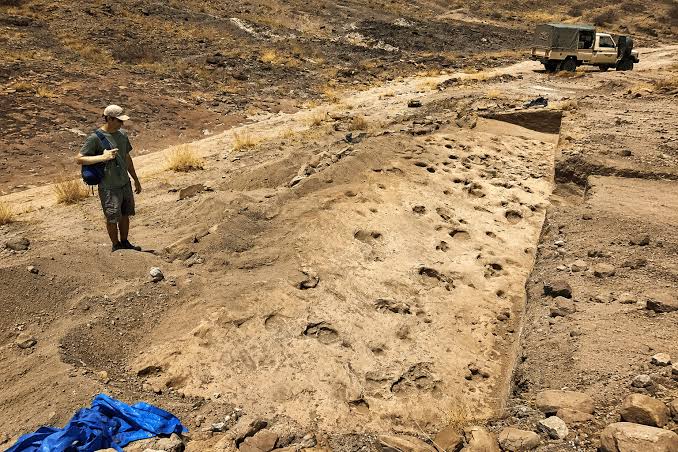
A trove of 21 fossilized footprints — soft impressions pressed into a muddy lakeshore some 1.43 million years ago and preserved ever since in layers of sediment — has just rewritten the physical profile of Paranthropus boisei, one of the strangest and most mysterious branches on humanity's family tree. According to a new study published in the Proceedings of the National Academy of Sciences, the individuals who left these tracks stood up to six feet tall and weighed as much as 165 pounds — comparable in size to Homo erectus, the more humanlike species it was living alongside, and roughly 40 percent taller and heavier than scientists had assumed for decades based on a handful of fragmentary bones.
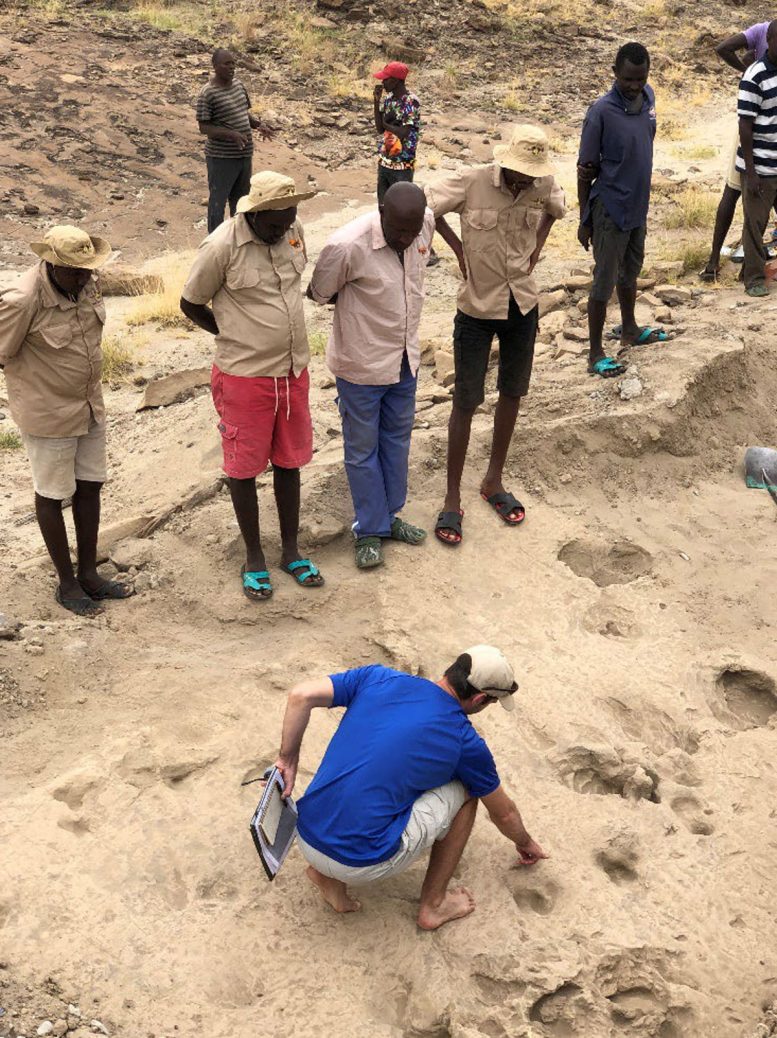
And it gets stranger. The pattern of the footprints suggests these individuals weren't wandering the shoreline alone. They were traveling together, in a group of eight, with signs pointing to an all-male crew moving as a unit — a level of complex social behavior nobody had firm evidence for in this species before.
"Each set of footprints like this one provides a window to a moment in time when we can directly observe how hominins were living, and engaging with their environments," said Kevin Hatala, the study's lead author, an associate professor of biology at Chatham University in Pittsburgh and an associate researcher at Germany's Max Planck Institute for Evolutionary Anthropology, in comments to CNN.
A Ghost From a Crowded Family Tree
To understand why a set of footprints is causing this much of a stir among paleoanthropologists, it helps to understand who — or what — Paranthropus boisei actually was.
First identified from a skull discovered in Tanzania's Olduvai Gorge back in 1959, P. boisei belonged to a group scientists call the "robust australopithecines" — a side-branch of the hominin family tree distinct from the direct lineage that eventually led to modern humans. It earned its popular nickname, "Nutcracker Man," because of its almost cartoonishly powerful jaw and huge, flat molars, engineered by evolution for grinding down tough plant material. For years, that anatomy fueled assumptions that the species survived on hard nuts, seeds, and tubers.
Later research using dental microwear analysis complicated that tidy story. It turned out P. boisei's teeth show a diet surprisingly rich in C4 plants — the tough grasses and sedges of the African savanna — more so than any other early human relative studied, even though its chewing apparatus was seemingly built for cracking, not grazing. Even its own signature adaptation, in other words, has never fully made sense.
P. boisei lived across East Africa for well over a million years, roughly between 2.5 million and 1.15 million years ago, overlapping for enormous stretches of time with early members of our own genus, Homo. And then, around a million years ago, it simply vanished from the fossil record — one of evolution's dead ends, leaving no known descendants. A leading theory blames dietary and behavioral inflexibility: as East Africa's grasslands and climate shifted, a species that had bet everything on one narrow ecological niche may have had nowhere left to turn.
Until now, almost everything scientists thought they knew about what this creature actually looked like walking around came from a scattering of isolated bones and teeth — the kind of fragmentary evidence that forces researchers to make careful, cautious, and sometimes wildly uncertain extrapolations about full body size.

What the Mud Remembered
Footprints solve a problem that bones can't. A skeleton tells you about one individual, frozen at the moment of death, often disassembled by time, scavengers, and geology long before a paleontologist ever finds it. A trackway captures something bones never can: a living creature in motion, its full weight and stride translated directly into the earth, alongside the footprints of whoever else happened to be walking nearby at that exact same moment.
The 21 tracks analyzed in the new study were uncovered in the Koobi Fora Formation on the eastern side of Lake Turkana, a site already legendary in paleoanthropology for the sheer density of hominin fossils it has yielded over the decades. Using the length and width of the impressions — a well-established method for estimating body mass and stature from footprint dimensions — Hatala's team calculated that the trackmakers were far larger than prior skeletal estimates had suggested: not the roughly 4-foot-2, 108-pound frame long assumed for P. boisei males, but something closer to 5-foot-11 and 165 pounds — in the same size range as Homo erectus, the species long assumed to be the more physically formidable of the two.
Just as striking was what the footprints revealed about behavior. The tracks show eight individuals crossing the same muddy ground within what appears to be a narrow window of time — not scattered individuals who happened to pass through the area months or years apart, but a group, moving together. Researchers say the size and shape patterns among the tracks point toward a group composed mostly, or entirely, of adult males — the kind of single-sex traveling party seen in some modern primate societies, where males patrol or range together while females and juveniles remain elsewhere.
That detail matters enormously for a species scientists have really only ever been able to reconstruct from disconnected fragments. It's the first direct physical evidence that P. boisei engaged in coordinated group movement at all, let alone something resembling the male-bonded travel patterns seen in certain living primates today.
Expert Perspective
Paleoanthropologists outside the study have described the find as a rare, almost uncanny form of evidence. Unlike bones, which can travel, erode, or get mixed together across different time periods before burial, a set of footprints on a single ancient lakeshore surface is essentially a single frozen afternoon — direct proof of individuals who were, quite literally, in the same place at the same moment, doing the same thing.
That immediacy is why researchers describe trace fossils like these as offering a different category of evidence entirely from body fossils. A skull can tell you about anatomy across a species; a trackway can tell you about a single social event, hundreds of thousands of years before anyone was around to write it down. Hatala's team frames the discovery not just as a revision of P. boisei's size chart, but as a rare, direct behavioral snapshot of an extinct species that otherwise exists for us only as scattered teeth and bone fragments — a body of evidence orders of magnitude thinner than what's available for our own direct ancestors.
The size revision itself also forces a broader rethink. If P. boisei really was built on the same scale as Homo erectus, that undercuts a long-standing assumption in paleoanthropology that H. erectus's success — the traits that allowed it to eventually spread out of Africa and give rise to later human lineages — was partly rooted in simply being the bigger, more physically capable species sharing the landscape. The two species, it now appears, may have been far more evenly matched physically than textbooks have long suggested, throwing the question of why one line persisted and the other died out back open.
What This Means for You
It's fair to ask why any of this should matter to someone who isn't a professional paleoanthropologist. The honest answer is that this is, quite literally, family history — just an unusually deep and unusually well-preserved branch of it. Every human being alive today descends from the lineage that, at this exact time and place 1.4 million years ago, was sharing the East African landscape with creatures like P. boisei: bigger, stranger, and more socially complex than we'd given them credit for, and yet ultimately a dead end in the story that led to us.
There's also something quietly humbling in a find like this. It's a reminder of how thin and lucky the fossil record really is — how much of what we think we "know" about extinct relatives rests on a small stack of bones, ready to be upended the moment the ground gives up something new. Paleontologists have long warned that reconstructing extinct species from fragmentary remains is an exercise in educated guesswork; this study is a vivid demonstration of just how far off those guesses can be, even for a species that's been studied since 1959.
And for anyone who's ever wondered what it might have felt like to stand on that muddy shoreline as it happened: the footprints suggest it might have looked less like a single wandering hominin and more like a small band of very large, very purposeful figures moving together along the water's edge — a scene that, until this summer, no one had any direct evidence ever happened at all.
Conclusion
Sixty-seven years after Louis and Mary Leakey first pulled Nutcracker Man's skull out of the dust at Olduvai Gorge, the species is still delivering surprises — this time not from a bone, but from a footprint pressed into mud on an ordinary day, 1.4 million years ago, that nobody involved could have known would still be readable today. Paranthropus boisei may have vanished from the evolutionary story without leaving descendants, but thanks to a stretch of ancient Kenyan lakeshore, it just got a lot harder to write the species off as a footnote.
Published By |