Two German biophysicists and a Stanford psychiatrist share the world's most famous science award for optogenetics — the technology that lets researchers flip neurons on and off with a beam of light, and is now helping blind patients glimpse the world again
SCIENCE & TECH
It started with a speck of green pond scum that wanted to find the sun. On Monday morning in Stockholm, that humble alga — and the three scientists who turned its light-sensing machinery into one of the most powerful tools in the history of brain science — walked off with the 2026 Nobel Prize in Physiology or Medicine.
Karl Deisseroth of Stanford University and the Howard Hughes Medical Institute, Peter Hegemann of Humboldt University in Berlin, and Georg Nagel of the University of Würzburg were honoured "for their discoveries concerning light-gated ion channels and optogenetics," the Nobel Assembly announced on 5 October. The prize is worth 12 million Swedish kronor, roughly $1.2 million, according to STAT News.
In plain English: these three made it possible to control individual brain cells with a flash of light. Not observe them. Not nudge them with clumsy electrodes or drugs that flood the whole brain. Control them — switching specific neurons on or off in milliseconds, in living, behaving animals. Scientists call it optogenetics, and it has quietly rewired how we study memory, fear, addiction, sleep and depression.
From Pond Water to the Prize Podium
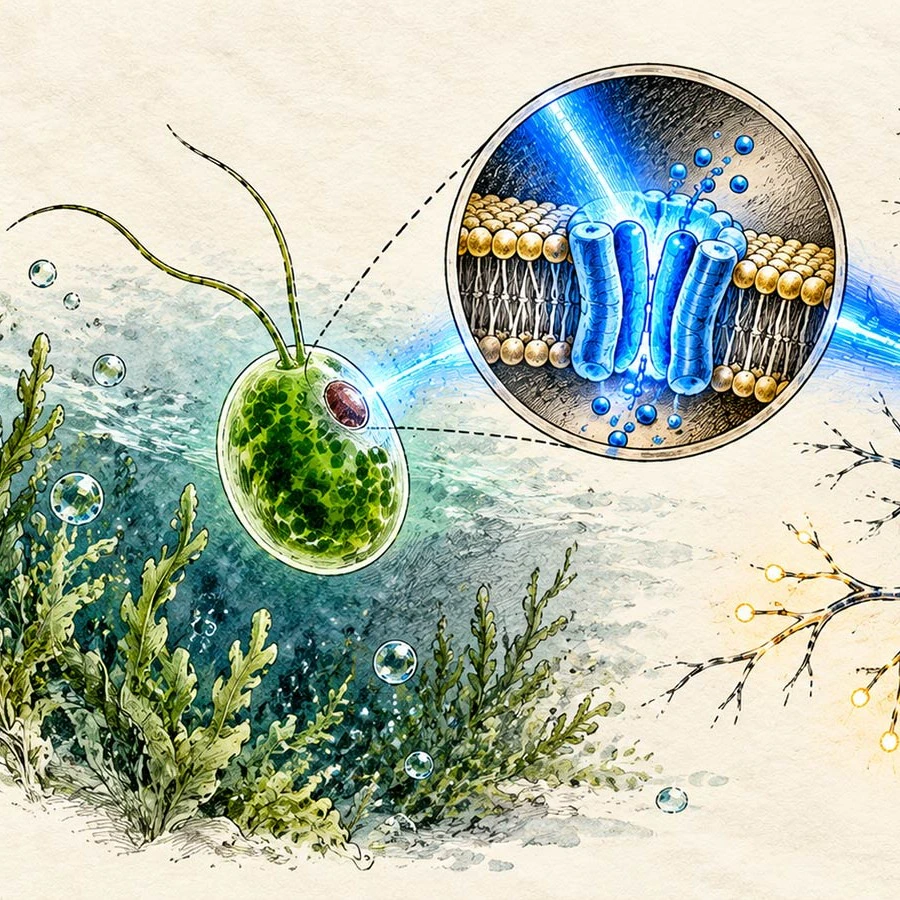
The story begins not in a glitzy neuroscience lab but in the study of Chlamydomonas reinhardtii, a single-celled green alga that swims towards light. Biologists had long known the little swimmer could sense brightness; what nobody understood was exactly how. Hegemann, working in Germany, spent years on the light-sensitive proteins in the alga's eyespot, and the trail eventually led to a family of molecules now called channelrhodopsins.
Hegemann's lab identified channelrhodopsin-1, the first light-gated ion channel, according to the account published by GEN (Genetic Engineering & Biotechnology News). Nagel's team then showed that channelrhodopsin-2, or ChR2, worked as a non-selective cation channel with far better properties — a single protein that acts as both the light sensor and the gate. Shine blue light on it and the channel pops open, letting positively charged ions rush in. In a nerve cell, that is exactly what it takes to make the cell fire an electrical impulse.
Think of it as a molecular light switch. Most proteins that respond to light need a long chain of chemical middlemen to do anything useful. ChR2 does it all by itself, and fast. The Nobel Committee notes the impulses occur within milliseconds, which is the same timescale on which the brain itself operates.
That speed is why the discovery mattered so much. The brain talks in split-second bursts. Earlier tools — electrodes, drugs, genetic knockouts — were either too blunt, too slow, or both. Here was a switch that matched the brain's own tempo.

Deisseroth Flips the Switch in a Brain Cell
Discovering a light-gated channel in algae is one thing. Persuading a mammal's neurons to use it is another. That leap belongs to Deisseroth, a practising psychiatrist as well as a bioengineer, who in 2005 successfully expressed channelrhodopsin-2 in cultured rat neurons. In a landmark paper in Nature Neuroscience, his team showed that blue light could make those cells fire with millisecond precision — and stop firing when the light went off.
The real trick was genetic targeting. By delivering the algal gene only to chosen types of neurons, researchers could make just those cells light-sensitive and leave their neighbours untouched. Pipe light into the brain through a hair-thin optical fibre and you have a remote control for one specific circuit among billions of cells.
By 2007, according to Neuroscience News, Deisseroth's work had demonstrated optical control of neural circuits in living, freely moving mice. Suddenly scientists could ask questions that had been out of reach for a century. Does this cluster of cells cause fear, or merely accompany it? Which neurons are responsible for a memory? Switch them on, see what the animal does, switch them off, see what stops.
"With optogenetics, we're not using light to collect information; we're using light to cause things to happen," Deisseroth said, as quoted by STAT News. It is a deceptively simple sentence that captures a profound shift: neuroscience moved from watching correlations to proving causes.
Deisseroth, 55, is also the youngest of the trio by a wide margin. Hegemann is 72 and Nagel is 73. Deisseroth reportedly described his fellow laureates as friends and spoke of a collaboration stretching back many years.
Why the Nobel Committee Called It a Dream Come True
Per Svenningsson, chair of the Nobel Committee, reached for the language of aspiration when explaining the decision. "Optogenetics provides opportunities for mapping the brain in a way that we could once only dream of," he said, according to the committee's announcement coverage.
The dream is an old one. Francis Crick, co-discoverer of DNA's structure, mused decades ago that the great obstacle in neuroscience was the need to control one type of cell in the brain while leaving the others unchanged — and suggested that light might one day do the job, though even he conceded the notion seemed "rather far-fetched," as GEN recounts. In the 1970s, Richard Fork at Bell Laboratories showed that laser light could stimulate neurons in the sea slug Aplysia, a hint of what was to come.
It took an alga, a pair of curious German biophysicists and a psychiatrist-engineer to make the far-fetched real.
What Light-Controlled Brains Have Taught Us
In the two decades since that first rat-neuron experiment, optogenetics has become a workhorse of laboratories around the world. The list of what it has been used to probe reads like a catalogue of human suffering and wonder.
Researchers have mapped circuits behind depression and anhedonia, the loss of the ability to feel pleasure. They have clarified the pathways disrupted in Parkinson's disease. They have identified and even manipulated memory engrams — the physical traces of specific memories in the brain. They have studied the neural machinery of addiction and substance-seeking, and the circuitry of panic and post-traumatic stress. Early work also examined how the brain flips between sleep and wakefulness by activating orexin neurons, and revealed how dopamine-releasing circuits are organised in the retina, Neuroscience News reports.
One of the most striking demonstrations has been in memory. By tagging the neurons active during an experience and later reactivating them with light, scientists have made mice recall — or in some experiments appear to recall — events on command. It sounds like science fiction, but it has become routine laboratory practice.
Crucially, optogenetics did not just generate headlines; it generated understanding. Because researchers can switch a circuit on and off at will, they can establish what that circuit is actually for. That is the difference between a map of the brain and a manual for how it works.
From the Lab Bench to the Eye Clinic
Perhaps the most exciting frontier is not in animals but in people. Retinitis pigmentosa is a family of inherited conditions in which the light-detecting photoreceptors of the retina gradually die, leaving patients blind even though the rest of the visual system is intact. Optogenetic therapy offers a clever workaround: instead of replacing the dead photoreceptors, give the surviving retinal ganglion cells the gene for a light-gated channel so they can sense light themselves.
GEN notes that intraocular injections of adeno-associated viral vectors carrying channelrhodopsin genes have shown promise in retinitis pigmentosa models, potentially restoring light sensitivity after photoreceptor degeneration. Neuroscience News adds that human trials for vision restoration are underway. Results so far suggest the approach can give some patients a measure of useful vision, though this is early-stage medicine and nobody should expect miracle cures overnight.
Beyond the eye, researchers are exploring how light-controlled approaches might one day be used in the brain and heart — though those applications face far steeper hurdles, from delivering genes safely to getting light deep inside tissue.
The Snub Fuelling the Social Media Storm
No Nobel announcement passes without a row, and this year's came within hours. STAT News reports that social media commentators argued Ed Boyden of MIT — first author on the landmark 2005 paper with Deisseroth — deserved a place on the podium.
The sticking point is a Nobel rule, not a scientific judgement: a prize can be split between no more than three people. With Hegemann and Nagel's discovery of the channel and Deisseroth's demonstration of its use in neurons forming the heart of the story, the committee had to choose, and others who contributed to the field's explosive growth were left out.
It is a familiar pattern. Big discoveries have many parents, and the three-laureate limit has famously squeezed out deserving names before. Whatever the debate, it underlines how many hands built this field.
Expert Perspective: A Tool That Changed the Questions
The reaction from the neuroscience community has been one of broad approval — and a sense that the prize was a matter of when, not if. Optogenetics has been a perennial Nobel favourite for years, regularly topping predictions lists.
What makes the technology special, researchers say, is how thoroughly it changed the kinds of questions scientists can ask. Before, a neuroscientist might record that a certain cell fires when an animal is afraid. Now they can make that cell fire and see whether the animal becomes afraid. That is the leap from correlation to causation, and it is why Deisseroth's own summary — using light to make things happen — is likely to be quoted for years.
Svenningsson's "could once only dream of" line captures the mood in the field: a sense that tools once belonging to the realm of wishful thinking are now ordinary equipment, humming away in thousands of labs.
What This Means for You
You will probably never see an optical fibre inside a brain. But the effects of this prize will reach you anyway.
First, the science. The better researchers understand the circuits behind depression, addiction, anxiety and Parkinson's disease, the better the chances of developing smarter drugs and more precisely targeted treatments. Many mental-health therapies today work like a sledgehammer; optogenetics is helping design the scalpel.
Second, sight. If gene therapies built on light-gated channels continue to succeed, people who lost their vision to inherited retinal disease may gain meaningful new options. That would be a direct line from a pond-dwelling alga to a hospital clinic.
Third, a reminder about how science works. Nobody who studied how green algae find light in the 1990s was trying to cure blindness or map memory. They were curious about a tiny swimming cell. Basic research — the kind that looks impractical, even frivolous, at the time — has a habit of producing tomorrow's medicine. That argument is going to be heard loudly in funding debates this autumn.
The Bottom Line
For a prize whose headline reads like biology jargon, the 2026 Nobel story is a gloriously human one: a lucky protein, a few stubborn researchers and the willingness to ask whether a plant's trick might work in a mammal's brain.
Hegemann and Nagel found the switch. Deisseroth wired it into the brain. Together they gave neuroscience a remote control, and the world is still discovering all the things it can do. The Nobel announcements continue this week with physics, chemistry and the other prizes, but few will match the sheer 'wow' of this one: the light really did go on.
Published By | Tech Wiz