Written By | Torch Media Africa
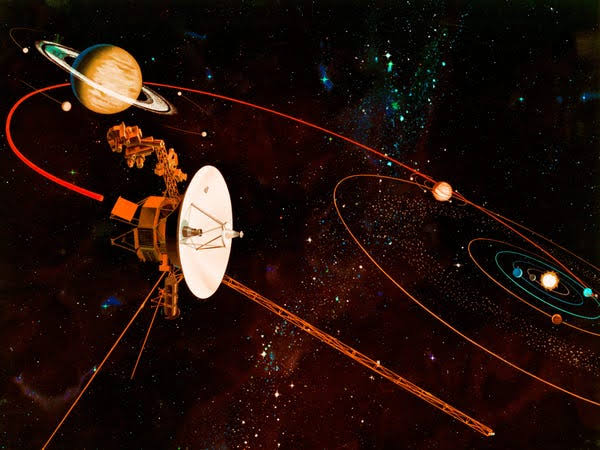
More than 12.8 billion miles from home, running on plutonium fumes and hardware older than most of its engineers, Voyager 2 was staring down its own silence
SCIENCE AND TECH
Forty-nine years ago this month, Voyager 2 left Cape Canaveral on a rocket, carrying a gold-plated record of Earth's music and greetings into a universe that had never heard from us before. It flew past Jupiter, Saturn, Uranus, and Neptune — the only spacecraft in history to visit all four outer planets — and then kept going, and going, and going, until in 2018 it crossed the invisible edge of our sun's magnetic bubble and became only the second human-made object, after its twin Voyager 1, to sail into true interstellar space.
Today it is more than 12.8 billion miles from Earth, so far out that a single radio command — traveling at the speed of light — takes nearly 19 hours just to arrive, and another 19 hours for a reply to come back. Mission engineers don't get a second chance if something goes wrong. They can't send a technician. They can't ship a spare part. Every decision has to work on the first try, transmitted into the dark and trusted to a machine that predates the cell phone, the internet as we know it, and nearly every engineer now working on it.
This summer, that machine was running out of power. And in early August, NASA's Jet Propulsion Laboratory announced it had pulled off a fix daring enough that the team gave it an appropriately cosmic nickname: the "Big Bang."
A SPACECRAFT SLOWLY GOING DARK
Voyager 2, like its twin, doesn't have solar panels — sunlight is far too weak, this deep into the solar system and beyond, to be useful. Instead, both spacecraft run on a radioisotope thermoelectric generator, a device that converts the heat given off by decaying plutonium-238 into electricity. It's an elegant, reliable design, but it comes with an unforgiving catch: plutonium-238 decays whether anyone wants it to or not, and the generator's output shrinks by roughly four watts every single year, permanently, with no way to refuel or recharge it.
Four watts a year sounds trivial. It is not. Voyager 2's science payload was designed decades ago around a power budget that has been shrinking that whole time, and mission engineers have spent the last several years making increasingly hard choices about which instruments stay on and which go dark forever. Without intervention, the mission team calculated, Voyager 2 was on track to lose yet another one of its remaining working science instruments before the end of 2026 — a quiet, permanent shutdown that would have narrowed our only direct sensory window into interstellar space just a little further.
Rather than accept that loss, the Voyager team designed a maneuver that had never been attempted in quite this way: a carefully choreographed, simultaneous swap of which onboard systems draw power, executed with mere hours of margin for error, on a spacecraft too far away to troubleshoot in real time.
THE MANEUVER THAT EARNED ITS NAME
On July 9, 2026, engineers at JPL sent Voyager 2 a sequence of commands that, if timed wrong or interpreted incorrectly by the spacecraft's decades-old onboard computer, could have plunged critical components below their safe operating temperature in the near-absolute-zero cold of interstellar space — instantly and irreversibly disabling them.
The plan: switch off two dedicated heaters and a digital tape recorder that, though no longer used for its original data-storage purpose, had been kept running for years simply because the residual heat it gave off was helping keep nearby components warm. At the very same time, switch on two different, lower-power heaters and another device that could supply comparable residual warmth — but sipping less electricity than the equipment being retired. Done correctly, the shuffle nets out to roughly 10 watts of power savings per year without letting a single instrument freeze.
It worked. According to NASA's Jet Propulsion Laboratory, the swap extended the operational runway of Voyager 2's three remaining active science instruments — its magnetometer, plasma wave subsystem, and cosmic ray subsystem — by at least one additional year, pushing the spacecraft's expected date of significant capability loss further into the future than it would otherwise have had.
"I think we're all happy and relieved that the Voyager probes have both operated long enough to make it past this milestone," said Suzanne Dodd, Voyager project manager at JPL, describing the broader arc of a mission that has repeatedly defied its own planned lifespan. "Now we're looking forward to what we'll be able to learn."
WHY THIS OLD SPACECRAFT STILL MATTERS
It would be easy to treat Voyager 2 as a nostalgia piece — a relic launched the same year "Star Wars" hit theaters, running on less computing power than a modern greeting card. But nostalgia isn't why NASA just spent months of careful engineering time keeping it alive. Voyager 1 and 2 remain, nearly half a century after launch, the only spacecraft humanity has ever flown into interstellar space, and their instruments are still returning real scientific data that nothing else can replicate: direct, in-situ measurements of the magnetic fields, charged particles, and plasma waves that fill the space between star systems — the actual physical environment a starship, or a message, would have to pass through to reach another sun.
Every additional year of operation is, quite literally, irreplaceable data. There is no other spacecraft currently positioned to take these measurements, and there won't be another for decades at the very least — no mission currently on the books is slated to reach interstellar space again anytime soon. Losing an instrument on Voyager 2 doesn't mean losing a nice-to-have; it means losing humanity's only eyes on that particular patch of the universe until some future mission, likely not yet designed, gets there.
The mission has already outlived almost every internal projection. Voyager 2's plutonium power source was engineered with an eye toward a mission that, at launch, was expected to last around five years — enough to reach Saturn. Instead, it kept flying past Uranus and Neptune, kept transmitting after crossing into interstellar space, and is now, on the strength of a power-budget trick engineered decades after launch, expected to keep at least partially functioning into the 2030s.
VOYAGER 1'S TURN IS COMING
The Big Bang fix isn't a one-time save — it's a template. NASA has confirmed that the mission team plans to perform a similar power-swap maneuver on Voyager 1, Voyager 2's twin and, at roughly 15 billion miles out, the most distant human-made object in existence. Voyager 1 faces the same relentless plutonium decay curve and the same shrinking list of hard choices about which instruments to sacrifice and which to protect. Engineers are expected to carry out the equivalent fix on Voyager 1 "in the coming months," according to JPL, applying lessons learned from the July 9 procedure to a spacecraft that is, if anything, an even more delicate patient given its greater distance and correspondingly longer communication delay.
EXPERT PERSPECTIVE
Scientists and engineers who work on the mission describe it less as routine maintenance and more as an ongoing act of triage performed on a patient nobody can physically visit. Each fix has to account for a spacecraft that was designed by engineers using slide-rule-era assumptions about how long anything they built could possibly need to last, now being kept alive by a team applying every trick modern mission operations has learned since.
Popular Science and CNN, among outlets that covered the July maneuver in detail, both noted that the procedure worked precisely because the Voyager engineering team maintains a level of institutional knowledge about 1970s-era spacecraft design that is increasingly rare — a skill set that itself has to be actively preserved and handed down, since almost nothing else NASA operates uses comparable hardware.
WHAT THIS MEANS FOR YOU
You will probably never touch a radioisotope thermoelectric generator or command a spacecraft light-days from home. But the Voyager program's continued survival matters well beyond its own instrument readings. It is, in a very real sense, a stress test for how humanity extends the life of anything expensive, remote, and irreplaceable — a discipline that echoes in far more down-to-earth places, from extending the service life of aging satellites and infrastructure to designing systems today that engineers fifty years from now can still creatively keep running past their intended expiration date.
It's also, more simply, a story about patience and stewardship paying off on a timescale most modern institutions no longer plan for. The scientists who conceived the Big Bang fix will likely not be the ones running the mission when Voyager 2 finally, someday, falls silent for good. They did the work anyway.
CONCLUSION
Voyager 2 will not last forever. Its power will keep declining at roughly four watts a year no matter how cleverly engineers shuffle its remaining instruments, and a day is coming — probably sometime in the 2030s — when the last signal from either Voyager will fade into the same silence its predecessors long ago vanished into. But that day is not today, and thanks to a piece of interplanetary engineering improvisation nicknamed for the very beginning of everything, it is at least one year further away than it was this spring.
Somewhere past the edge of our solar system's magnetic influence, a spacecraft built before most of its own operators were born just got handed a reprieve — sent across nineteen hours of empty space, received exactly as planned, and carried out flawlessly by hardware that was never supposed to still be listening.



