Written By | Torch Media Africa
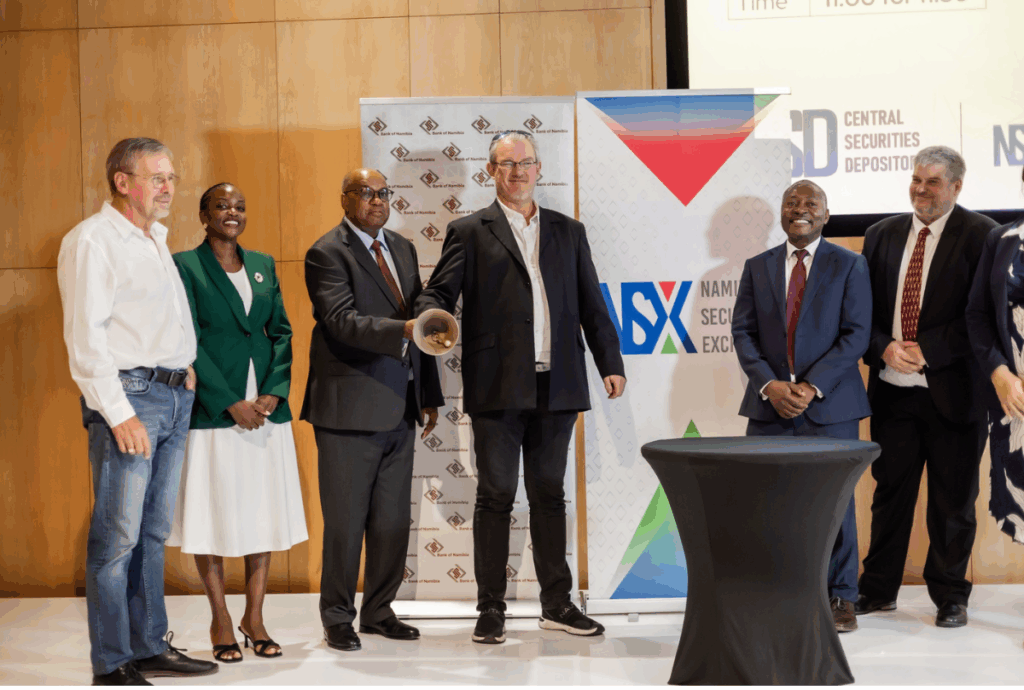
Namibia Launches Central Securities Depository, Ushering in Fully Digital Capital Market Era
TECHNOLOGY
For most of the past two decades, Namibia's economic story has been told through diamonds, uranium, and more recently offshore oil and green hydrogen. In 2026, a quieter but arguably more consequential shift is underway: a coordinated push across connectivity infrastructure, digital payments regulation, and capital-markets policy aimed at turning one of Southern Africa's smallest and most sparsely populated economies into a genuine regional technology hub. The pieces are still assembling, but the direction is unusually explicit, anchored in a National Digital Strategy that sets hard 2030 targets and a set of institutional moves — a new submarine cable interconnection, a national instant-payments system, and a startup-to-stock-exchange pipeline — that are each meant to reinforce the others.
Closing the Connectivity Gap
Namibia's starting point is a familiar African paradox: reasonably high mobile penetration alongside patchy, expensive broadband. As of October 2025, the country had roughly 2.00 million internet users out of a population of just under three million, an internet penetration rate of 64.4 percent, while mobile subscriptions stood at about 2.58 million and mobile phone ownership at roughly 79.7 percent. Yet Namibia ranks only 147th globally for fixed broadband, with average download speeds around 15.51 Mbps and mobile speeds near 27.9 Mbps, and an estimated 12 percent of the population — concentrated in remote northern and eastern regions — still lacks 4G coverage entirely.
The infrastructure response has centered on submarine cable diversification. In mid-June 2026, Telecom Namibia, Angola Telecom, and Satélite e Cabo TV signed a Master Service Agreement to physically integrate the upcoming Southern African Regional Submarine System (SARSSy) with Google's Equiano cable system, a tripartite commercial arrangement valued at roughly $118 million. The deal builds on Namibia's earlier landing of the Equiano cable itself: Telecom Namibia has inaugurated a dedicated Equiano Cable Station in the coastal town of Swakopmund, giving the country a second major international gateway alongside its existing links and a stronger negotiating position on wholesale bandwidth pricing, historically one of the biggest cost drivers behind Namibia's high retail data prices.
On the compute side, Windhoek-based operator Paratus has opened a new Tier III facility just outside the capital — dubbed Armada — now the largest data center in the country. Coming shortly after Namibia's National Digital Strategy 2025–2029 explicitly called for expanded, high-quality digital infrastructure as a precondition for everything else in the plan, the facility positions Namibia to host more domestic data processing rather than routing it through South African or European data centers, a shift with implications for both cost and data-sovereignty policy across the wider Southern African Development Community region.
Building Digital Government from a Low Base
Namibia currently ranks 114th in the UN's E-Government Development Index, a middling position that the National Digital Strategy 2025–2029 — unveiled in August 2025 — is explicitly designed to improve. The strategy sets a series of concrete, dated targets: raising internet usage from roughly 53 percent to 90 percent by 2030, lifting minimum guaranteed internet speeds from 2 Mbps to 25 Mbps, and, under the country's Sixth National Development Plan (NDP6), fully digitizing government services by the end of the plan period in 2030. The strategy's stated priorities span digital identity, interoperability between government systems, e-procurement, taxation, education, and healthcare — a broad mandate that officials acknowledge will require sustained, multi-year budget commitments from the Ministry of Information and Communication Technology rather than a single flagship project.
Namibia's low digital-literacy rate remains one of the more persistent obstacles cited by the ministry, which has responded by funding rural ICT centres intended to extend both connectivity and basic digital skills training into underserved communities. How quickly those centres scale, relative to the strategy's 2030 deadlines, will be one of the clearer tests of whether Namibia's digital-government ambitions move from policy document to lived experience for citizens outside Windhoek.
A Payments System Built for Inclusion
The most immediate, bankable piece of Namibia's digital transformation is arguably its payments infrastructure overhaul. The Bank of Namibia has launched a National Payment System (NPS) Vision and Strategy for 2026–2030 under the banner 'Inclusive Payments, Shared Prosperity,' with a national instant-payment system as its centerpiece. Originally targeted for a June 2026 go-live, the system's launch has since been pushed to the third quarter of 2026, even as the central bank reports that several participating institutions have already completed system integration and testing — a sign the delay reflects sequencing rather than fundamental technical trouble.
Around that public infrastructure, a private fintech layer has grown quickly. PayPulse, backed by Standard Bank Namibia, lets users pay merchants, buy airtime and electricity, and settle invoices from a mobile app; Bank Windhoek's Pay2Phone and FNB's eWallet occupy similar ground from competing banks, while newer entrants like PayToday and MobiPay are pitching themselves as lower-cost disruptors. The Bank of Namibia's own reporting links the National Payment System reforms directly to measurable growth in electronic transaction volumes — card payments, electronic funds transfers, and mobile money usage all rising in tandem with the regulatory push. A Financial Technology Regulatory Sandbox gives newer fintech entrants a controlled environment to test products before full licensing, and the country has begun introducing crypto-specific policy frameworks, an area regulators across the region are treating as increasingly urgent given rising informal crypto adoption.
A Startup Ecosystem Finding Its Footing
Namibia's venture and startup landscape remains small by regional standards, but 2026 has brought its most concrete institutional support to date. On March 17, 2026, Windhoek launched the Accelerate36 initiative, led by Grindstone — the startup growth engine co-owned by South African investors Knife Capital and Thinkroom — with the explicit goal of building a pipeline of high-growth Namibian companies ready to list on the Namibia Securities Exchange's Development Capital Board (DevX). The model is deliberately different from the venture-capital-heavy playbooks pursued in Kenya or Nigeria: rather than chasing large private funding rounds, Accelerate36 is betting that a structured path to public capital-markets listing can substitute for a thin domestic VC base.
That thin base is real. Namibian founders seeking Series A funding and beyond typically still have to look to South African or international investors, since local early-stage capital remains scarce. The government's response, alongside Accelerate36, has been the ScaleUp Namibia (SUN) initiative, launched in 2025 by the National Commission on Research, Science and Technology, which offers mentorship, investment-access support, co-working space, and help with digital-transformation projects, alongside a push for regulatory reforms to make the broader business environment more startup-friendly.
The early results are measurable, if modest. In the 2026 StartupBlink Global Startup Ecosystem Index, Namibia climbed to its highest-ever ranking: 10th in Africa and 94th globally, while holding its position as the second-ranked ecosystem in Southern Africa behind only South Africa. Windhoek itself was the standout mover, jumping 104 places to rank 512th globally — the strongest improvement of any city in Southern Africa this cycle. Those rankings remain well behind the continent's established hubs in Lagos, Nairobi, or Cairo, but the trajectory — and the deliberate policy architecture behind it — suggests Namibia's government sees digital and startup policy as a genuine diversification strategy, not a side project to its resource economy.
An Integrated Bet
What distinguishes Namibia's 2026 push is less any single initiative than the attempt to sequence them together: better international bandwidth and domestic compute capacity from the SARSSy-Equiano tie-up and the Paratus data center; a digitized, more efficient government under NDP6; an inclusive instant-payments backbone from the Bank of Namibia; and a public-markets-oriented startup pipeline through Accelerate36 and the NSX's DevX board. Each piece depends partly on the others succeeding — digital government services need the connectivity to reach rural users, fintech adoption needs the payments rails to be fast and cheap, and startups need both a functioning digital economy and a viable exit path to attract capital. Whether Namibia, with a population of under three million and a startup ecosystem still ranked well outside Africa's top tier, can execute all of these simultaneously by the shared 2029–2030 deadlines its own strategies have set will be one of the more interesting mid-sized African digital transformation stories to watch over the next several years.



