Written By | Torch Media Africa
Tesla and SpaceX just broke ground on what could become the largest building on Earth — a Texas mega-fab built to feed America's robots, rockets and AI habit. Locals aren't all cheering
SCIENCE & TECH
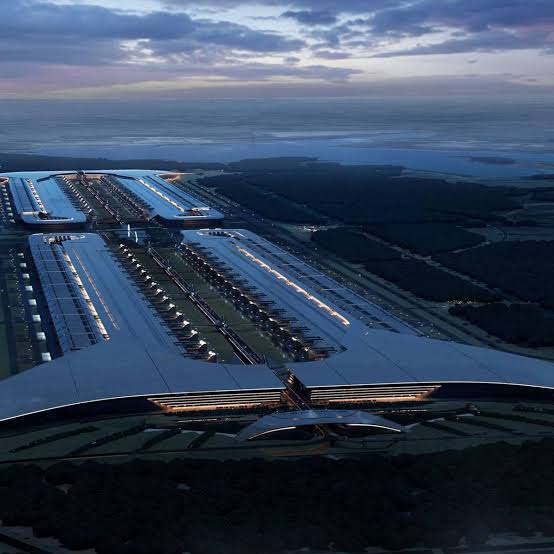
Out past the pine forests and cattle pasture of Southeast Texas, on the shores of the Gibbons Creek Reservoir, ground has officially broken on a building so vast that when it's finished, it may be the single largest structure ever erected by human hands — bigger than the Pentagon, bigger than Boeing's Everett plant, bigger than anything Amazon has ever poured concrete for.
Its name is Terafab. Its founders are Elon Musk's Tesla and SpaceX, with a silent but consequential assist from chip giant Intel. And this week, Texas Governor Greg Abbott stood in front of cameras and made it official: the $16.8 billion first phase of the project is real, it's happening in Grimes County, and it's coming with 3,000 jobs attached.
For a state that has spent the last five years turning itself into Elon Musk's personal industrial playground — Gigafactory Texas in Austin, Starbase down on the Gulf Coast, and now this — Terafab is the biggest bet yet. And for the rest of us, it's a signal flare: the AI chip wars have officially outgrown Silicon Valley, and they're being fought now in cow pastures with nine-figure tax breaks attached.
THE BUILDING THAT ATE TEXAS
Musk first teased Terafab back in March at a splashy unveiling inside Austin's historic Seaholm Power Plant, pitching it as a joint venture between Tesla, SpaceX and his AI company xAI — three of his companies pooling resources to build the chips none of them could get enough of anywhere else. By April, Intel had signed on as a manufacturing partner, lending decades of fabrication expertise to a venture that, on paper, was trying to do something no single company had attempted before: build logic chips, memory chips, packaging and testing all under one roof, at a scale measured not in square feet but in tens of millions of square feet.
The number that keeps grabbing headlines is the size: more than 100 million square feet of floor space when fully built out, according to filings and reporting on the project — enough to make Terafab, by some measures, the largest building on the planet. The first phase alone, the $16.8 billion chunk that broke ground this week, will be a fraction of that ultimate footprint, but it's still bigger than most entire industrial parks.
And the money involved keeps climbing. When Musk first unveiled the concept, he pitched it as a $25 billion venture. By May, filings reviewed by CNBC put the full buildout cost as high as $119 billion. Wall Street analysts at Bernstein have floated even more eye-watering numbers — suggesting that if Terafab scales to its most ambitious version, the total investment over the coming years could approach $5 trillion. For context, that would dwarf the GDP of most countries on Earth.
Whether Terafab ever reaches that scale is an open question. What's confirmed, and now shovel-ready, is the $16.8 billion first phase — enough to start pouring foundations, laying utility lines, and hiring the first wave of the promised 3,000 engineers, technicians and plant operators who will run the place.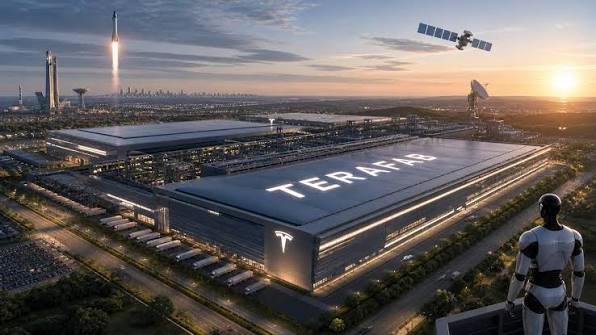
WHY MUSK NEEDS HIS OWN CHIP FACTORY
To understand why Musk is building a chip fab from scratch instead of just buying more from Nvidia or Taiwan Semiconductor, you have to understand what he's trying to feed.
Tesla is racing to mass-produce its Optimus humanoid robot, a machine Musk has repeatedly claimed could eventually become the company's most valuable product line — bigger than cars. Every Optimus unit needs a brain: a compact, power-efficient AI chip capable of real-time vision, balance and decision-making, running locally rather than phoning home to a data center. Tesla's self-driving Cybercabs need something similar. Both are exactly the kind of specialized "edge inference" silicon that general-purpose chipmakers aren't necessarily racing to prioritize.
Meanwhile, SpaceX has its own voracious and very different appetite: high-power chips designed to run space-based data centers, part of Musk's increasingly serious push to move compute-heavy AI workloads off the power-hungry, heat-constrained Earth and into orbit, where solar power is constant and cooling is, in theory, easier. According to reporting on the project's internal compute allocation, roughly three-quarters of Terafab's eventual output is earmarked for SpaceX's AI-in-space ambitions, with the remaining quarter going to Tesla's robots and vehicles.
Add in xAI, Musk's AI company that trains the Grok chatbot and competes directly with OpenAI and Google, and you have three enormously capital-hungry businesses all fighting the same global shortage of advanced chips — a shortage that has made Nvidia the most valuable company in the world and left everyone else scrambling for allocation. Terafab is Musk's answer: stop competing for a slice of the world's chip supply and build his own instead.
Tesla's fifth-generation AI chip, known internally as AI5, is reportedly among the first products slated to come off the line, with small-batch pilot production targeted for later this year and full volume production expected in 2027.
THE TOWN THAT DIDN'T ASK FOR THIS
Not everyone in Grimes County is thrilled to be living next door to the biggest building on Earth.
Southeast Texas has become accustomed to Musk-adjacent development — Bastrop's Gigafactory and the Gulf Coast's Starbase have already reshaped local economies and, in Starbase's case, even incorporated as its own city. But Grimes County is smaller, quieter, and until this year, largely defined by the Gibbons Creek Reservoir and the ranchland around it. A packed county meeting this month drew hundreds of residents, and the mood, by multiple local accounts, was not uniformly celebratory.
Concerns raised at the meeting centered on the scale of tax incentives being handed to a trillion-dollar-adjacent venture, the pace at which the deal came together, and a broader unease about transparency — residents said they felt like they were being asked to approve a fait accompli rather than weigh in on a genuine decision. Texas's Enterprise Fund kicked in a $30 million grant to SpaceX specifically, on top of the project qualifying for the state's Jobs, Energy, Technology and Innovation program, which offers its own substantial abatements. Reaction on social media split predictably along tribal lines — Musk boosters framing it as a generational jobs windfall, skeptics pointing to water usage, grid strain, and the track record of Musk projects blowing past their original budgets and timelines.
Those concerns aren't hypothetical. Terafab's own price tag has already roughly tripled from its original pitch in five months, a pattern anyone who has followed Tesla's Cybertruck production delays or SpaceX's Starship test flights will recognize. Big promises, bigger cost overruns, and a finish line that keeps moving — but also, so far, projects that eventually do get built.
WHAT THE EXPERTS ARE SAYING
Industry analysts are split on what Terafab actually means for the broader chip industry. Some see it as a legitimate structural response to a real supply crunch — the same shortage of high-bandwidth memory and advanced logic chips that has forced even Nvidia to reportedly scale back specifications on upcoming chip designs because suppliers simply can't produce enough. In that reading, Musk isn't just building a factory for himself; he's hedging an entire vertical stack of companies against a chip famine that shows no signs of easing before the end of the decade.
Others are more skeptical, noting that stacking three enormously ambitious Musk companies — none of which has a track record in semiconductor manufacturing — on top of one enormously ambitious construction project introduces a lot of ways for things to go wrong. Chip fabrication is one of the most technically unforgiving industries in existence; a speck of dust in the wrong place can ruin a wafer worth thousands of dollars, and building a "vertically integrated" fab that handles logic, memory, packaging and testing all in one facility is a claim even established players like TSMC and Samsung approach cautiously. That's part of why Intel's involvement matters — its decades of fabrication know-how is widely seen as the technical backbone the venture needs to have any credibility, even as the company has offered few public details about the precise nature of its role.
WHAT THIS MEANS FOR YOU
If you drive a Tesla, work anywhere near the AI industry, or just pay a power bill, Terafab is worth watching. A successful chip fab in Texas could, over time, ease the global shortage of the advanced silicon that underpins everything from your phone's AI assistant to hospital imaging equipment to the data centers running the chatbot you talked to this morning — potentially bringing costs down across the entire AI supply chain.
It also means Southeast Texas is about to experience the kind of rapid, disruptive economic transformation that Bastrop and the Gulf Coast have already lived through: a flood of construction jobs and eventually thousands of high-paying technical positions, alongside strained roads, housing markets, water systems and power grids that weren't built for a project of this scale. If you own property near Gibbons Creek Reservoir, expect your neighborhood to look very different in three years.
And if you're a Tesla or SpaceX shareholder, Terafab is either the long-term bet that finally insulates Musk's empire from the global chip crunch — or it's the next in a long line of Musk mega-projects whose budgets balloon and timelines slip before they eventually, remarkably, get built anyway.
THE BOTTOM LINE
Terafab is, depending on who you ask, either the boldest vertical-integration play in the history of the semiconductor industry or a spectacularly expensive gamble stitched together from three companies that have never built a chip fab before. What's beyond dispute is the scale: $16.8 billion committed, 3,000 jobs promised, and a building that — if it ever reaches its full 100-million-square-foot footprint — will change what "big" means in American manufacturing.
Ground has broken. The pilot chips are supposed to start rolling by year's end. Whether Terafab becomes the plant that finally frees Musk's robot army and rocket fleet from the global chip shortage, or another line item in the long history of his projects costing three times what he first promised, Grimes County — and the rest of us — are about to find out together.



