Technological Transformation Series
For most of the past twenty years, Morocco’s modernization story was told through hardware you could see: automotive plants around Tangier, phosphate terminals at Jorf Lasfar, the mirrored expanse of the Noor solar complex. Since late 2024, the kingdom has been assembling a companion story in code. A national digital strategy launched in September 2024, a simultaneous three-operator 5G switch-on in November 2025, a sovereign artificial intelligence roadmap unveiled in January 2026, and a wave of data center announcements aimed at European and sub-Saharan markets together amount to the most coordinated digital push in North Africa — timed, not coincidentally, to a decade that ends with Morocco co-hosting the 2030 FIFA World Cup with Spain and Portugal.
Digital Morocco 2030: the master plan
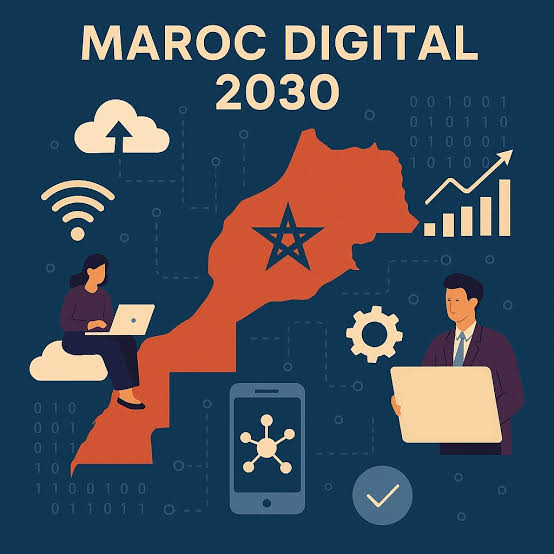
The framework document is Digital Morocco 2030, launched on September 25, 2024. Its targets are unusually specific for a strategy of this kind: add roughly $10.4 billion to national output by 2030, create 240,000 digital-sector jobs, lift Morocco from around 100th place into the top 50 of the United Nations Online Services Index, launch 3,000 startups, and train 100,000 young people annually in digital fields through new scholarships and academic partnerships. The government has backed the plan with an initial allocation of 11 billion dirhams — about $1.2 billion — for 2024 through 2026, directed at fiber-optic expansion, AI initiatives, and public-service digitization. Progress is measurable if incomplete: Morocco’s e-government ranking has climbed from 140th in 2008 to 90th in 2024, placing it 11th in Africa, with the top-50 goal still requiring a substantial leap over the strategy’s remaining four years.
The 5G moment — and a continental showcase
The most visible milestone came on November 7, 2025, when all three national operators — Maroc Telecom, Orange Maroc, and Inwi — activated commercial 5G networks on the same day, a coordinated launch rare anywhere in the world. The networks promise speeds above 2 gigabits per second and ultra-low latency; Orange Maroc alone switched on service across 135 prefectures and provinces at launch, while its rivals concentrated first on major cities and economic hubs. The license terms carry teeth: operators are obligated to cover 45 percent of the population by the end of 2026 and 85 percent by 2030, a buildout expected to absorb roughly $8 billion in investment.
The timing was deliberate. Six weeks after launch, on December 21, 2025, Morocco kicked off the Africa Cup of Nations — the continent’s biggest sporting event — and used it as a live stress test for the new networks, from stadium broadcasting to fan-facing digital services across host cities. The tournament functioned as a dress rehearsal for the far larger connectivity demands of the 2030 World Cup, which Moroccan planners treat as the hard deadline for the entire digital program: networks, e-government platforms, digital payments, and security systems all scoped against the arrival of millions of visitors.
Maroc IA 2030: sovereignty as strategy
In January 2026, the government layered an artificial intelligence roadmap on top of the digital strategy. Branded “AI Made in Morocco,” the Maroc IA 2030 plan translates the outcomes of the National Artificial Intelligence Conference held in Rabat in July 2025 into an operational framework centered on three themes: modernizing public services, strengthening technological sovereignty, and supporting economic competitiveness. Its most distinctive institutional feature is the JAZARI network — named for the medieval Muslim engineer — beginning with JAZARI Root in Rabat, launched in early 2026, and extending to planned Jazari Institutes in each of Morocco’s twelve administrative regions, each serving as a local hub for AI research, training, and application development. The regional design is a pointed departure from the Casablanca-Rabat centralization that has historically concentrated Morocco’s tech economy.
Data centers: selling proximity to two continents
Morocco’s AI ambitions rest on a parallel bet that the kingdom can become a data and compute hub serving both Europe — fourteen kilometers away at the Strait of Gibraltar — and sub-Saharan Africa. The project pipeline has grown quickly. Texas-based Iozera announced plans in 2024 for a $500 million, 386-megawatt facility in Tetouan; in 2025, South Korea’s Naver unveiled a 500-megawatt project at the same site in partnership with Nvidia; and Cassava Technologies has added Morocco to its African data center footprint. The government complemented these with its own roughly $60 million sovereign data center plan announced in October 2025. Morocco’s pitch combines renewable energy from its solar and wind fleet, political stability, and undersea cable connectivity — though analysts caution that grid capacity and still-thin domestic demand remain constraints the sector must outgrow.
A startup ecosystem finding local money
The financing layer of the ecosystem crossed a symbolic threshold in 2025. In July, Casablanca-based super-app ORA Technologies closed a $7.5 million Series A led by the state-backed Azur Innovation Fund — the largest all-local funding round in Moroccan startup history, bringing the company’s total to $11.9 million raised entirely from Moroccan investors since its January 2023 launch. ORA’s trajectory — a platform spanning peer-to-peer payments, food delivery through its Kooul service, and the ORA Cash mobile wallet — continued in November 2025 with its acquisition of delivery firm Cathedis, described as Morocco’s first merger between locally funded startups. The broader market has responded: by August 2025 Morocco had climbed to fourth place in MENA startup funding rankings, overtaking Egypt for the first time. Local capital formation matters strategically, because Moroccan startups have historically depended on French and Gulf investors whose appetite fluctuates with cycles far from Casablanca.
The gaps in the story
The risks are real. Digital-talent emigration to France, Canada, and the Gulf remains heavy, and the 100,000-trained-annually target is as much about replacement as expansion. The data center boom depends on power infrastructure that must expand in parallel with electrified industry and water desalination — competing claims on the same renewable buildout. E-commerce and digital payments still trail infrastructure: cash remains dominant in daily commerce, which is precisely the gap fintechs like ORA are attacking. And the top-50 e-government target requires Morocco to climb 40 places in six years, a pace few countries have managed. What distinguishes the Moroccan program, however, is sequencing discipline: infrastructure first (fiber, 5G, data centers), institutions second (JAZARI, digital-ID, regulatory reform), with the World Cup as an immovable deadline forcing execution. In a continent where digital strategies often remain documents, Morocco has attached its own to a date the whole world will be watching.
Published By | Tech Wiz