Technology Transformation
A kingdom's bet on data centres
Most African technology stories are about access: getting coverage, handsets and payments to people who lack them. Morocco's is different. The kingdom already has broad connectivity, a mature telecom market and a well-developed outsourcing industry, and it is now attempting something harder and more capital-intensive: to become the place where Africa's artificial intelligence is actually computed. Two projects announced around GITEX Africa 2026, held in Marrakech from 7 to 9 April with about 50,000 participants and more than 1,450 exhibitors from over 130 countries, define the bet: a renewable-powered data-centre campus in Dakhla, and a $1.28 billion AI factory near Casablanca.
The strategic logic is straightforward. Africa generates a growing share of the world's data, yet most of it is processed abroad. Morocco has cheap and increasingly green electricity, proximity to Europe through submarine cables and a short time-zone gap, a government that has put digital sovereignty at the centre of policy, and a geography that allows it to serve both the Mediterranean and the Sahel. The unresolved question is whether supply built ahead of demand will find its customers.
Dakhla: the 'data embassy' on the Atlantic
The first project is known as Igouda (also rendered Igoudar Numérique in some reports), a planned green data-centre campus in Dakhla with a target capacity of 500 megawatts by 2030. Officials describe it as a 'data embassy' on the edge of the Sahel, powered entirely by renewable energy and cooled with Atlantic water. The project was first announced in July 2025 under the Digital Morocco 2030 roadmap, which envisages a hybrid national cloud combining sovereign and public-cloud elements. Reports from April 2026 said feasibility studies had begun, and a related AI institute has been announced for the city.
Ecofin Agency noted at the time of the original announcement that key details remained undisclosed: construction cost, implementation partners, timeline and actual operational specifications. That remains a useful caution. For scale, 500 megawatts is larger than most African data-centre markets today; it would place a single Moroccan campus in the range of a major European hyperscale cluster. The plan is credible mainly because Morocco's Atlantic coast has strong wind and solar resources and because Mohammed VI Polytechnic University's data centre has already been offering hosting services since January 2025, giving the country a working reference facility.
Dakhla also carries a political dimension. The city lies in the disputed territory of Western Sahara, and international customers, insurers and legal teams will have to weigh the status of the territory when contracting data services there. This is a factor for the project's finance and clientele rather than a technical one, but it is a real element of the risk profile and one that Moroccan officials rarely dwell on.

Nouaceur: a $1.28 billion AI factory
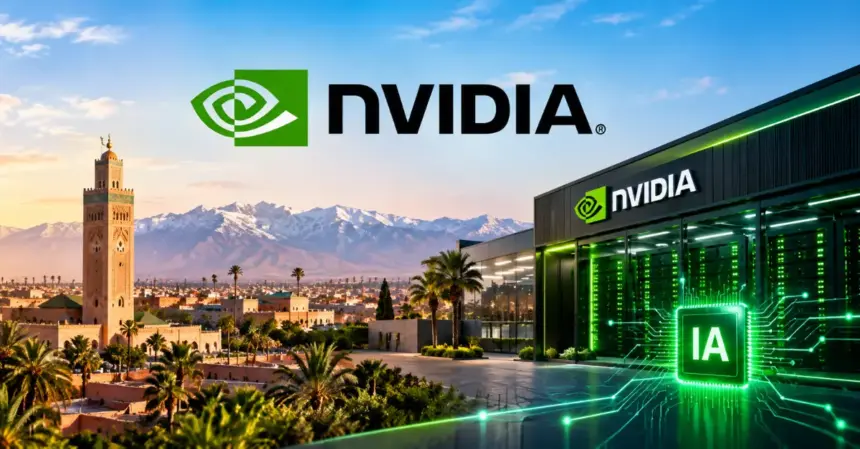
The second project is more concrete. At GITEX Africa 2026, London-based Nexus Core Systems, founded in 2025, signed a memorandum of understanding with Morocco for an 'AI factory' valued at 12 billion dirhams, about $1.28 billion, in two phases: $550 million (5 billion dirhams) for a first hub at Nouaceur, and $750 million (7 billion dirhams) for a northern expansion. The target is 36 megawatts of capacity by the end of 2027, with potential expansion up to 500 megawatts. Named partners include Nvidia, South Korea's Naver Corporation and the Dubai-based investor Lloyds Capital, alongside Morocco's Ministry of Digital Transition and Administrative Reform, the Ministry of Investment and the national investment and export agency.
A memorandum of understanding is not a construction contract, and the announced job numbers show how capital-intensive such facilities are: reports mention about 50 jobs in the first phase and 125 in total by 2027. That is a small workforce for more than a billion dollars. The value lies in what the compute enables: training and serving models for African languages, running government and banking workloads locally, and giving Moroccan and regional start-ups an alternative to renting GPU time in Europe or the United States. The 'AI Made in Morocco' roadmap talks of a $10 billion contribution to GDP by 2030, a figure best treated as an aspiration rather than a forecast.
The foundations: connectivity, energy and talent
These projects sit on relatively solid foundations. As of March 2025 Morocco had 39.9 million internet subscriptions and 1.12 million fibre-to-the-home connections, a rise of 22.7 percent on the year, according to the telecom regulator ANRT data cited in local reporting. The kingdom's renewable share was 45.3 percent of installed capacity, with a target above 52 percent by 2030. On the 2025 Government AI Readiness ranking Morocco rose 14 places to 87th globally and eighth in the MENA region. These are respectable rather than leading numbers, which suggests that the infrastructure ambition is running ahead of the current state of adoption.
Digital Morocco 2030 sets out the demand-side targets. It aims to raise outsourcing export revenues to 40 billion dirhams and create 270,000 jobs, to build 3,000 start-ups, to train 100,000 digital specialists a year, to halve delays in key administrative procedures, and to rank first in Africa and in the top 50 globally on the UN's e-government index. The second National Broadband Plan aims to cover 1,800 rural localities by 2026 and ensure a minimum speed of 20 Mbps for all citizens. If these targets are met, the domestic customer base for local compute would be considerably larger than it is today.
Risks: demand, water, energy and dependence
The first risk is demand. Data centres are expensive to build and quickly obsolete, and their economics depend on utilisation. Morocco's own market for GPU-scale workloads is still small, so the projects rely on winning European, Gulf and African clients, competing with South Africa, Nigeria, Kenya and Egypt, all of which have their own announcements. Investors will want anchor tenants, and none has been named publicly for either project.
The second is resources. Morocco has suffered a multi-year drought, and even seawater-cooled facilities need land, grid connections and transmission capacity that compete with agriculture and industry. Renewable generation in the south must be matched with firm supply and grid upgrades, and green power purchase agreements will be scrutinised by customers who need credible carbon claims.
The third is dependence. An 'AI factory' built with foreign chips, foreign capital and foreign model partners can produce sovereignty in location but not necessarily in control. Export controls on advanced chips, vendor lock-in and the terms of partnerships with Nvidia and Naver will shape how much of the value stays in Morocco. Local skills are the other side of the equation: 100,000 trained digital workers a year is a very ambitious target that requires universities and vocational schools to expand rapidly.
What to watch next
Four signals will show whether the strategy is working. First, whether the Nouaceur memorandum converts into signed financing, land and power agreements with a dated construction schedule. Second, whether Dakhla's feasibility studies produce a costed plan and named developers. Third, whether anchor customers, whether Moroccan banks, government agencies, European enterprises or regional telecom operators, commit to capacity before it is built. Fourth, whether the human-capital pipeline of Digital Morocco 2030 delivers enough engineers, operators and researchers to run the facilities.
Morocco's advantage is that it is planning as a state rather than as a single firm: energy, digital and investment ministries are aligned, and the country has a record of delivering large infrastructure, from Tanger Med to the Noor solar complex. If it can do the same for compute, it could become the first African country to export computing capacity at scale. If demand lags, it will still have built a valuable national cloud. Either way, the experiment offers the continent a live test of a question that will define the next decade: is AI capacity something Africa must import, or something it can host?
Published By | Tech Wiz