SCIENCE & TECH
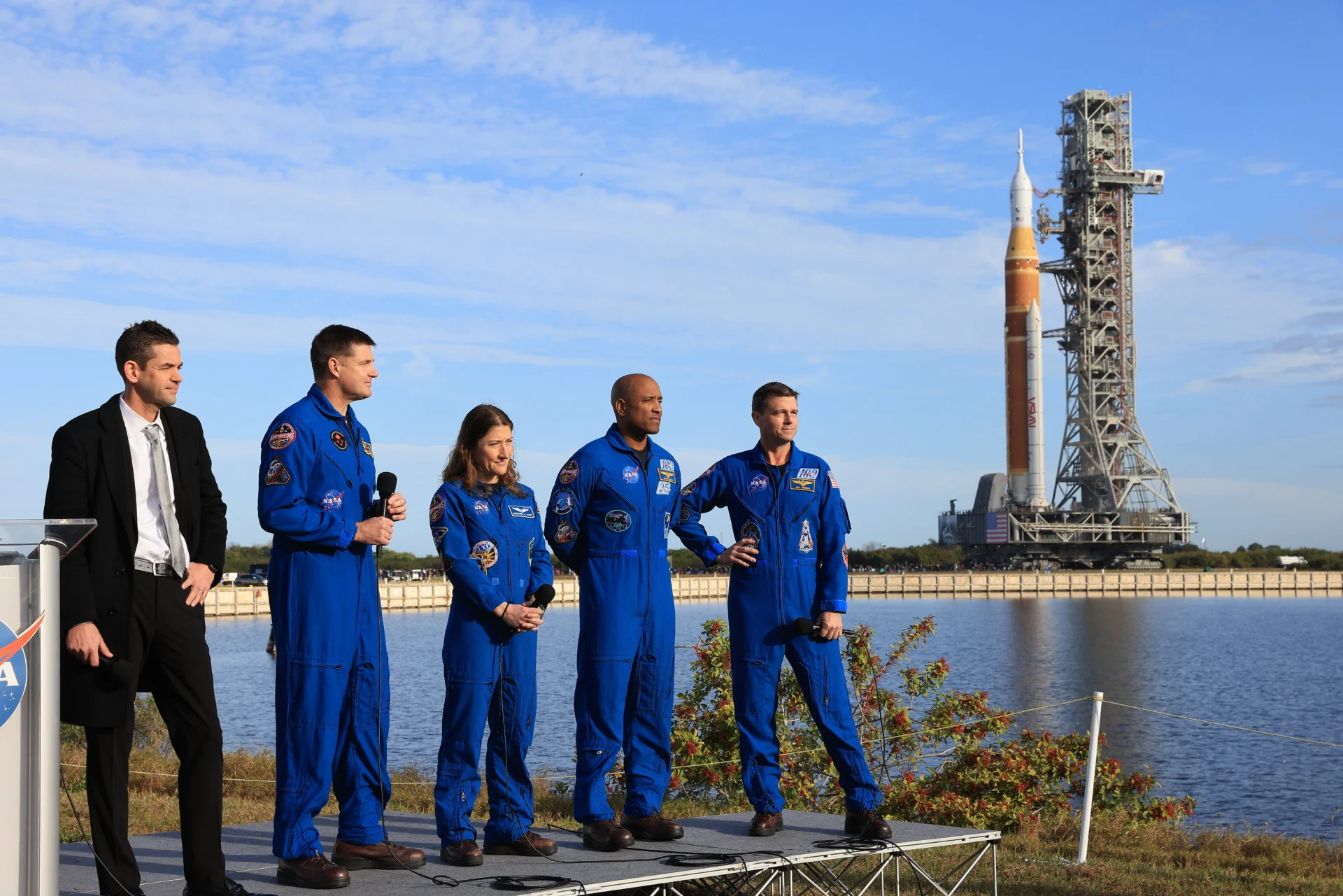
Under the fluorescent glare of the Vehicle Assembly Building, where twin white nose cones the size of grain silos had just been hoisted into place, NASA Administrator Jared Isaacman said the words the agency has been almost afraid to say out loud for the better part of a decade: next year, astronauts are really going to the Moon.
"I'm extremely confident that we are going to be able to launch Artemis 3 next year," Isaacman told reporters gathered at Kennedy Space Center on Friday, Aug. 14. "That's why we stepped into stacking operations" — a reference to the meticulous, months-long process of assembling the Space Launch System (SLS) rocket, piece by piece, inside High Bay 3 of the VAB.
It's the kind of confident declaration that space agencies have learned to make carefully. Artemis has been delayed before — repeatedly. The first crewed landing was once targeted for 2024, then pushed to 2025, then 2027. But this time, there's hardware to point to: four of the ten segments of the solid rocket boosters are already stacked. Engine integration onto the core stage is underway in High Bay 2. The Orion capsule's crew and service modules have been mated. And just a day before Isaacman's remarks, workers wheeled two enormous aerodynamic nose cones — the pointed caps that will sit atop the SLS boosters to cut through the atmosphere — into the assembly building for integration.
This is not, NASA insists, a paper rocket anymore.
THE RISKIEST HANDSHAKE IN SPACE HISTORY
What makes Artemis 3 unlike any human spaceflight mission ever attempted isn't just that it aims to put boots on the Moon's south pole — it's the audacious, three-act orbital ballet NASA has designed to get there safely.
The mission has been fundamentally reengineered since it was first conceived. Originally billed as a straight shot to the lunar surface, Artemis 3 was redesigned earlier this year into what NASA calls an "earth-orbital test flight" — essentially a dress rehearsal in Earth orbit before anyone commits to an actual Moon landing on a later mission.
Here's how the sequence is supposed to play out, according to Isaacman and NASA officials. First, Blue Origin will launch its massive New Glenn rocket, carrying a test version of its Blue Moon Mark 2 lunar lander into low Earth orbit. Days later, NASA's own SLS rocket will thunder off Kennedy's Launch Pad 39B, carrying a crew of four astronauts inside the Orion spacecraft. Orion will then chase down and dock with the uncrewed Blue Origin test lander — a lander that, while missing its actual Moon-capable BE-7 engine, does carry a working life-support system and a crew habitation area, meaning the Artemis astronauts could, in theory, climb aboard and live inside it while the two spacecraft are mated in orbit.
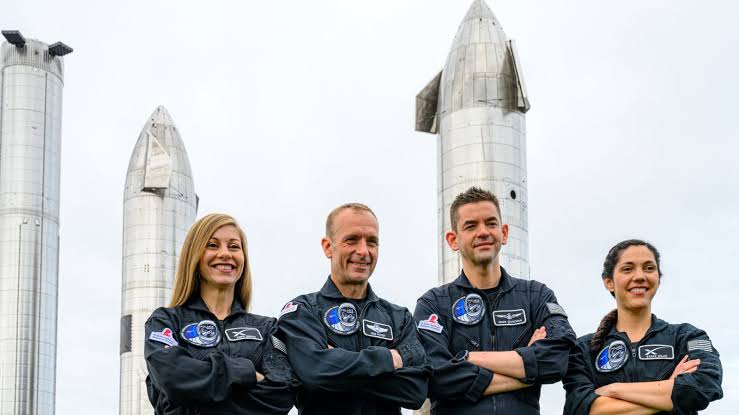
Then, in the mission's second act, Orion will separate from the Blue Origin vehicle and rendezvous with a second spacecraft entirely: a SpaceX Starship Version 3, fitted with a docking adapter on its nose. Because that Starship test article won't have a habitation area of its own, the astronauts will stay put inside Orion for that docking — but the maneuver itself, NASA says, is just as critical, proving out the rendezvous, communications and control systems needed for an actual crewed lunar landing.
It is, in other words, a mission built entirely around answering one question for two rival landers at once: can we trust these things enough to ride them down to the Moon's surface next time?
"What we are going to learn from that mission, the amount of risk we're going to be able to bring down in advance of Artemis 4, will be significant," Isaacman said, describing recent conversations with Blue Origin engineers as he toured their assembly line. "I think, in fact, if you coupled that with the uncrewed landing demonstration, you'd be very confident in what they're going to be able to achieve potentially in 2028."
THE FOUR ASTRONAUTS WHO WILL RIDE THE GAUNTLET
The crew tasked with pulling off this unprecedented double-docking mission has already been named: NASA astronaut Randy Bresnik will command the flight, joined by ESA astronaut Luca Parmitano as pilot, with NASA astronauts Frank Rubio and Andre Douglas serving as mission specialists. Bresnik and Douglas were on hand this week inside the Vehicle Assembly Building, watching the very rocket that will carry them come together piece by piece — a moment that, for astronauts, is equal parts thrilling and surreal, watching your ride to space get bolted together in real time.
It's a veteran crew for an unprecedented mission. Rubio, notably, holds the American record for longest single spaceflight, having spent more than a year aboard the International Space Station after a Soyuz coolant leak forced an extended stay. That kind of experience with the unexpected may prove useful on a mission built almost entirely around choreographed uncertainty.

A RACE AGAINST THE CLOCK — AND EACH OTHER
Underpinning the entire mission is a genuine commercial space race, with Blue Origin and SpaceX each racing to prove their lunar landers are ready, watched closely by a NASA that badly needs at least one of them to succeed on schedule.
SpaceX's path hasn't been smooth. The company's Starship program, while racking up an aggressive launch cadence, has also suffered its share of high-profile setbacks over the past two years, and NASA's own timeline is explicitly contingent on SpaceX proving it can fly reliably and often. "If they're able to launch again in early September after their last launch and continue to track inside the month, potentially every couple of weeks before the end of the year, that's going to — we're going to feel very good about their time to contribute to Artemis 3 next year," Isaacman said. He added that SpaceX has "already started cutting hardware" for its lunar test vehicle, something NASA officials say they track "every single day."
Blue Origin, meanwhile, is coming off its own recent stumble: the company's New Glenn rocket suffered an explosion during a static-fire test earlier this month, an incident Blue Origin says it has now traced to a specific engine issue. That failure, just weeks before Isaacman's confident press conference, is a reminder of how much has to go right, and how little room for error either company has, for the 2027 timeline to hold.
Still, Isaacman struck an unmistakably optimistic tone, framing the redesigned test-flight approach as a strength rather than a compromise. "I certainly hope we have to work some deconfliction issues" between an upcoming public air-and-space expo at Kennedy and the actual Artemis 3 rocket rollout, he joked at one point — suggesting NASA is now confident enough in its schedule to worry about scheduling conflicts with an air show.
EXPERT PERSPECTIVE
Space policy analysts have noted that NASA's decision to restructure Artemis 3 into an orbital test flight, rather than attempting a direct crewed landing, reflects lessons learned from years of schedule slips tied to lander readiness. By decoupling the "prove the hardware works" phase from the "put boots on regolith" phase, NASA effectively lowers the stakes of any single mission while still keeping astronauts flying on a roughly annual cadence — a deliberate strategy to maintain public and congressional confidence in the program after years of delay headlines. It's also, analysts note, a hedge: if either Blue Origin or SpaceX stumbles, NASA still has a mission worth flying with whichever lander is ready.
The mission is also historically unprecedented in a specific way: it will be the first time NASA has planned for a single crewed spacecraft to rendezvous and dock, in the same mission, with two entirely different, competing commercial vehicles built by two of the most bitter rivals in the space industry.
WHAT THIS MEANS FOR YOU
You don't need a NASA badge to feel the ripple effects of Artemis 3. A successful mission would mark the first time American astronauts have ventured beyond low Earth orbit since the Artemis 2 lunar flyby, and the clearest signal yet that a real, crewed Moon landing — the first since Apollo 17 in 1972 — could happen on Artemis 4 as soon as 2028. For the Space Coast economy around Kennedy, it means continued investment, jobs, and the kind of momentum that's already drawing a privately funded "Max Power" air-and-space expo to the area this November, expected to draw crowds eager to catch a glimpse of the SLS rocket rolling to its launch pad. And for the broader push toward a sustainable human presence on the Moon — including NASA's long-term "Moon Base" ambitions, which the agency says will lean on repurposed Gateway station hardware — Artemis 3's success or failure will set the tone for everything that follows, including eventual missions to Mars.
There's also a simpler, more human reason to watch: if this mission goes as planned, it will be the riskiest, most technically complex piece of orbital choreography four human beings have ever attempted, live, hundreds of miles above Earth, watched by millions.
CONCLUSION
For now, all NASA can do is keep stacking. Segment by segment, engine by engine, nose cone by nose cone, the rocket that will carry Bresnik, Parmitano, Rubio and Douglas toward their rendezvous with two experimental Moon landers is taking shape inside the Vehicle Assembly Building — the same cavernous hangar that once housed the Saturn V rockets that carried the Apollo astronauts to the actual lunar surface more than 50 years ago. Whether Artemis 3 launches on schedule in 2027 will depend on hundreds of variables still outside NASA's control: whether SpaceX can sustain its launch cadence, whether Blue Origin can recover cleanly from its New Glenn setback, whether the next 12 months of testing turn up any surprises. But for the first time in years, the agency's own administrator is willing to say, on the record and in front of cameras, that he's "extremely confident." After a decade of Artemis delays, that alone counts as news.
Published By | Tech Wiz