Written By | Torch Media Africa
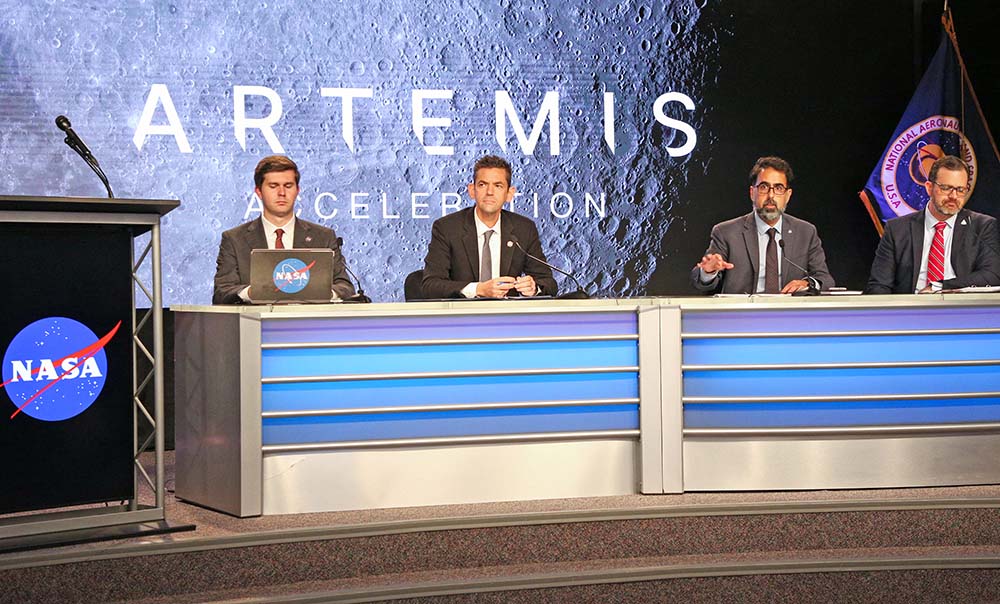
Administrator Jared Isaacman admits the schedule is about 90 days behind, keeps SpaceX and Blue Origin locked in a head-to-head fight, and says flight data, not contracts, will pick the winner
KENNEDY SPACE CENTER, Florida
America's return to the Moon just got a new script, and it reads less like a victory lap and more like a high-stakes dare. On Friday, NASA Administrator Jared Isaacman stood at Kennedy Space Center and laid out an Artemis plan that keeps two rival companies in the race, adds a risky new rocket stage to the shopping list, and quietly admits the schedule is running roughly 90 days late.
The headline promise has not changed: American boots on the lunar surface in 2028. But the road there now runs through a nail-biting orbital rehearsal next summer, a pair of competing landers that have yet to prove their hardest tricks, and a spacesuit that had to be put on a diet. If it all works, the Moon is back on the menu. If it does not, Isaacman has already told the world who to blame: the laws of physics.
"No amount of my enthusiasm or schedule pressure changes the laws of physics," Isaacman said at the briefing, according to coverage of the event. It is a striking line from a leader who built his reputation on bold, fast-moving spaceflight, and it sets the tone for what NASA now calls its Artemis acceleration plan.
The big reset: Artemis III is no longer a landing
The biggest shift happened months ago but is now coming into sharp focus. In late February, NASA changed Artemis III from a crewed Moon landing into a low-Earth-orbit test flight. The mission, targeted for no earlier than summer 2027, will carry four astronauts on a roughly 14-day trip in which the Orion capsule practices docking with test versions of both commercial lunar landers.
A slide shown at the briefing laid out the choreography. Blue Origin's Blue Moon vehicle launches first. Then the Space Launch System rocket sends Orion skyward. Orion links up with Blue Moon on the third day of flight, separates, and later docks with SpaceX's Starship on flight day eight. Think of it as a dress rehearsal where every cable, latch and procedure gets tested with real people on board, but with a very important safety net.
That net is distance. Because the crew stays in Earth orbit, any emergency leaves them hours from home rather than days. After the long gap since Apollo 17 in 1972, NASA is clearly deciding that the safest way to go back to the Moon is to practice close to Earth first.
The actual landing moves to Artemis IV, which the agency now says will be the first Artemis mission to touch down on the lunar surface, in 2028.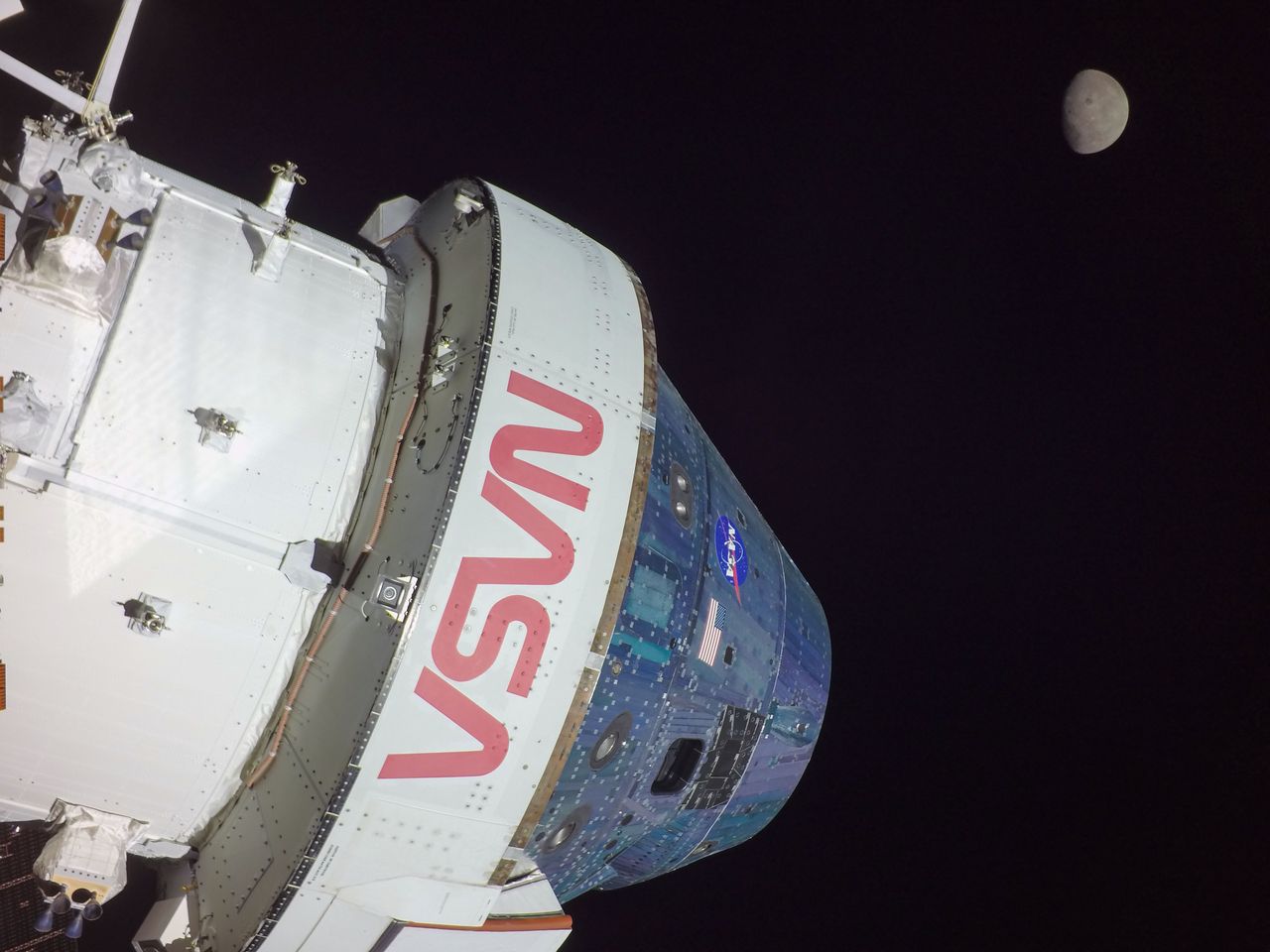
A rocket that is about to be stacked and shaken
Back at the Vehicle Assembly Building, the hardware is slowly coming together. NASA says it has finished the first phase of stacking the twin solid rocket boosters for Artemis III, with the massive core stage scheduled to be lowered in between them the following week.
This particular stack is a stubby oddity. It will have no upper stage and no Orion capsule on top. Instead, it will roll out to Launch Complex 39B for tanking tests, a series of fuel-loading trials aimed at solving a persistent headache: liquid hydrogen leaks at the tail service mast umbilical interfaces, which cropped up during the first two Artemis missions. NASA began redesigning those umbilicals in April.
The catch for impatient space fans is timing. According to reporting from NASASpaceflight.com, the tanking test that was once expected around now has slipped to several months away. A cylindrical spacer will hold the place of Orion so the stack still fits existing ground equipment.
It is not glamorous work, but it matters. A rocket that leaks hydrogen on the pad cannot fly a crew, and a crew that cannot fly cannot dock with anything.
The upper-stage puzzle
Beyond Artemis III, NASA faces a plainly awkward problem: it is running out of upper stages. Three interim cryogenic propulsion stages were built for the original Block 1 version of the rocket. Two have flown. The third has been reassigned to Artemis IV.
The more powerful Exploration Upper Stage planned for the Block 1B configuration was canceled earlier this year after cost and schedule overruns. The older stage is based on a design whose production line has closed, so there is no easy way to make more.
NASA's answer is to look at United Launch Alliance's Centaur V as its standard upper stage going forward. A stretched-tank version has been formally confirmed as an option, although the timing is still open, and a kick stage is also being studied. Reporting on the briefing says Artemis IV could fly either the last of the old stages or a stretched Centaur V, with a decision expected around next summer, close to the Artemis III launch window. A program official said the stretched stage would hold about 50 percent more fuel, and that NASA has not yet placed an order.
Switching would not be free. Centaur V would require modifications to the mobile launcher so that ground connections line up. It is a classic space-program trade: more performance, more paperwork, more risk to the calendar.
The spacesuit that went on a diet
If the rockets are a headache, the spacesuits have been a migraine. In 2022 NASA awarded service contracts to Axiom Space and Collins Aerospace for moonwalking and space station suits. Collins withdrew in 2024, leaving Axiom responsible for both. Axiom's lunar suit, known as AxEMU, missed its mass target at a 2024 design review, and testing slid from 2025 to 2027.
NASA's own inspector general called the old timeline "overly optimistic," warning that typical delay patterns could push suits to 2031, far too late for a 2028 landing.
So NASA is changing the ask. It has directed Axiom to build a lighter, simpler "sortie" suit derived from the AxEMU, with fewer interfaces to the lander. The sortie suit will be certified for surface outings of at least two hours. It will not be rated for the permanently shadowed regions near the lunar south pole, nor for long multi-outing campaigns. The full-featured suit stays in development for later missions.
To put two hours in perspective, Apollo 11's single moonwalk lasted about two and a half hours, while Apollo 17 crews racked up more than seven hours across three excursions. In other words, the first Artemis moonwalkers may do something closer to a historic visit than a long-term camping trip.
Two landers, two wild plans
The most gripping part of the update is how differently the two competing landers plan to reach the Moon. NASA says it will keep both options alive for Artemis IV for as long as possible, which buys schedule flexibility and improves the odds of a 2028 landing.
Blue Origin's approach starts in low Earth orbit with three transfer stages derived from its Blue Moon Mk1 vehicle. The crew lander, Mk2, launches on a New Glenn rocket from Launch Complex 36B, docks with those stages and heads for an elliptical polar orbit around the Moon. Two of the stages drop away on the way, leaving one attached. Orion flies directly to the Moon and meets the lander there. Two astronauts move across, Orion undocks, and the remaining stage lowers the lander to low lunar orbit before Blue Moon makes the final descent.
SpaceX's approach is a spectacular exercise in orbital logistics. A depot Starship launches first and is topped up by multiple tanker flights. The lunar Starship then launches, docks with the depot to refuel, and climbs to a distant orbit, while the depot is refilled again. After a second refueling, the lander heads to a high Earth orbit, where Orion docks with it. The joined stack then fires toward the Moon and settles into low lunar orbit. NASA is also studying modifications to Orion to save propellant for the trip home.
At the briefing, the agency showed first public images of crew cabin hardware from both companies: a test-article crew cabin from Blue Origin and SpaceX's "Cabin 1," a full-scale, flight-like crew compartment mockup inside its Starfactory. No new images of the actual landing systems were released.
Why the old orbit is gone
One quiet but important change is where Orion meets the landers. With the Lunar Gateway station paused earlier this year, NASA has dropped plans to rendezvous in a near-rectilinear halo orbit and instead chose low lunar orbit. That option is considered safer, but it demands more propellant. Orion's European-built service module also has limited performance for a lunar round trip, which is one reason an upgraded upper stage is on the table.
Put simply, every decision in this architecture pushes on every other one. More fuel means a bigger rocket stage, which means launcher changes, which means more testing, which means more schedule risk.
Flight data over paperwork
Perhaps the most notable promise from Isaacman is how NASA will pick a winner. According to coverage of the briefing, he said flight data, not signed contracts, will decide which lander ultimately carries astronauts to the surface. He also vowed that NASA will no longer build programs that are "too big to fail and too costly to succeed."
He was blunt about the hurdles, too. Both lander teams must prove complex launch campaigns and large-scale transfer of super-cold propellant in space, something never done at this scale. SpaceX is expected to attempt a ship-to-ship refueling demonstration in the first quarter of 2027. Blue Origin's larger architecture depends on New Glenn returning to flight, expected in December or January.
There is serious money behind the contest. Reporting around the briefing noted that Blue Origin raised $10 billion this year at a reported $140 billion valuation, and that the U.S. Space Force awarded SpaceX, ULA and Blue Origin about $13.7 billion in launch contracts last year. Investors noticed the briefing too: SpaceX shares closed up 1.9 percent at $147.49, though the move was attributed mainly to a separate pre-briefing report about cell-tower access. More shares become eligible to trade Monday after a lockup release, with about 328.4 million set to be freed.
Politics, budgets and a safety warning
The engineering is only half the story. A bipartisan NASA Authorization Act of 2026 would authorize $25.3 billion for the agency in fiscal 2027 and back at least two Moon landers. It cleared the Senate Commerce Committee unanimously in March but still awaits a full vote. The U.S. midterm elections arrive on 3 November, and the continuing resolution funding NASA expires on 11 December.
Meanwhile, a separate warning flickered across space-news feeds this week. NASA's safety advisory panel has raised concerns about Artemis IV and future access to low Earth orbit, according to a daily briefing from Orbital Radar. That outlet was careful to describe it as a warning about program risks, not an announcement of a cancellation or a new launch date. But it is a reminder that the people paid to worry are worrying.
Expert perspective: ambition meets arithmetic
Space-policy watchers have seen this movie before, and the plot twist is usually the schedule. The Apollo program reached the Moon in under a decade by throwing enormous resources at a single architecture. Artemis is attempting something different: two commercial approaches, each depending on technology that has not yet been demonstrated.
That is why the Artemis III rehearsal is the real hinge. If Orion docks cleanly with both landers in 2027, and if in-space refueling works, the 2028 date looks achievable. If either of those steps slips, 2028 becomes a stretch. NASA's own inspector general has already warned against optimistic timelines, and Isaacman's physics remark reads as an attempt to inoculate the public against surprise.
Notably, the agency is also showing signs of managing expectations through scope: a sortie suit rated for just two hours, a low-orbit rehearsal rather than a landing, and a decision-by-data approach to the lander contest. Those are the moves of an organization trying to protect a date by shrinking what must go right.
What this means for you
For most readers, the Moon is not a daily concern. But Artemis shapes things that touch everyday life. Contracts worth billions flow to companies across the country, supporting jobs in aerospace, manufacturing and software. Technologies tested for lunar missions, from life-support systems to cryogenic fuel handling, often find their way into other industries.
For space fans, the calendar just got more concrete. Keep an eye on New Glenn's return to flight around December or January, SpaceX's refueling demonstration in early 2027, and Artemis III itself next summer. Each is a milestone that will tell you whether 2028 is realistic long before anyone straps into a spacecraft.
For taxpayers, the two-lander approach is both a hedge and a cost. It protects against one company stumbling, but it means funding two complex systems. The Authorization Act vote, and the December funding deadline, will show whether Congress is willing to pay for that insurance.
The bottom line
NASA's message on Friday was equal parts confidence and caution. The agency says it is committed to returning Americans to the lunar surface in 2028, and it has built a plan with more off-ramps than a spaghetti junction. A 14-day docking test in 2027 will show whether Orion, Blue Moon and Starship can actually work together. Until then, the countdown is less about days on a calendar and more about checkboxes: leak-free fueling, a working upper stage, a lighter suit and a pair of landers that can do something nobody has ever done.
The Moon has waited more than half a century. It can wait a little longer, as long as someone is really on the way.



