Written By | Torch Media Africa
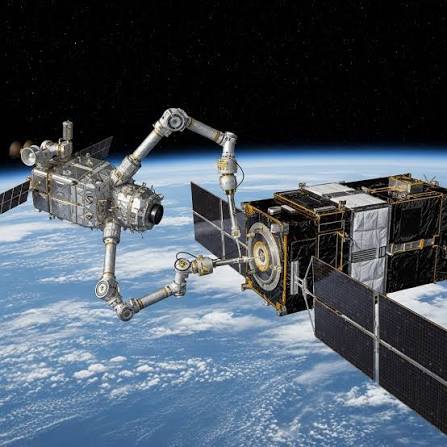
A first-of-its-kind American robot with ten-foot metal arms just rocketed into orbit — and its job is to crawl up to dying satellites and bring them back from the dead
CAPE CANAVERAL, Florida
At 5:15 p.m. on Tuesday, July 21, a SpaceX Falcon 9 rocket lit up the Florida coastline and carried something into the sky that has never flown before: a commercial robot built to grab, grip, and repair other spacecraft while both are hurtling through space at roughly 6,700 miles per hour.
The machine is called the Mission Robotic Vehicle, or MRV-1, and it is the handiwork of Northrop Grumman's space servicing arm, SpaceLogistics, built in partnership with the Pentagon's most futuristic research shop, the Defense Advanced Research Projects Agency (DARPA), and engineers at the U.S. Naval Research Laboratory. Riding shotgun with it were three refueling-and-repair modules known as Mission Extension Pods. Together, they represent the opening act of what officials are calling America's first true "satellite repair shop in the sky."
If it works as designed, MRV-1 will spend the next decade crawling across geostationary orbit — the ring of space roughly 22,500 miles above Earth where communications, weather, and military satellites hover in fixed positions — grabbing aging, out-of-fuel spacecraft that would otherwise be left to drift as multimillion-dollar space junk, and giving them a new lease on life.
A Robot Mechanic With Ten-Foot Arms
Strip away the acronyms and MRV-1 is, in essence, a 3,000-kilogram tow truck with hands. It's fitted with two robotic arms, each roughly three meters — about ten feet — long, engineered with seven degrees of freedom, meaning they can bend, twist, and rotate with something close to the dexterity of a human shoulder, elbow, and wrist combined. More than 20 cameras and sensors are mounted across the spacecraft to give it what engineers call "situational awareness" — essentially a robot's sense of sight and depth perception, critical for creeping up on a satellite without smashing into it.
“Doing docking is a whole other level of sophistication and complexity,” said Rob Hauge, president of SpaceLogistics, describing just how difficult it is to get one spacecraft to safely latch onto another while both are moving in orbit.
That difficulty is precisely why this mission has been eight years in the making. DARPA launched its Robotic Servicing of Geosynchronous Satellites program back in 2016, betting that government-funded robotic technology — specifically, the arms themselves, which were designed and built by the Naval Research Laboratory — could be married to a commercially owned and operated spacecraft. Northrop Grumman put up the money to build the rest of the vehicle and turn a research project into something resembling a business. This week, that eight-year bet officially left the launch pad.
From Tow Truck to Repairman
This isn't Northrop Grumman's first rodeo in orbit. The company's earlier Mission Extension Vehicles, MEV-1 and MEV-2, already proved that a robotic spacecraft could dock with an aging satellite and essentially become its engine, providing propulsion and steering so the customer satellite could keep functioning years past the point where it ran out of its own fuel.
MEV-1 launched in 2019 and docked with Intelsat 901 in 2020, keeping the aging communications satellite in service until this year, 2025, when it finally guided the spacecraft to a "graveyard orbit" — a kind of retirement parking lot for dead satellites, far enough away that it won't collide with anything still working. MEV-2 went a step further, docking directly with an active satellite, Intelsat 10-02, while it was still fully operational, and adding an estimated five more years to its working life.
But MEV-1 and MEV-2 could only push and steer. They couldn't touch, grip, or fix anything. MRV-1 is the leap from "tow truck" to "repairman." With robotic arms in the mix, the new vehicle isn't limited to just extending a satellite's life with the three Mission Extension Pods it's carrying — small jetpack-like modules that can be grabbed by the arms and mounted onto a customer satellite to give it fresh propulsion. It can, in theory, also inspect a malfunctioning satellite up close, attempt repairs, and even install hardware upgrades — jobs that, until now, required either abandoning a multimillion-dollar asset or sending a very expensive, very risky human spacewalk.
Officials say a single MRV can extend the working life of up to thirty satellites, each weighing roughly 2,000 kilograms, over the course of its service life — a claim that, if it holds up, would fundamentally change the economics of owning a satellite.
Why This Matters Now
For decades, the rule in the satellite business has been brutally simple: once a spacecraft runs low on fuel or suffers a critical malfunction, it's essentially garbage. Operators either spend hundreds of millions of dollars building and launching a replacement or watch a functioning, valuable piece of hardware slowly drift into uselessness — all while contributing to the growing cloud of debris circling the planet.
That reality has made in-space servicing one of the most closely watched frontiers in the space industry, sitting alongside asteroid mining and lunar bases as a next-generation business line. SpaceLogistics is currently the only company in the world actively providing on-orbit servicing to satellites in geostationary orbit, giving Northrop Grumman a head start in what analysts describe as an "emerging and increasingly competitive" market for in-space servicing, assembly, and manufacturing — an industry sometimes shortened to "ISAM" in trade publications, and one that governments, including the Pentagon, are watching closely for both commercial and national security reasons.
The Pentagon's interest isn't incidental. Geostationary orbit is packed with military communications and surveillance satellites that are exceptionally expensive to replace and, increasingly, seen as strategically vulnerable. A robotic vehicle capable of repairing, refueling, or repositioning those assets on short notice has obvious defense value beyond the commercial servicing contracts SpaceLogistics sells to communications companies.
There's also an environmental and safety angle that rarely makes headlines but matters enormously to the people who track orbital traffic. Every satellite that gets refueled or repaired instead of replaced is one less rocket launch, one less pile of retired hardware left drifting through crowded orbital lanes, and one fewer contributor to the space debris problem that has worried astronomers and satellite operators for years as the number of objects in orbit has exploded.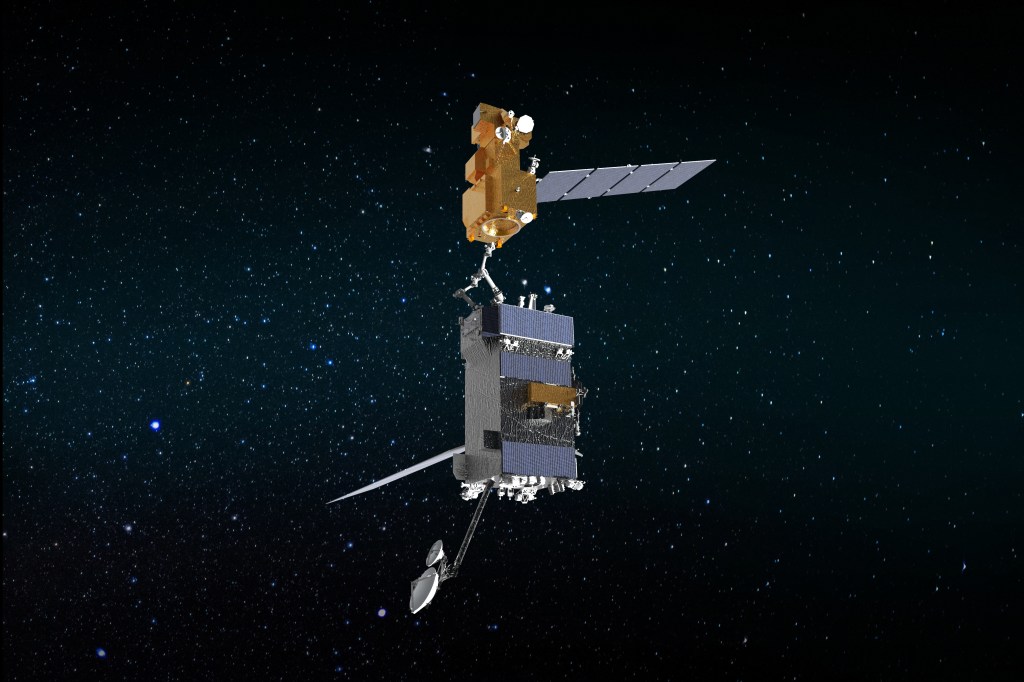
What Happens Next
MRV-1 won't be grabbing satellites right away. After launch, the spacecraft has to complete a lengthy checkout process, testing its propulsion, robotic arms, and sensors while easing into its working orbit. Once it's operational, the plan calls for it to begin docking demonstrations, likely starting with government or partner satellites before moving on to paying commercial customers.
Northrop Grumman has described this as the start of a decade-long demonstration effort, suggesting the company sees this less as a one-off mission and more as the debut of an entirely new product line — one it hopes to scale into a fleet of robotic servicers roaming geostationary orbit, extending the lives of satellites that would otherwise be scrapped.
Competitors are watching closely. Firms in the United States, Europe, and Japan have floated their own satellite servicing and debris-removal concepts in recent years, but none has yet put hardware with working robotic arms into geostationary orbit. That gives Northrop Grumman and its government partners a real, if temporary, head start in a market some analysts believe could be worth billions of dollars as more of the roughly 500-plus active satellites in geostationary orbit age past their original design lives over the coming decade.
What This Means for You
It's easy to hear "satellite servicing robot" and file it under space-nerd trivia, but the ripple effects reach further than most people realize. Geostationary satellites are the backbone of much of the world's television broadcasting, weather forecasting, long-distance telephone routing, and military communications. When one of those satellites runs out of fuel prematurely, the cost of replacing it — often hundreds of millions of dollars, plus a launch — tends to get passed down the chain to the companies, governments, and ultimately consumers who depend on the service that satellite provides.
A functioning in-space repair economy could mean cheaper, more resilient satellite services over time, fewer sudden outages when aging hardware fails, and a slower buildup of space debris that could otherwise threaten the satellites we all rely on for GPS, weather alerts, and broadband. It's also a preview of a future many space executives have been promising for years: an orbital economy where spacecraft aren't simply built, launched, and discarded, but maintained, upgraded, and kept working — not unlike how a fleet of aircraft or ships gets serviced rather than scrapped after every mechanical issue.
The Bottom Line
MRV-1's arms haven't grabbed anything yet, and the real test of this technology will come in the months ahead as it attempts its first delicate dockings 22,500 miles above the planet. But its launch marks a genuine milestone: the first time a commercially built, robotically armed spacecraft has been sent into geostationary orbit with the explicit mission of fixing, refueling, and upgrading other satellites rather than simply pushing them around.
If Northrop Grumman, DARPA, and the Naval Research Laboratory can pull off what eight years of development have promised, the era of simply abandoning multimillion-dollar satellites the moment something goes wrong may finally be coming to an end — replaced by a robotic repairman quietly working the night shift, a satellite's-throw away, 22,500 miles above our heads.



