SCIENCE & TECH
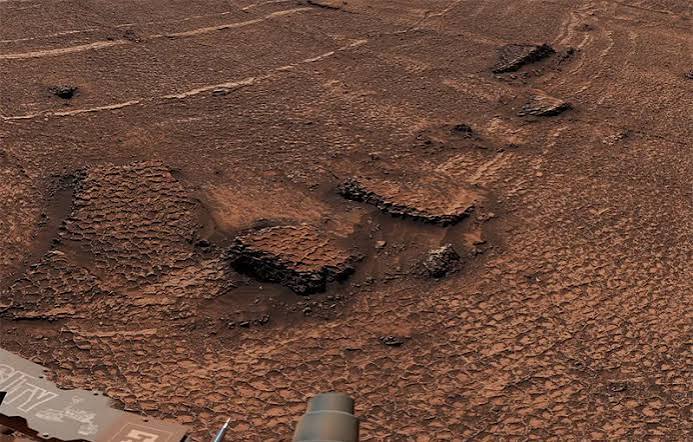
Four billion miles from the nearest beehive, NASA's Curiosity rover has photographed something that looks, unmistakably, like a honeycomb — except it's carved into solid Martian bedrock, it stretches farther than the rover's cameras can see, and nobody currently on Earth or Mars can say for certain how it got there.
The discovery, announced by NASA's Jet Propulsion Laboratory and first captured in a sweeping 360-degree panorama taken over two days in June, has sent planetary geologists into a frenzy of speculation. Curiosity has spent nearly 14 years crawling across Gale Crater, and in that time it has spotted small patches of similar geometric cracking before. What it found this time, in a valley the mission team has nicknamed "Valle Grande," is something else entirely: a field of polygonal fractures so vast and so uniform that scientists are describing it as unlike anything the rover has documented in its entire mission.
"We've seen a lot of fascinating landscapes through Curiosity's eyes, but this sea of polygons took our breath away," said Ashwin Vasavada, the mission's project scientist at NASA's Jet Propulsion Laboratory in Southern California, in a statement released alongside the images.
A LANDSCAPE THAT SHOULDN'T MAKE SENSE
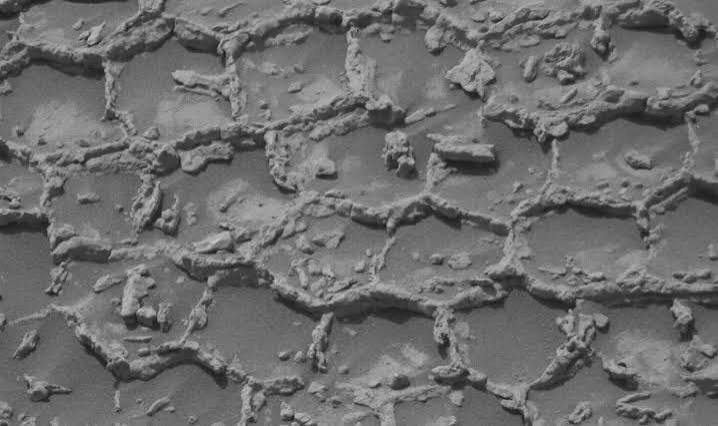
To understand why this is such a big deal, you have to picture what Curiosity actually found. Each individual polygon in the pattern measures roughly 4 to 8 centimeters across — about the size of a drink coaster — with razor-straight fracture lines running between them in a tessellating, honeycomb-like lattice. That alone wouldn't be remarkable; small polygon patches have shown up in Curiosity's photos for years, and similar "desiccation cracks" form on Earth all the time when mud dries out and shrinks.
What stopped mission scientists cold is the sheer scale of it. The pattern doesn't just cover a patch of ground — it blankets the floor of Valle Grande and then climbs, uninterrupted, up the flanks of a nearby butte the team has named "Miraflores," a roughly 20-foot-tall mound capped with a thick layer of wind-blown sand. Polygon cracking that consistent, across that much terrain and that much vertical relief, is something the mission has never documented before on this scale anywhere in Gale Crater.
"We measured their shapes and chemistry carefully and are hopeful there are clues in the data as to how these features formed," Vasavada said.
That last part matters more than it might sound. Curiosity isn't just taking pretty pictures — it's carrying a full geochemistry lab on wheels, and the team has been running the rover's instruments over the honeycomb terrain to analyze the mineral composition locked inside those cracks, looking for chemical fingerprints that might betray exactly what process carved them billions of years ago.
THREE THEORIES, NO WINNER YET
Here's the maddening part for the scientists involved: polygon patterns like this one can form through at least three completely different geological processes, and from orbit or even from ground-level photos alone, they can look nearly identical.
The first and most familiar explanation is simple mud cracking — the same process that splits a dried-up puddle into a mosaic of hexagonal plates in your backyard after a rainstorm. Curiosity has confirmed this exact mechanism before at other sites in Gale Crater, where ancient lakebeds dried out and left behind unmistakable desiccation cracks. If that's what happened at Valle Grande, it would be powerful new evidence that a genuinely enormous body of water once sat in this part of Mars long enough to leave its fingerprints across an entire valley floor.
The second possibility is thermal contraction — repeated cycles of extreme heating and cooling that stress rock or sediment until it fractures into polygonal blocks, a process seen in permafrost regions on Earth, including Antarctica and the Arctic tundra, where the ground freezes and thaws in a seasonal rhythm for thousands of years. If that's the culprit on Mars, it would say less about ancient water and more about the planet's brutal, longstanding climate extremes.
The third theory involves buried, water-rich sediment. As layers of wet material get compressed under the weight of newer rock piling up on top of them over geologic time, the compaction alone can crack the surface into polygon shapes as the material is squeezed and dewatered from below — a subtler, slower process that wouldn't necessarily require a lake or standing water at the surface at all.
Each theory tells a radically different story about ancient Mars — one where water once pooled and evaporated across a wide valley, one dominated by punishing freeze-thaw cycles, and one shaped by deep, slow-motion geological pressure. Untangling which one actually happened is exactly the kind of forensic puzzle Curiosity was built for, and the mission team says the rover's onboard chemistry data, still being analyzed back on Earth, may hold the answer.
WHY THIS ISN'T JUST A PRETTY PICTURE
It's tempting to file this under "cool space photo" and move on, but planetary scientists say discoveries like this one carry real weight for a much bigger question: whether Mars was ever hospitable enough, for long enough, to support life.
If the honeycomb terrain turns out to be classic mud-crack desiccation, it would add to a growing body of evidence — including Curiosity's earlier finds of ancient streambeds, lakebed minerals, and organic molecules — that Gale Crater once held a genuinely large, long-lived body of liquid water, rather than a few fleeting puddles. Water that sticks around long enough to dry, crack, and get buried under new sediment implies a far more stable ancient environment, which matters enormously to anyone trying to figure out whether Mars could once have supported microbial life.
If instead the cracks turn out to be a product of ancient freeze-thaw cycles, that reshapes the story in a different direction — pointing toward a colder, harsher early Mars where any water present was more often locked as ice than pooling as a lake, a less hospitable picture for potential ancient biology but still an important data point on the planet's early climate.
Either way, Valle Grande has become one of the more compelling geological puzzles Curiosity has handed scientists in years, and it's a reminder of just how much this nearly 14-year-old rover, launched in November 2011 and still grinding across Gale Crater on the same six aluminum wheels, continues to surprise the people who built it.
THE ROVER THAT KEEPS DELIVERING
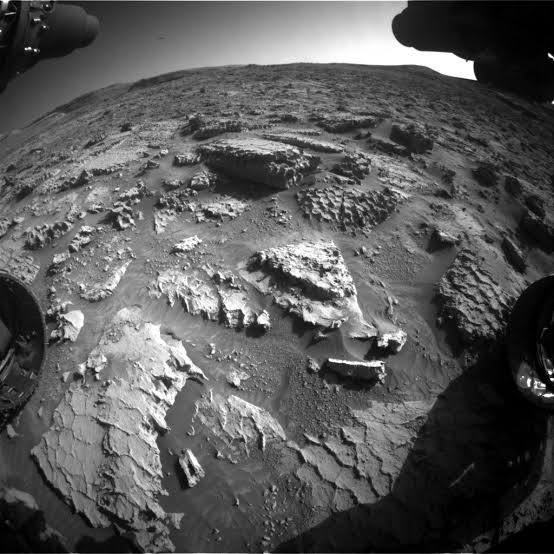
Curiosity wasn't designed to last this long. Its original prime mission was slated for two years; it has now operated for nearly fourteen, weathering dust storms, wheel damage, and the general wear of dragging a one-ton, plutonium-powered laboratory across some of the most unforgiving terrain in the solar system. Along the way, it has fundamentally rewritten the scientific understanding of ancient Mars, confirming that Gale Crater once held lakes and rivers, detecting complex organic molecules in ancient mudstone, and tracking seasonal methane fluctuations that remain one of the more tantalizing, unresolved mysteries in planetary science.
The honeycomb discovery adds another chapter to that legacy, and mission planners say Curiosity will continue studying the Valle Grande polygons and the Miraflores butte in the coming weeks, using its Mastcam and ChemCam instruments to build out a more detailed chemical map of the fractured terrain before eventually rolling on toward its long-term destination higher up Mount Sharp, the towering central peak the rover has been climbing since 2014.
Meanwhile, Curiosity isn't alone out there anymore. NASA's newer Perseverance rover and China's Zhurong rover (currently dormant) have both documented their own polygon-like features elsewhere on Mars in recent years, and orbital imagery from missions like the European Space Agency's Mars Express and NASA's own Mars Reconnaissance Orbiter has cataloged similar patterns across scattered regions of the planet. But nothing previously spotted matches the scale and uniformity of what Curiosity just found at ground level in Valle Grande — a reminder that orbital images, however sharp, still miss enormous amounts of detail that only a rover crawling across the actual surface can catch.
EXPERT PERSPECTIVE
Planetary geologists outside the mission have called the find a valuable natural laboratory for testing competing models of Martian surface evolution, precisely because the three leading explanations — desiccation, thermal contraction, and sediment compaction — make different, testable predictions about the chemistry and layering hidden just beneath the crust. Resolving the debate won't happen overnight; it will likely require months of comparing Curiosity's chemical readings against similar polygon terrain here on Earth, in places like Utah's dried salt flats and Antarctica's permafrost fields, where scientists can study the same processes up close.
WHAT THIS MEANS FOR YOU
You're not booking a flight to Valle Grande anytime soon, but this is exactly the kind of finding that quietly reshapes what future Mars missions — including any eventual human expedition — will target. Regions with strong evidence of long-lived ancient water are the leading candidates for future sample-return missions and, eventually, the search for preserved biosignatures. A discovery like this helps NASA prioritize where to look next, and it's a vivid, visual reminder of just how alien and unfinished our understanding of Mars still is, more than sixty years after humanity first started sending spacecraft there.
CONCLUSION
Nobody is suggesting Mars was ever home to giant space bees, whatever the internet jokes might say. But the honeycomb field at Valle Grande is a genuine scientific puzzle, sitting right now in NASA's data pipeline, waiting to be solved. Somewhere between a sea that dried up, a climate that froze and thawed for millennia, or sediment that was slowly squeezed from below, lies the true story of how this pattern got there — and Curiosity, fourteen years into a two-year mission, is still the only thing capable of finding out.
Published By | Tech Wiz