SCIENCE & TECH
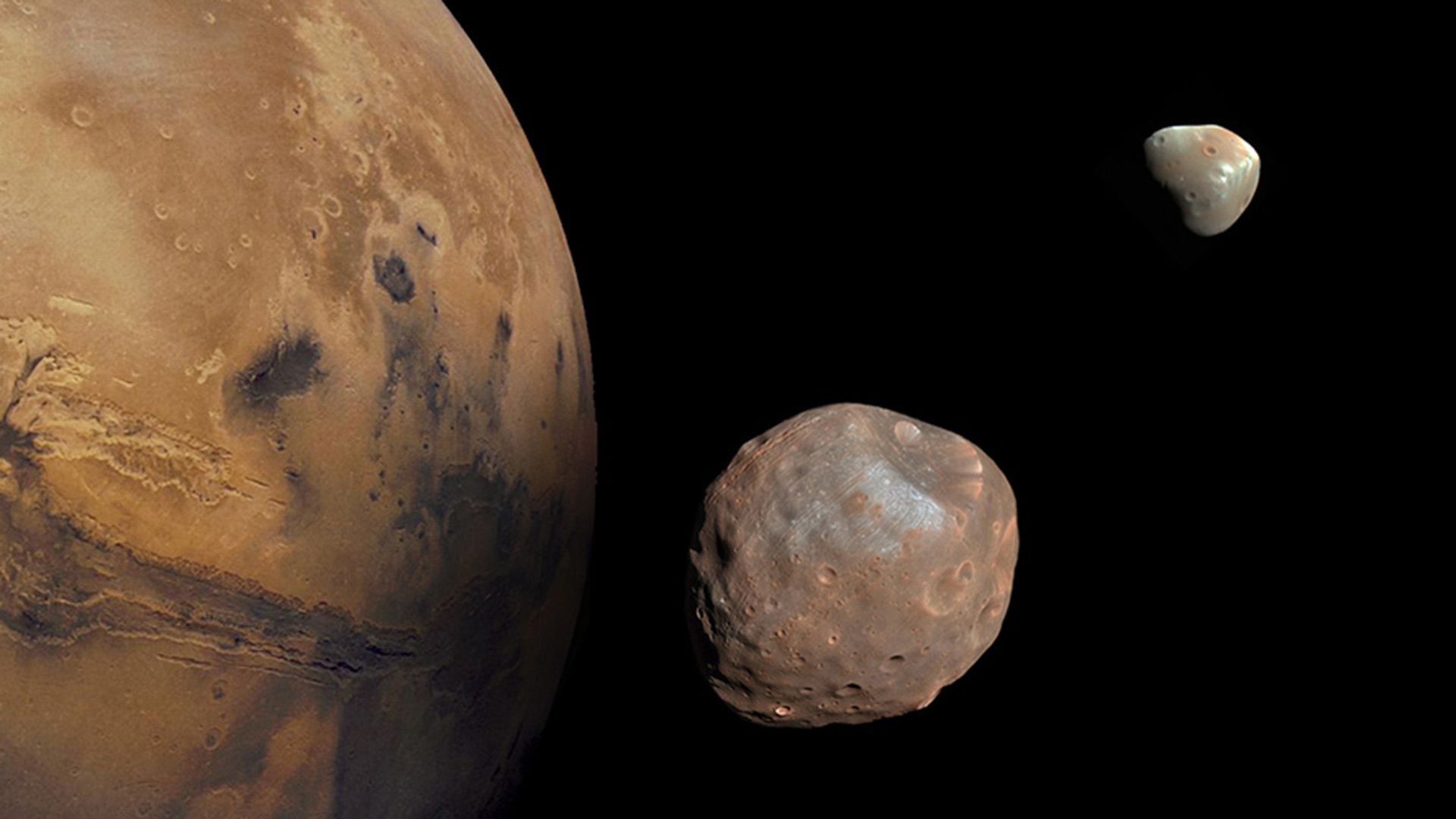
For nearly fifty years, the lumpy little moon orbiting far out from Mars has been keeping a secret. Deimos, the smaller and more distant of the Red Planet's two moons, has always looked wrong. It's shaped like a potato. One side is oddly smooth. There's a strange, shallow depression carved into its south pole that scientists have never been able to fully explain. And now, thanks to a nail-biting flyby by a European spacecraft on its way to a completely different asteroid, researchers think they've finally cracked the case — and the answer is far more violent than anyone expected.
According to a new study published this week in Nature Astronomy, Deimos was almost certainly reshaped by a single, powerful asteroid impact: a strike from a projectile roughly 320 meters wide — about the length of three football fields — slamming into the moon at an angle. The collision didn't shatter Deimos into pieces. Instead, it did something stranger: it scarred the moon, kicked up a haze of dust and debris that rained back down and blanketed the entire surface, and left behind unmistakable proof that Deimos isn't a solid chunk of rock at all. It's something closer to a loosely bound pile of gravel, held together by little more than its own weak gravity.
"Our simulation is consistent with patterns of brightness observed across the moon's surface, linked to the gradual migration of regolith that behaves more like loosely packed dust than anything more cohesive," said Dr. Sabina Raducan of the University of Bern, who led the research in collaboration with scientists from the Observatoire de la Côte d'Azur, the University of Arizona and the University of Tokyo.
In plain English: Deimos is basically a cosmic dust bunny. And that finding upends decades of assumptions about one of the solar system's most overlooked little moons.
A DETOUR THAT BECAME A DISCOVERY
The real hero of this story wasn't built to study Deimos at all. Hera is a European Space Agency spacecraft launched in October 2024 with a very different mission: to follow up on NASA's DART mission, which in 2022 deliberately slammed a spacecraft into the asteroid moonlet Dimorphos to test whether humanity could nudge a dangerous space rock off a collision course with Earth. Hera's job is to survey the aftermath of that impact up close, essentially acting as a crash investigator for planetary defense.
But to get to the Didymos-Dimorphos asteroid system, Hera first had to swing past Mars for a gravity assist — a cosmic slingshot maneuver that uses the planet's gravity to save fuel and adjust course. That flyby, which took place in March 2025, gave Hera's cameras and instruments a rare, close-up look at Deimos, a moon that has been visited by remarkably few spacecraft in the history of space exploration. Most of what scientists previously knew about Deimos came from grainy, distant images taken by orbiters that were primarily focused on Mars itself, not its moons.
This new study is the first scientific publication built on data gathered during that flyby, and it didn't disappoint. Using the flyby imagery combined with a powerful modeling tool called the Bern Smoothed Particle Hydrodynamics code — essentially a supercomputer simulation that can recreate asteroid collisions in exhaustive physical detail — the research team tested dozens of impact scenarios until they found one that matched what Hera actually saw.
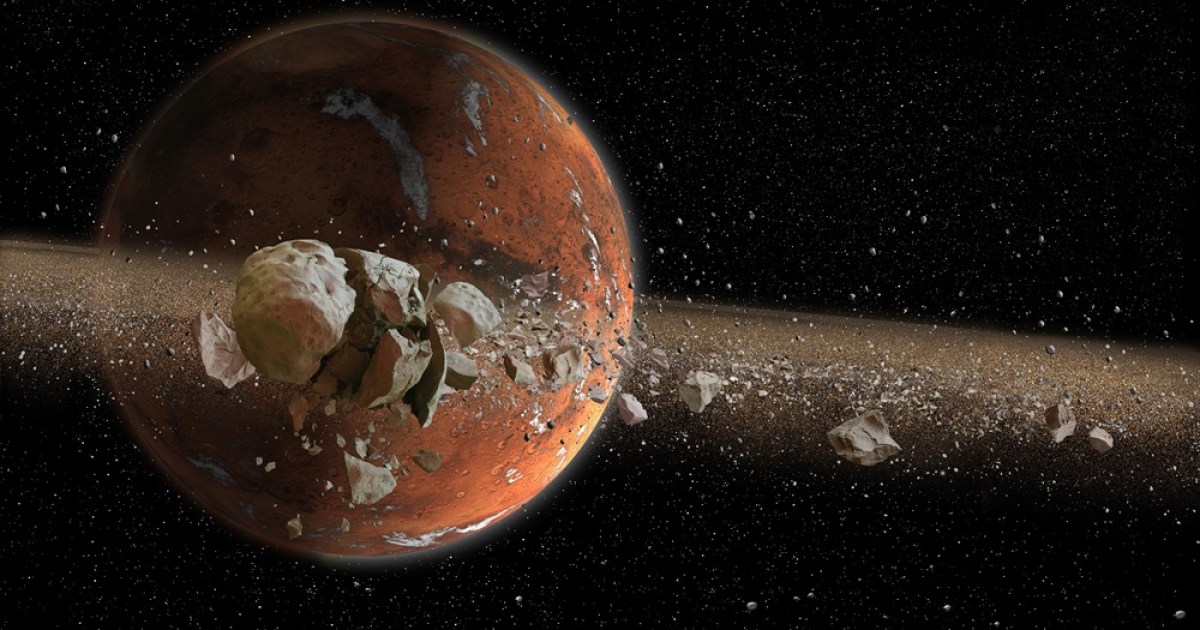
The winning scenario: an oblique impact, meaning the asteroid struck at a shallow, glancing angle rather than head-on. That single event, the simulations show, can account for practically everything strange about Deimos: the depression at its south pole, the moon-wide blanket of loose surface material known as regolith, the bright streaks that stripe its surface, and even the way debris appears to have partially filled in older, pre-existing craters.
WHY A "RUBBLE PILE" MATTERS
If Deimos really is a rubble pile — a body held together more by weak internal friction and gravity than by solid rock structure — it puts the little moon in the same category as some of the most closely studied asteroids in the solar system, including Dimorphos itself, along with Ryugu and Bennu, the two asteroids visited and sampled by Japan's Hayabusa2 and NASA's OSIRIS-REx missions in recent years.
That classification matters enormously to scientists for two reasons. First, it helps solve an old mystery about where Deimos and its sibling moon Phobos actually came from. For decades, planetary scientists have debated whether the two Martian moons are captured asteroids that wandered too close to Mars and got trapped by its gravity, or whether they're debris left over from a giant impact on Mars itself, similar to the way Earth's Moon is thought to have formed. A body that behaves like a loose rubble pile, shaped by later bombardment rather than born as a single solid chunk, adds important evidence to that ongoing debate.
Second, and just as importantly for planetary defense researchers, understanding how impacts behave differently on rubble-pile bodies versus solid rock is exactly the kind of knowledge that could someday matter for defending Earth. DART proved humanity can hit an asteroid hard enough to change its path. Hera and studies like this one are filling in the crucial follow-up question: what actually happens, physically, when you do that? A loosely packed pile of rubble absorbs and redistributes the shock of an impact very differently than a solid boulder would, which changes how engineers might calculate the force needed to deflect a genuinely hazardous asteroid barreling toward Earth in the future.
"The low surface cohesion required for the crater to collapse, and the high porosity and low interior crushing strength required to dissipate the impact shock, all point to the same conclusion," researchers noted in the study, emphasizing that the interior of Deimos dampened the shockwave from the strike rather than shattering outward.
Notably, the Hera flyby also revealed previously hidden craters on Deimos that predate the impact responsible for the south pole depression — meaning this violent chapter in the moon's history was not even its first brush with a major asteroid strike.

THE BIGGER PICTURE: A MOON NOBODY VISITS
Part of what makes this discovery so exciting to planetary scientists is simply how starved of data Deimos has been. Mars itself has been visited by dozens of orbiters, landers and rovers over the past six decades. Phobos, the larger and closer of the two Martian moons, has drawn its own share of attention, including a planned Japanese sample-return mission called MMX aimed at bringing pieces of it back to Earth. Deimos, by comparison, has largely been an afterthought — a faint, distant speck glimpsed only in passing by spacecraft with other priorities.
That obscurity is exactly what made the Hera flyby so valuable. Every image and data point gathered during those few critical hours as the spacecraft swung past Mars represented a meaningful fraction of everything humanity has ever directly observed about this little moon. Scientists effectively got a decades' worth of bonus science from a spacecraft that was just passing through on its way to somewhere else entirely.
EXPERT PERSPECTIVE
Beyond Dr. Raducan's team, the study has drawn attention from planetary defense specialists who see it as a template for how "opportunistic science" — squeezing extra research out of a spacecraft's incidental flybys — can pay off in unexpected ways. Researchers involved in the DART and Hera missions have long argued that studying how different asteroid and moon compositions absorb impacts is essential groundwork for any future mission that might need to deflect a real threat. This Deimos study, several scientists involved in the broader Hera mission have noted, effectively serves as a natural experiment: a real-world impact event, frozen in the geological record, that scientists can now use to calibrate and stress-test their models against actual observed outcomes rather than relying purely on theory.
The timing is notable too. Hera is still en route to Dimorphos, with its main scientific campaign at the Didymos-Dimorphos system expected to ramp up as it approaches its primary target. That means the mission has already delivered a major, headline-making scientific result before it has even reached the asteroid it was built to study — a reminder that in space exploration, some of the most valuable discoveries happen along the way, not just at the final destination.
WHAT THIS MEANS FOR YOU
You're not about to book a vacation to Deimos, but this discovery matters more than it might first appear. Planetary defense — the effort to detect and, if necessary, deflect asteroids that could threaten Earth — depends entirely on scientists correctly understanding how different kinds of space rocks respond to being hit. Get that physics wrong, and a real-world deflection mission modeled on DART could fail to move a genuinely dangerous asteroid enough, or could unpredictably fracture it into multiple smaller but still hazardous pieces. Every data point like this Deimos study, gathered from a real impact recorded in the geological record of an actual moon, makes those models sharper and the plans built on them more trustworthy.
It's also a small but pointed reminder of how much of the solar system remains genuinely unexplored. Mars has been photographed in obsessive detail for decades, yet one of its own two moons still held a fundamental mystery about its very structure until a spacecraft happened to fly past on its way somewhere else. There are almost certainly more surprises like this waiting in the solar system's overlooked corners.
CONCLUSION
Deimos may be small — barely 12.4 kilometers across at its widest point — but its secrets turned out to be anything but. A violent, glancing blow from a house-sized asteroid millions of years ago didn't destroy the moon; it revealed what Deimos was made of all along: not solid rock, but a fragile, loosely bound pile of rubble, dusted in a blanket of its own shattered debris. Thanks to a spacecraft that was only ever supposed to be passing through, humanity now understands its neighbor's neighbor a little better — and picked up a valuable new data point in the ongoing effort to make sure that if a real asteroid ever does have Earth in its crosshairs, we'll know exactly how to knock it off course.
Published By | Tech Wiz