Written By | Torch Media Africa
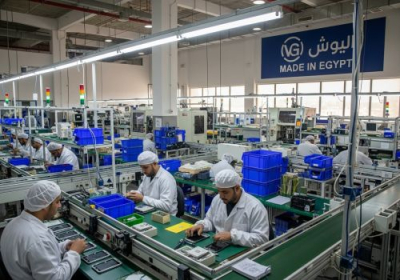
In about three years, Egypt has built the largest handset manufacturing base in Africa.
Technological Transformation
Most discussion of African technology focuses on software: fintech apps, startup funding rounds, cloud regions and AI strategies. Egypt is running a different experiment. In 10th of Ramadan City, east of Cairo, and in the Beni Suef governorate in Upper Egypt, factory lines are now producing millions of smartphones a year for brands including Samsung, Oppo, Vivo, Xiaomi, Nokia and Infinix. In about three years, Egypt has built the largest handset manufacturing base in Africa.
The numbers have grown quickly. Local production went from about 3 million phones in 2024 to around 10 million in 2025. The government expects output to exceed 15 million in 2026, roughly five times the 2024 level. Installed annual capacity is about 20 million units, and officials are targeting 30 million by 2028. By the government's count, 15 international brands now make phones and accessories locally, with about US$200 million of investment in new lines (Samsung's long-standing Beni Suef complex is counted separately). Fitch Solutions estimates that local assembly has cut imports of finished handsets by 97 per cent. It also forecasts that Egypt's handset market will grow from US$2.5 billion in 2025 to US$4.8 billion by 2031.
The central question is which parts of each phone Egypt actually makes. The answer will decide whether this becomes a real electronics industry or stays a large, protected assembly operation.
The policy architecture: Egypt Makes Electronics
The expansion was planned. It is the flagship result of Egypt Makes Electronics, a state strategy run by the Ministry of Communications and Information Technology and its industry-development agency, ITIDA. In its 2026 review of Egypt's innovation policy, the OECD describes the programme as an attempt to move Egypt from consuming electronics to manufacturing, designing and exporting them for Arab, African and European markets.
The policy uses both incentives and import restrictions:
Officials said the exemption could be removed because local capacity had caught up with demand. Ending it also closed a major smuggling route and recovered lost tax revenue. Together, the two sets of measures make it cheaper to build phones in Egypt and more expensive to bring them in.
The factories
Each of the three anchor investments shows a different stage of industrial depth.
Samsung (Beni Suef). Samsung was in Egypt long before the current push. It says its total investment in the Beni Suef complex has passed US$700 million, including US$85 million spent between 2022 and 2024 on phone and tablet production. Reported capacity is about 6 million devices a year. The site also manufactures circuit boards, not just final assembly, which makes it the deepest operation in the country.
Vivo (10th of Ramadan City). Vivo opened its plant in 2022 with an investment of about US$20 million. ITIDA rates it at up to 500,000 units a month, with about 1,200 direct and indirect jobs and local value added of around 42 per cent. Vivo's most significant step for Egypt has been making smartphone motherboards locally and exporting them to its operation in Turkey. That is an early sign that Egyptian factories can take part in cross-border electronics supply chains, not only serve the domestic market.
Oppo (10th of Ramadan City). Oppo opened in October 2025 as part of a roughly US$50 million investment programme. The 24,000-square-metre plant started with 17 production lines producing about 400,000 phones a month, and the company has said it will expand to 20 lines. It reports local value added above 42 per cent and has named Arab markets as export targets.
Xiaomi, Nokia and Infinix produce through local industrial partners such as El-Safi Industrial Group and SICO, and some of this output is already exported to North African neighbours.
The export ledger is still small
Exports show both how far the project has come and how far it still has to go. According to the Cabinet Media Centre, Egypt's exports of mobile phones and components rose from just US$129,000 in 2019 to US$12 million in 2024, an increase of more than 90 times. Measured against a domestic market worth about US$2.5 billion, though, US$12 million is very small. So far, Egypt's phone industry mainly replaces imports. It does not yet earn much from exports.
That matters because of Egypt's chronic shortage of foreign currency. Local assembly reduces imports of finished phones, but the factories still pay in dollars for chips, displays, memory, camera modules and batteries. The Middle East Observer notes that electronics and engineering goods have become an important source of non-petroleum exports, but they account for an even larger share of non-petroleum imports. The useful measure is not how many phones carry a "Made in Egypt" label. It is how much foreign currency each locally made phone saves or earns once imported parts are subtracted. For an economy that has spent much of the past three years managing currency shortages under an IMF programme, that figure matters more than unit counts.
Who pays: the consumer side of protection
Protection has a cost, and Egyptian consumers are paying it. After the travellers' exemption ended in January 2026, the Mobile Phone Traders Division of the Giza Chamber of Commerce reported that prices of locally made smartphones rose by an estimated 5 to 15 per cent. Oppo and Honor were among the first brands to raise prices. The division's head, Mohamed El-Haddad, called the increases excessive given that manufacturers already receive state incentives. He urged the Competition Protection Authority and the Consumer Protection Agency to watch prices more closely.
Traders also want the government to stop classifying smartphones as luxury goods, a category that adds taxes and customs costs. They argue that phones are now essential, especially as Egypt's education system relies more on digital platforms. This is the main risk of an import-substitution strategy. If foreign competition is shut out and domestic producers compete weakly with each other, the gains go to factory owners rather than to the households whose connectivity the digital economy relies on.
Moving up the value chain
Egypt does not need a semiconductor fab to build a competitive electronics sector. Very few countries have one. The realistic next steps are in the middle of the value chain:
Incentive design will shape which of these happens. If support mainly rewards factory capacity and the number of finished units, manufacturers can hit their targets while continuing to import every sophisticated input. Incentives linked to supplier development, rising local-content thresholds over time, engineering jobs and export performance would push firms to deepen production. The fixed 40 per cent local-value rule, which the anchor plants already exceed, may soon be too low a bar.
Why it matters for the continent
Egypt's experiment is relevant across Africa. Smartphone affordability remains one of the biggest obstacles to digital inclusion on the continent. In several markets, an entry-level device costs a large share of a poor household's monthly income. If Egypt can become a competitive, export-oriented assembly hub and use AfCFTA preferences, its Suez location and its access to European and Gulf markets, it could supply cheaper devices to African markets now served mostly from Asia. If the industry instead depends on high tariffs at home, it will make phones more expensive for Egyptians and do little for anyone else.
What to watch
In three years, Egypt has shown that global brands will build phones there at scale. The harder part is making sure the most valuable work in each device is done in Egypt too.



