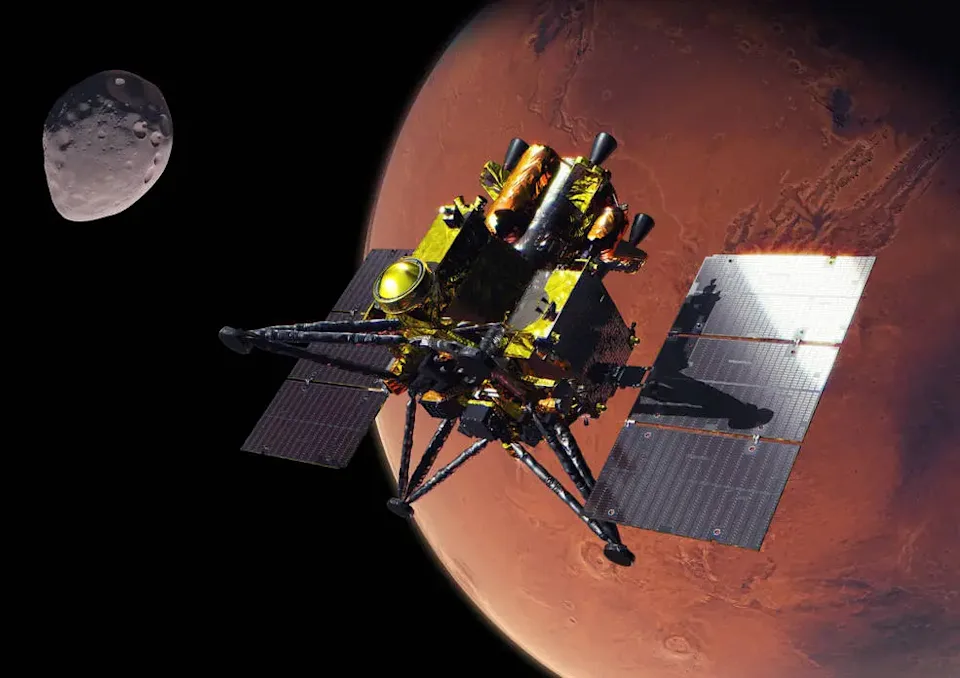
The MMX probe is racing toward Phobos with a bouncing German-French rover, two sample-grabbing machines and a mission to bring home 10 grams of alien dirt by 2031 — in a place where earlier missions have crashed, gone silent or never left Earth.
TANEGASHIMA, JAPAN
Liftoff at dawn
A pre-dawn thunderclap rolled across the southern Japanese island of Tanegashima this week, and a spacecraft the size of a small room began a journey that nobody has ever completed. At 4:41 a.m. local time on Tuesday, 20 October 2026 (3:41 p.m. Eastern time on 19 October), Japan's H3 rocket in its powerful H3-24L configuration climbed away from the Tanegashima Space Center carrying the Martian Moons eXploration probe, known to space fans as MMX.
Just over an hour later, controllers at the Japan Aerospace Exploration Agency (JAXA) got the news they had been praying for. According to Sky & Telescope, the probe separated from the rocket 1 hour and 11 minutes after liftoff, and JAXA confirmed it had received the expected signals showing the spacecraft was healthy and 'beginning its journey toward the Martian system.' The launch itself, by all accounts, was flawless.
For a country that has sent spacecraft to asteroids and returned their dust to Earth, this mission is something altogether more daring. MMX is heading not for a lump of rock floating between planets but for the Martian neighbourhood, to land on a tiny, potato-shaped moon, scoop up its surface and fly the loot all the way home. If it works, Japan will have pulled off the first round trip to the Martian region in history.

The mission in a nutshell
The goal is simple to state and fiendishly hard to execute. MMX will travel for roughly ten months, arriving at Mars around August 2027. It will settle into a so-called quasi-satellite orbit that keeps it close to the Martian moons, spend time surveying Phobos and Deimos, then drop a lander onto Phobos to collect at least 10 grams of surface material. The sample capsule is due back on Earth in 2031, touching down at the Woomera site in Australia, where the Australian space agency will handle recovery.
Ten grams may not sound like much, but to planetary scientists it is a jackpot. Sky & Telescope reports that one gram will go straight to Japanese and international researchers, while the remaining nine will be stored at JAXA's Extraterrestrial Sample Curation Center in Sagamihara for study by generations of scientists.
The price tag, according to Interesting Engineering, is about $578 million. That makes MMX a serious investment, and one with serious international fingerprints on it. NASA, the European Space Agency, France's CNES and Germany's DLR have all contributed hardware, expertise or communications support. NASA and ESA will use their Deep Space Network and Estrack antennas to keep in touch with the probe across the void.
A mystery older than the Martian canals
Why go to all this trouble for two lumpy moons? Because nobody knows where they came from. Astronomer Asaph Hall discovered Phobos and Deimos in 1877, and for nearly a century and a half they have defied explanation.
One theory says they are captured asteroids, wanderers that strayed too close to Mars and were trapped by its gravity. The rival theory says they were born from debris thrown into orbit when a giant object smashed into the Red Planet billions of years ago, much as Earth's Moon is thought to have formed. The two ideas predict different chemistry. Capture would leave the moons looking like primitive asteroids; an impact would leave them looking more like Mars itself.
Only a real sample can settle the argument, and the answer matters far beyond two small moons. Understanding how Mars acquired its satellites could reveal how rocky planets and their moons form across the galaxy, and what happened in the violent early days of our own solar system.
Meet the machines
MMX is a Swiss Army knife of a spacecraft. Its star hardware includes a pair of sampling devices, a tiny rover and instruments from three continents.
The first sampler, called P-Sampler, was built by Honeybee Robotics and is a copy of the PlanetVac device that recently flew to the Moon on Firefly's Blue Ghost lander. It uses puffs of pressurized nitrogen gas to blast loose surface dust and capture it in seconds. The second, JAXA's C-Sampler, is a coring device designed to drill for material beneath the surface. Having two ways to grab dirt provides a vital backup if one fails.
Then there is Idefix, the 25-kilogram German-French rover built by DLR with CNES. Idefix will be released from about 40 metres above Phobos and will bounce, tumble and roll across the surface on four wheels. It can right itself if it lands upside down, though soft soil or boulders could still strand it. During its expected 100 days of work it will beam back images, temperature readings and mineral data from a Raman spectrometer, scouting the safest landing sites for the main spacecraft. It is the first vehicle ever to attempt to travel across the surface of Phobos.
NASA contributes MEGANE, a gamma-ray and neutron spectrometer built at Johns Hopkins Applied Physics Laboratory that will read the moon's elemental make-up, a key clue to its origins. CNES supplies a near-infrared spectrometer to analyse minerals from orbit.
Why Phobos is a nightmare to land on
Phobos is roughly 27 kilometres long and whips around Mars every 7 hours and 39 minutes. Its gravity is so feeble that a careless touch could send a spacecraft bouncing away like a beach ball. The surface may be covered in fine, powdery regolith, boulders, or both.
The moon is also living on borrowed time. Its orbit is slowly shrinking, and scientists expect Phobos to be torn apart or to crash into Mars in 30 to 50 million years. Its sibling Deimos, about 16 kilometres across and taking 30 hours per orbit, is drifting gradually away. MMX will fly past Deimos several times rather than land on it, using the flybys to compare the two worlds.
The history of attempts to reach Phobos is sobering. Soviet Phobos 1 was lost on its way in 1988, and Phobos 2 fell silent in 1989 when it was just 50 metres from the surface. Russia's Phobos-Grunt never left Earth orbit in 2011. Even Japan's own first Mars mission, Nozomi, failed to enter orbit and ended in 2003. Phobos has earned its reputation as a spacecraft graveyard.
The long road ahead
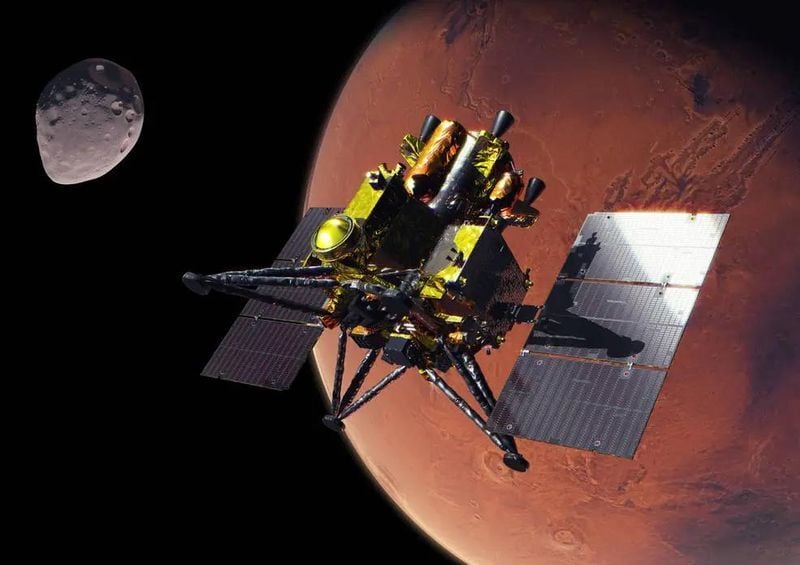
MMX's schedule is a marathon. After arriving in August 2027, the spacecraft will spend months studying the moons from close range. Interesting Engineering reports that two landing attempts are planned for late 2028 or 2029, with the lander touching down briefly on Phobos before lifting off again. The probe will then spend about a year around Mars making passes by Deimos before leaving the Martian system around November 2030 and returning to Earth in 2031.
That timetable matters because of a space race that has quietly sprung up. The Kuwait Times notes that NASA's plan to bring home samples collected by the Perseverance rover has effectively been cancelled, while China's Tianwen-3 mission, due to launch around 2028, hopes to return Mars samples as early as 2031. The Phobos sample could therefore be among the first material returned from the Martian system, though Chinese hardware may land first.
Another spacecraft is also on its way. According to Sky & Telescope, the ESCAPADE mission is still travelling to Mars and should arrive around September 2027, shortly after MMX.
What the scientists are watching
The scientific logic behind the mission is elegantly simple. The NASA-built MEGANE instrument exists precisely because the two origin theories predict different compositions, so measuring what Phobos is made of can tip the scales. And laboratory analysis of returned grains on Earth can measure things that no spacecraft instrument can, from precise isotope ratios to tiny organic compounds.
JAXA also has form. Its Hayabusa and Hayabusa2 missions successfully returned samples from the asteroids Itokawa and Ryugu, showing the agency can pull off tricky small-body touch-and-go operations. Phobos is harder: a deeper gravity well, a more complex trajectory and a much longer trip. But the rocket that launched MMX, the H3, has also matured into a dependable workhorse, and its flawless performance this week will be reassuring.
What this means for you
You will not feel the effects of MMX in your wallet next week, but this mission touches everyday life in surprising ways. The technologies being tested, from gas-puff sample collectors to bouncing rovers that can right themselves, feed into robotics, autonomous navigation and materials science that eventually reach industry. International partnerships like MMX also keep scientific cooperation alive at a time when space politics is tense.
For the dreamers, there is a bigger prize. JAXA describes Phobos as a possible 'natural space station' for future human Mars missions. A moon with almost no gravity could serve as a safe parking spot, a radiation-shielded base and a refuelling stop. Knowing what Phobos is made of, and whether it holds water ice or useful minerals, could shape how and when humans ever go to Mars.
And there is the simple wonder of it. Within a decade, a small pot of dust from another world's moon could be sitting in a Japanese laboratory, being examined by schoolchildren's future teachers. It is the sort of thing that makes you look up.
The verdict
Many things must go right for MMX to succeed. It must survive nearly a year in deep space, enter its tricky orbit at Mars, deploy a rover that may or may not land on its wheels, land on a surface nobody has touched, scoop its sample and then make the long haul home. Phobos has humbled space agencies before.
But the first step has been taken, and it was a perfect one. A rocket flew true, a spacecraft is healthy and the clock is ticking toward August 2027. Somewhere out in the dark, a small Japanese probe is heading for a doomed little moon with a bucket and a big question. The world will be watching.
Published By | Tech Wiz