Written By | Torch Media Africa
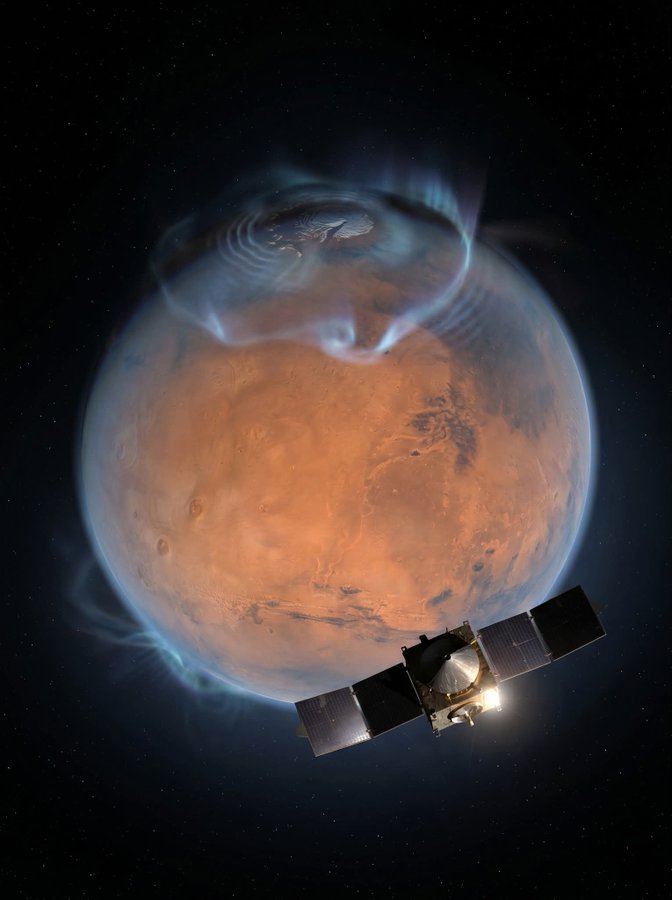
Scientists at the University of Colorado Boulder now say it's the first definitive physical evidence of a colossal "lost" world—possibly as large as Mars—that once circled the young Sun.
BOULDER, COLORADO
It looked unremarkable: a dark, fist-sized chunk of rock dug from the Sahara in 2019. But scientists at the University of Colorado Boulder now say it's the first definitive physical evidence of a colossal "lost" world—possibly as large as Mars—that once circled the young Sun.
"We only know it existed because a few fragments of it happened to land on Earth," said assistant research professor Aaron Bell, lead author of a study published this month in Earth and Planetary Science Letters.
The Rock That Shouldn't Exist
The meteorite, cataloged as NWA 12774, belongs to a rare family called angrites—some of the oldest volcanic rocks in the solar system, formed just a few million years after the first solid material condensed. But this specimen stood out. Inside, researchers found clinopyroxene crystals unusually rich in aluminum, a chemical signature that only forms under enormous pressure—at least 17.5 kilobars, according to lab experiments.
That kind of pressure doesn't occur in asteroids or dwarf planets. It happens deep inside something genuinely big.
Yet the crystals also had sharp, unweathered edges—meaning they formed near the surface and were quickly ejected into space. The only way to reconcile deep pressure with a shallow resting place is if the parent body was enormous. Bell's team calculated its radius at between 1,118 and 2,050 miles—somewhere between the Moon and Mars. In other words: not an asteroid. A protoplanet.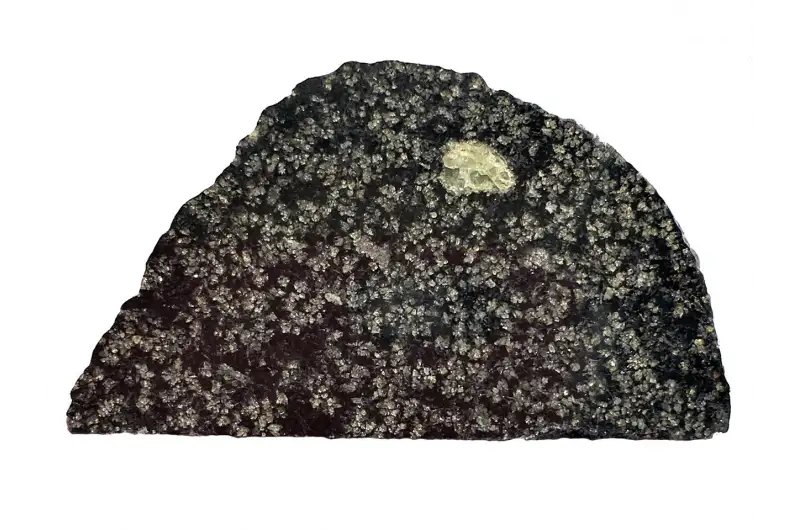
A Solar System Full of Ghosts
Rewind 4.5 billion years, and the young solar system was a chaotic demolition derby crowded with dozens of planetary embryos. Most didn't survive—they were absorbed, ejected, or shattered. The Moon itself is believed to have formed from a Mars-sized impactor called Theia slamming into early Earth.
Scientists have long suspected these "lost" worlds existed, but proof requires a literal piece of the body. NWA 12774 clears that bar: its chemistry doesn't match Earth, Mars, or Vesta (the only other body linked to angrites). "It points to a distinct and separate evolutionary path," Bell said.
Cain and Abel, But Make It Planets
How did this Mars-sized world die? The leading theory: it was hit by something else. A collision with another large embryo would have shattered its outer layers, exposing deep material (those high-pressure crystals) while freezing them in pristine condition before they could be altered. The wreckage scattered across the inner solar system—some of it likely ending up inside Earth itself.
Expert Perspective
Researchers have long suspected the angrite parent body was Moon-to-Mars scale based on isotopic and magnetic data. NWA 12774 adds a specific physical pressure signature, turning suspicion into something close to physical proof. "First definitive evidence" doesn't mean absolute certainty—a single meteorite is still one data point—but it's about as strong as planetary science gets.
What This Means for You
Every atom in your body heavier than hydrogen was forged in stars or the wreckage of planetary collisions. Earth itself is a survivor built from the rubble of worlds that didn't make it. Understanding these ancient catastrophes helps answer why our solar system turned out the way it did—and helps astronomers interpret the debris disks and planetary systems they observe around other stars.
Conclusion
NWA 12774 now sits in a research collection—a small, unassuming rock that happens to be the only known eyewitness to a planet's death. Scattered across the asteroid belt, inside Mars, and quite possibly beneath your feet, the rest of that vanished world is still out there, in a billion forgotten pieces. Scientists now have their first confirmed fragment of the headstone.



