Written By | Torch Media Africa
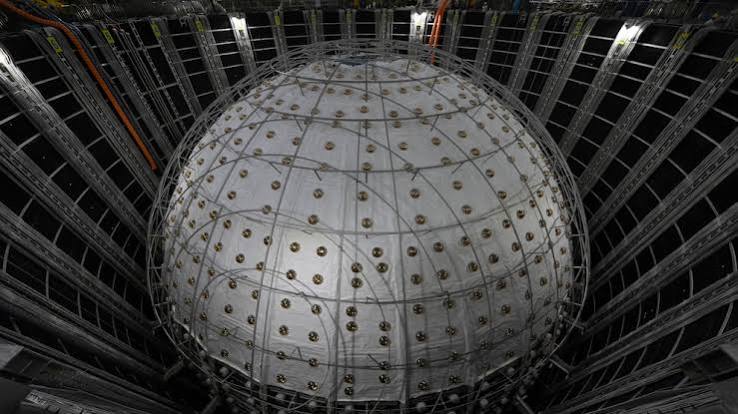
Pictures: The Jiangmen Underground Neutrino Observatory, or JUNO
GUANGDONG PROVINCE, CHINA
Right now, as you read this, approximately 400 trillion neutrinos from the Sun are passing through your body. They enter through your head. They exit through your feet. They do not care that you exist. They are, in the blunt assessment of physicists, the most antisocial particles in the universe — and for nearly a century, they have been among the least understood.
That century of confusion got shorter on June 10, 2026, when Nature — the world's most prestigious scientific journal — handed its cover to an experiment most people have never heard of: the Jiangmen Underground Neutrino Observatory, or JUNO.
Buried 700 meters beneath a mountain in southern China, JUNO used just 59 days of data to produce measurements of neutrino behavior that are 1.6 times more precise than every previous neutrino experiment in history — combined.
"JUNO ushers in the next generation of neutrino experiments," Nature declared. The scientific community, rarely given to superlatives, largely agreed.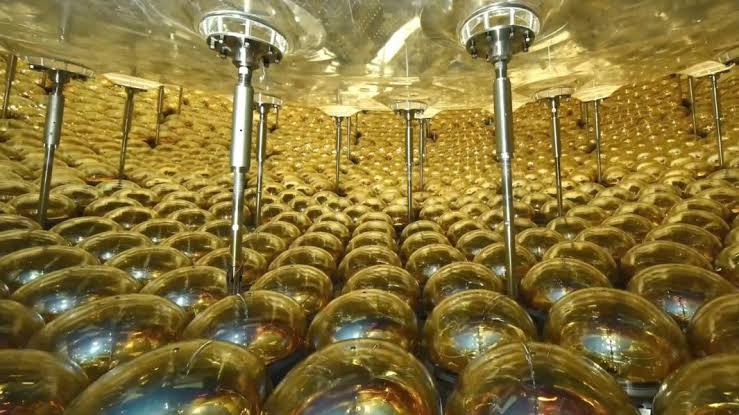
Meet the Ghost Particle
Neutrinos are fundamental building blocks of matter, produced in enormous quantities by the Sun, nuclear reactors, and exploding stars. They are the most abundant fundamental particles in the universe after photons — yet they are extraordinarily difficult to detect.
They carry no electric charge. They have almost vanishingly small mass. A neutrino can pass through a light-year of lead — 9.5 trillion kilometers — and still emerge unscathed. To catch even a handful, a detector must be enormous and exquisitely sensitive.
The other maddening thing: neutrinos oscillate. A neutrino born as one "flavor" transforms into another mid-flight and back again. Understanding this quantum dance has been a central challenge of particle physics.
Inside the Machine: An Underground Cathedral
JUNO is an engineering marvel. At its heart sits a 35.4-meter acrylic sphere — the size of a seven-story building — filled with 20,000 tonnes of ultra-pure liquid scintillator. Surrounding it are 43,000 photomultiplier tubes, all submerged in a 44-meter-deep water pool 700 meters underground, shielded from cosmic rays.
JUNO is twenty times larger than any previous detector of its type. Its primary neutrino source is not the Sun but nearby nuclear power reactors, positioned exactly 53 kilometers away — the ideal distance to reveal the particles' mass properties.
The Results: 59 Days That Changed Physics
JUNO began operations on August 26, 2025. In just 59 days, it measured two key oscillation parameters with precision 1.6 times better than every previous neutrino experiment — from Super-Kamiokande to Borexino — over decades of work, combined.
Every neutrino observatory ever built collectively achieved a certain precision. JUNO, in two months, beat them by 60%.
But this is just a calibration exercise. The true goal is still ahead.
The Ultimate Goal: Cracking the Mass Hierarchy
We know neutrinos have mass — a Nobel Prize was awarded for that. But we don't know the order of those masses. Is the heaviest one on top (normal hierarchy) or on the bottom (inverted hierarchy)?
This sounds technical, but it touches on the deepest questions: how matter was distributed in the early universe, and why matter exists at all instead of nothing but antimatter.
JUNO is uniquely positioned to answer this. Scientists estimate it will need about six years of data — through the early 2030s — to make a definitive determination. Given that the first 59 days outperformed expectations, the answer may arrive on schedule.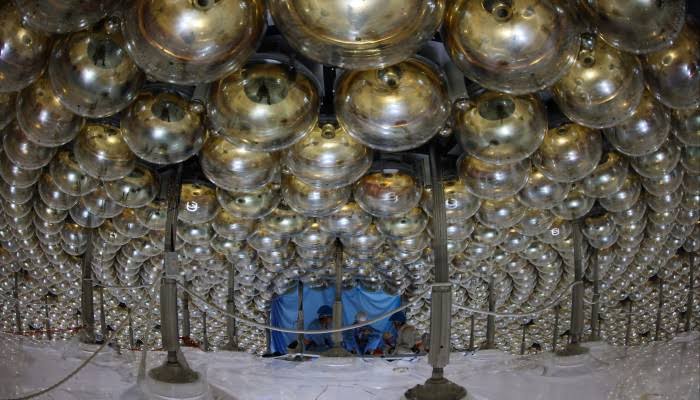
What This Means for You
The honest answer: the immediate practical consequences are limited. Neutrinos don't power anything. They can't be weaponized.
But the history of science is a history of basic research that seemed impractical at the time and proved transformative later. Quantum mechanics made your smartphone work. Electromagnetic theory powers the grid. Understanding the neutrino mass hierarchy could unlock physics beyond the Standard Model — and lead to technologies we cannot yet imagine.
More immediately, JUNO is a statement about global science. China has invested enormously in fundamental research, and landing the cover of Nature is a measure of its success.
A Question Older Than Quantum Physics
The neutrino was first proposed in 1930 by Wolfgang Pauli as a "desperate remedy." It was confirmed in 1956. It took another 39 years to prove it has mass. And now, 70 years after its discovery, we still don't know the full shape of that mass.
Deep beneath the mountains of Guangdong, 43,000 light sensors arrayed around a cathedral of acrylic and liquid scintillator are reading the faint flashes made by those elusive particles — 400 trillion of which just passed through your body as you read this sentence.
The first answer has arrived, and it is already the most precise in history. The most important one is still coming.



