A decade-old mystery that scientists thought they'd finally solved just got blown wide open again — and this time, the machines did the digging
VIENNA, AUSTRIA / BERKELEY, CALIFORNIA
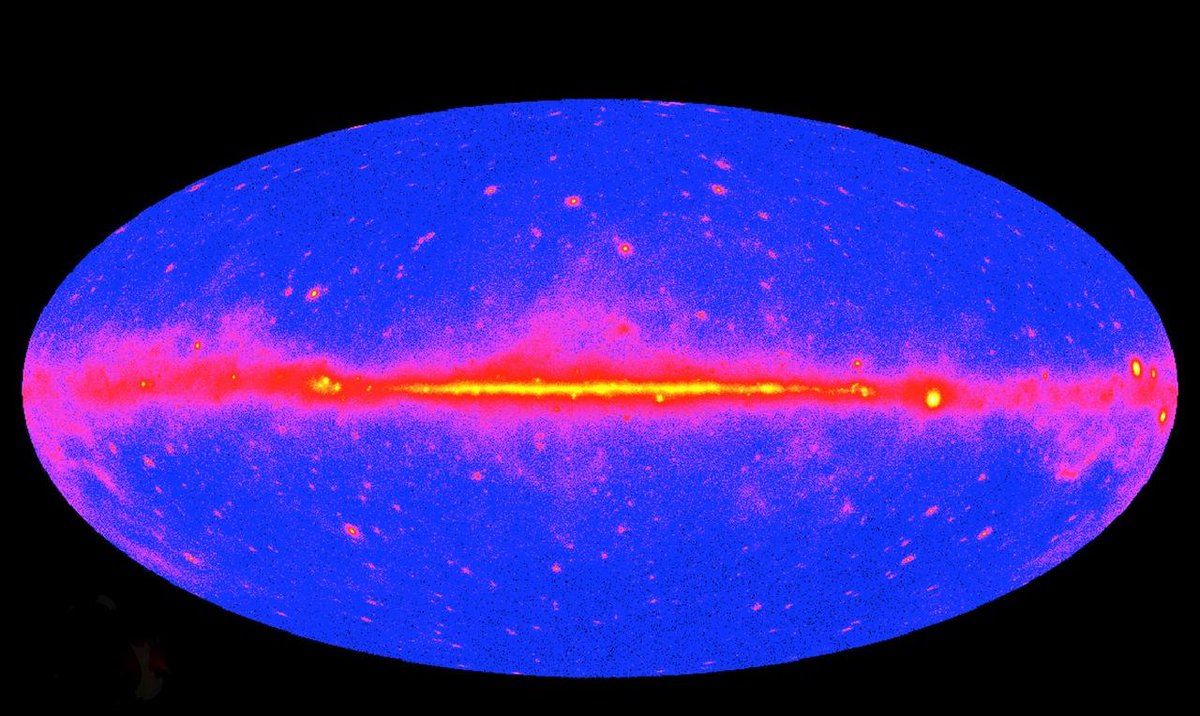
For more than ten years, there has been a strange, stubborn glow coming from the exact center of our own galaxy — a soft haze of gamma rays, the most energetic light in the universe, pooling right around the supermassive black hole at the Milky Way's core. Nobody disputes that it's there. What nobody has been able to agree on is what's making it.
Now, a team of physicists from the University of Vienna and Lawrence Berkeley National Laboratory has thrown a machine-learning model at the problem — training it on more than a million simulated gamma-ray observations — and come back with an answer that scientists on one side of a decade-long argument really did not want to hear: dark matter is still on the table. Not just plausible. Not ruled out. Very much still in the running to explain one of the most tantalizing signals in modern astrophysics.
The findings, published in the journal Physical Review Letters, don't prove dark matter is real. But they do something almost as dramatic in the slow-moving world of astrophysics: they yank the rug out from under the theory that was, until recently, treated as the more boring, more probable answer.
The mystery at the center of everything
Here's the setup. Deep in the heart of the Milky Way, roughly 26,000 light-years from Earth, sits Sagittarius A*, our galaxy's resident supermassive black hole. Surrounding it, astronomers have long observed a diffuse, roughly spherical glow of gamma rays — a signal so understated it took years of data from NASA's Fermi Gamma-ray Space Telescope even to confirm it was really there, and not some artifact of instrument noise or background contamination. Scientists call it, with admirable directness, the Galactic Center Excess, or GCE.
From the moment it was confirmed, the GCE became one of astrophysics' great "choose your fighter" debates, because there are exactly two serious explanations for it, and they could not be more different in what they'd mean for our understanding of the universe.
Explanation one: dark matter. The invisible, undetected substance that makes up roughly 85% of all matter in the universe, dark matter is believed by many physicists to be capable of "annihilating" — colliding with itself and converting into ordinary particles, including gamma rays — when it clusters densely enough. And nowhere in the galaxy is dark matter thought to be denser than right at the gravitational core, where the Milky Way's mass funnels inward. If the GCE really is dark matter annihilating, it would be the first-ever direct observational evidence of dark matter interacting with itself anywhere in the universe — a genuine, Nobel-tier discovery.
Explanation two: pulsars. Specifically, millisecond pulsars — the ultra-dense, rapidly spinning corpses of collapsed stars, some rotating hundreds of times per second, flinging out beams of gamma radiation like cosmic lighthouses. A large-enough hidden population of these faint, unresolved pulsars packed into the galactic core could, in theory, blur together into exactly the kind of diffuse glow astronomers see. This explanation is less thrilling, but it's the safer bet: pulsars are known to exist, dark matter annihilation has never been directly observed anywhere.
For the past several years, the pulsar explanation had been winning. A wave of analyses through the early-to-mid 2020s found that the glow's shape looked "clumpy" rather than perfectly smooth — a texture consistent with a swarm of individual point sources like pulsars, rather than the buttery-smooth signal you'd expect from an evenly distributed haze of annihilating dark matter. The scientific consensus was drifting steadily toward "boring answer, case mostly closed."
Enter the machine
The Vienna-Berkeley team, led by Florian List at the University of Vienna and Nick Rodd at Lawrence Berkeley National Laboratory, went back to that "clumpy" evidence with a more sophisticated tool: machine learning trained not just on where the gamma-ray photons landed in the sky, but on their individual energies too — a level of detail earlier statistical analyses of the GCE had never fully incorporated.
That's a bigger deal than it sounds. Earlier methods essentially asked, "does this patch of sky look grainy or smooth?" The new approach asked a much richer question: given everything we know about how real pulsars behave — their energy spectra, their expected brightness distribution, their known population statistics from the pulsars we actually can detect — how many hidden pulsars would it actually take to produce this exact signal, done convincingly, texture and energy both included?
The algorithm's answer stunned even researchers already skeptical of the pulsar explanation. To account for the observed signal purely through pulsars, the model calculated, the galactic core would need to be hiding at least 35,000 individual millisecond pulsars — a figure that dwarfs the "few hundred to few thousand" that earlier, cruder analyses had assumed was sufficient.
That's not a small revision. That's an order-of-magnitude leap that strains credibility on its own terms. Thirty-five thousand undetected pulsars, tightly packed into the galaxy's central few hundred light-years, all individually too faint to spot directly, all conveniently arranging themselves into a signal that looks exactly like what dark matter annihilation would produce — it's the kind of number that makes physicists uncomfortable in both directions. It's implausibly high for the pulsar camp to explain away easily, and yet it's also not proof dark matter did it. It just means the "easy," "boring" explanation isn't actually easy or boring anymore.

What the scientists are actually saying
The research team has been careful — almost pointedly careful — not to overclaim a discovery. Their framing, consistent across the announcement materials, is one of reopening a question rather than answering it: the analysis shows dark matter "cannot currently be ruled out" as an explanation, language that is deliberately, scientifically modest, but that lands as a genuine reversal after years of momentum running the other way.
Commentary on the findings has emphasized just how uncomfortable the new pulsar numbers are. Requiring an "invisible army" of 35,000 pulsars to explain a signal — when not one of those individual pulsars has ever been directly detected in the region — represents a serious credibility problem for what had become the field's preferred explanation. It doesn't resurrect dark matter as the leading theory outright, but it drags the argument back to something close to a coin flip, undoing years of analysis that had tilted the scales toward pulsars.
It's worth being clear about what this study is and isn't. It's not a new telescope observation. It's not new gamma-ray data. It's a new, more rigorous statistical re-analysis of data astronomers already had, using AI to extract more signal from noise than earlier statistical tools could manage. That distinction matters for how much weight to put on it — but it also underscores something bigger happening across physics right now: machine learning isn't just accelerating discovery, it's forcing scientists to go back and re-check conclusions they thought were settled, because the old tools simply weren't sensitive enough to catch what the new ones can see.
The next move: an even bigger eye on the sky
Neither side of this debate expects the argument to be settled by statistics alone, and relief is reportedly on the way. Later this year, the Cherenkov Telescope Array — an enormous, next-generation gamma-ray observatory built from dozens of dish-shaped telescopes split across sites in the Canary Islands and Chile — is expected to begin science operations. Unlike the space-based Fermi telescope that first spotted the GCE, CTA observes from the ground, detecting the faint flashes of light produced when gamma rays slam into Earth's atmosphere, and it will do so with vastly greater sensitivity and resolution than anything used to study the galactic center before.
Physicists working on CTA have specifically designed parts of its observing program to settle exactly this dispute: after a relatively modest observing campaign pointed at the galaxy's inner core, the array should be sensitive enough to either directly detect individual millisecond pulsars in the region — confirming the "boring" explanation once and for all — or rule out the pulsar population entirely, leaving dark matter annihilation as the last theory standing. It's a genuine put-up-or-shut-up moment for a debate that has run for more than a decade on statistics and inference alone.
Expert perspective: why physicists are both excited and annoyed
Ask a physicist how they feel about this result and you'll likely get a complicated answer, because the finding is scientifically thrilling and professionally inconvenient at the same time. Thrilling, because if dark matter really is behind the GCE, it would represent the first direct observational hint of dark matter self-interaction ever recorded — arguably the biggest open question in modern physics, suddenly cracked open by a signal that's been sitting in plain sight in our own cosmic backyard the whole time. Inconvenient, because an entire subfield had begun converging on the pulsar explanation, publishing papers, building careers, and shaping the next decade of research proposals around an answer that a smarter statistical model just quietly pulled the floor out from under.
That tension is, in many ways, exactly how science is supposed to work — but it rarely feels comfortable in the moment. Nobody enjoys being told their settled question is unsettled again, especially when the culprit is a machine learning model that can see patterns human researchers, working with older tools, genuinely could not.
What this means for you
You will not feel dark matter tomorrow morning. Nothing about your commute, your job, or your bank account changes because of a gamma-ray glow 26,000 light-years away. But this story matters for a more foundational reason: roughly 85% of all the matter in the universe is dark matter, and despite decades of dedicated search — underground detectors, particle colliders, space telescopes — humanity has never directly observed it interacting with anything. Every galaxy, every star cluster, every cosmic structure in the universe is shaped by dark matter's gravity, and yet we still don't know, at a basic physical level, what it actually is. A confirmed detection at the galactic center wouldn't just close one astrophysics debate — it would be one of the most significant scientific discoveries of the century, reshaping particle physics, cosmology, and our basic understanding of what the universe is made of.
It's also a quietly important story about how science gets done in 2026. The breakthrough here didn't come from a new telescope, a new experiment, or a new particle collider. It came from feeding old data into a smarter algorithm and asking better questions of it — a preview of how machine learning is increasingly becoming as important a research instrument as the telescopes themselves.
Conclusion: the coin is back in the air
For a few years, it looked like the smart money on the galaxy's strangest glow had settled on pulsars — a satisfying, if slightly deflating, resolution to a mystery that once promised something much bigger. The Vienna-Berkeley team's machine-learning re-analysis has undone that comfort, dragging the debate back to somewhere near even odds and, in doing so, keeping alive the tantalizing possibility that the answer to one of physics' biggest open questions has been glowing quietly at the center of our own galaxy the entire time, waiting for someone — or something — smart enough to notice.
The Cherenkov Telescope Array will start listening later this year. Sometime in the next few years, one side of this argument is going to lose, decisively, for the first time in a decade. Until then, the glow at the heart of the Milky Way keeps its secret.
Published By | Tech Wiz