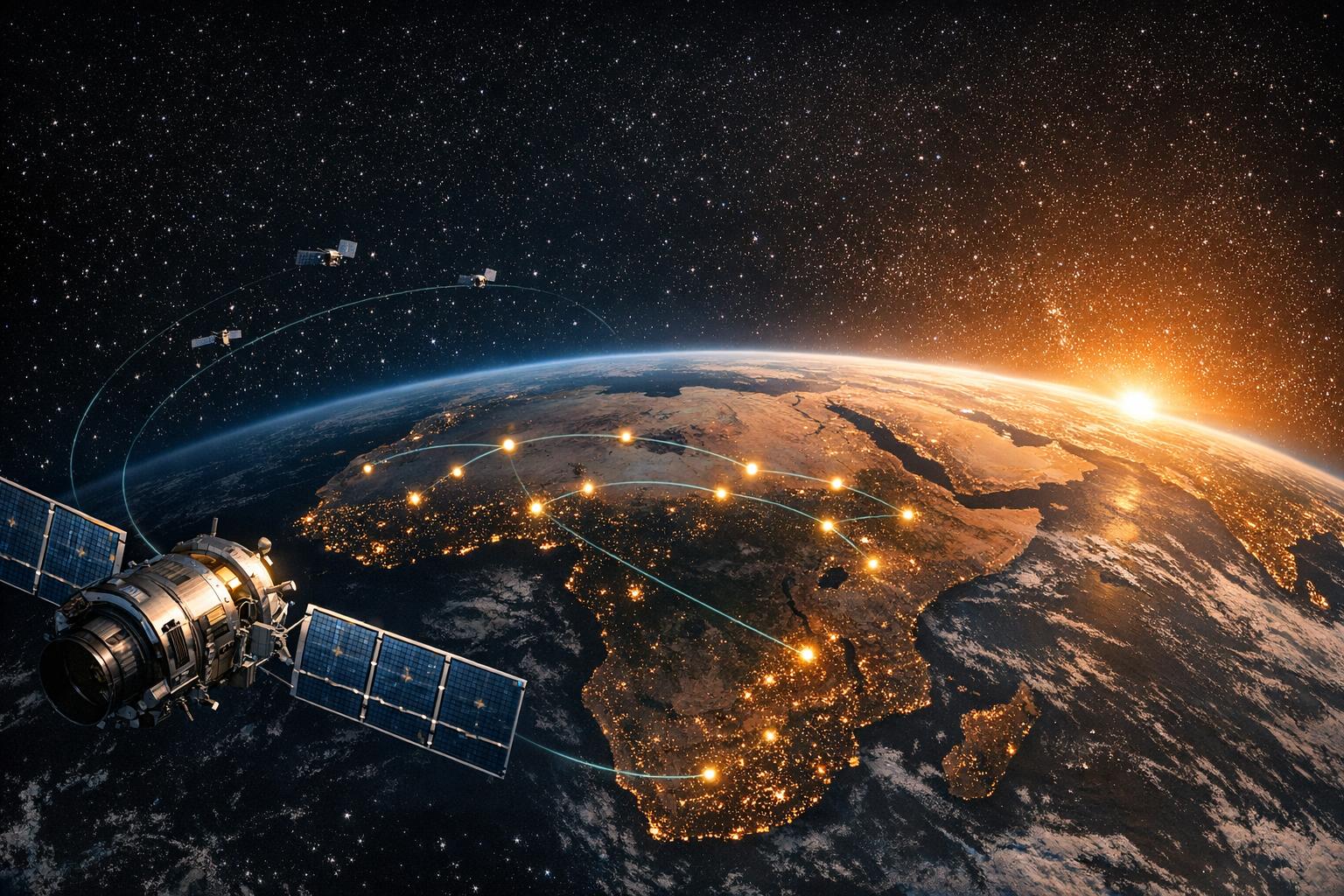
Technological Transformation
In January 2026, torrential rains driven by La Niña conditions swept across southern Africa. South Africa declared a national disaster on 19 January; by 22 January the IFRC had counted 37 deaths in Mpumalanga and Limpopo alone, while in Mozambique hundreds of thousands of people were displaced and whole districts of Gaza province were cut off. Regional death tolls passed 200. Meteorological agencies had issued warnings — but, as researchers have since pointed out, warnings that are issued are not the same as warnings that are received, understood and acted upon. That gap, between a forecast in a weather office and an informed decision in a village, is now the central technological challenge for African climate resilience. In 2026 it is attracting an unusual mix of tools: AI weather models that run on a laptop-class server, a new continental satellite nowcasting network, and mobile-phone alerting systems that can reach every handset in a danger zone.
The Scale of the Problem
The World Meteorological Organization's State of the Climate in Africa 2025 report, launched on 18 June 2026, documented at least 13 million people affected and more than 3,000 reported deaths from extreme weather in 2025. Floods accounted for over half of reported events, and drought affected more than 8.5 million people in East Africa. The continent is warming faster than the global average. Yet the report found that only about 40% of African countries report having multi-hazard early-warning systems — press coverage put it at 22 of 54 countries reporting the necessary preparedness and response capabilities.
Other tallies are more optimistic: UNDRR says the number of African countries with multi-hazard early-warning systems has grown from 14 in 2015 to 41 in 2026. The difference reflects definitions — having some system versus reporting comprehensive, end-to-end capability — but both numbers point to the same conclusion: coverage is expanding, quality is patchy, and the last mile remains the weakest link.

The Data Desert Beneath the Forecasts
Every forecast, whether produced by a physics-based supercomputer model or a neural network, depends on observations. Here Africa starts at a disadvantage. A UNFCCC presentation on the Systematic Observations Financing Facility (SOFF) notes that the number of radiosonde (weather balloon) observations from Africa entering global models fell by half between 2015 and 2020. A 2020-era WMO assessment estimated that more than 2,000 new or rehabilitated stations were needed across least developed countries and small island states. SOFF-linked analysis published in 2026 suggests that adding surface and upper-air observations in data-scarce regions could cut forecast errors in Africa by more than 30%.
SOFF is beginning to fill the gaps country by country. Chad's investment plan calls for 33 surface stations and six upper-air stations compliant with the Global Basic Observing Network (GBON); Malawi, Madagascar and Tanzania have investment-phase projects; and in June 2026 Cabo Verde reported two stations now transmitting real-time data to the global network. These are unglamorous gains, but they are the foundation on which every AI breakthrough rests.
AI Forecasting: The 'Leapfrog' Promise
The most striking technical shift is the arrival of data-driven weather models. Systems such as ECMWF's Artificial Intelligence Forecasting System (AIFS), which became operational in 2025, and MET Norway's high-resolution Bris model can generate forecasts with a fraction of the computing power required by traditional numerical weather prediction. For national meteorological services that cannot afford supercomputers, this opens a possibility WMO explicitly describes as 'leapfrogging'.
Malawi is the proving ground. Under a CREWS-funded pilot running from July 2025 to June 2026, the Department of Climate Change and Meteorological Services worked with MET Norway and ECMWF to run Bris and an AIFS-based 'forecast-in-a-box' package locally, testing forecast skill, timeliness and operational feasibility. Director Lucy Mtilatila described the initiative as 'a strategic opportunity to strengthen Malawi's early warning infrastructure' and build long-term capacity among forecasting staff. The model is portable by design: it lets a national service tailor its own pipeline rather than simply downloading products made elsewhere.
WMO is careful not to oversell the technology. It notes open 'question marks about the capability of AI to support forecasts and warnings of local high-impact weather and water hazards' — exactly the convective storms and flash floods that kill most people. Its Executive Council has requested technical guidelines on incorporating AI into the WMO Integrated Processing and Prediction System, and the organisation is also helping African Regional Climate Centres apply AI to sub-seasonal forecasting.
Satellites for the Next Six Hours: AMSAF
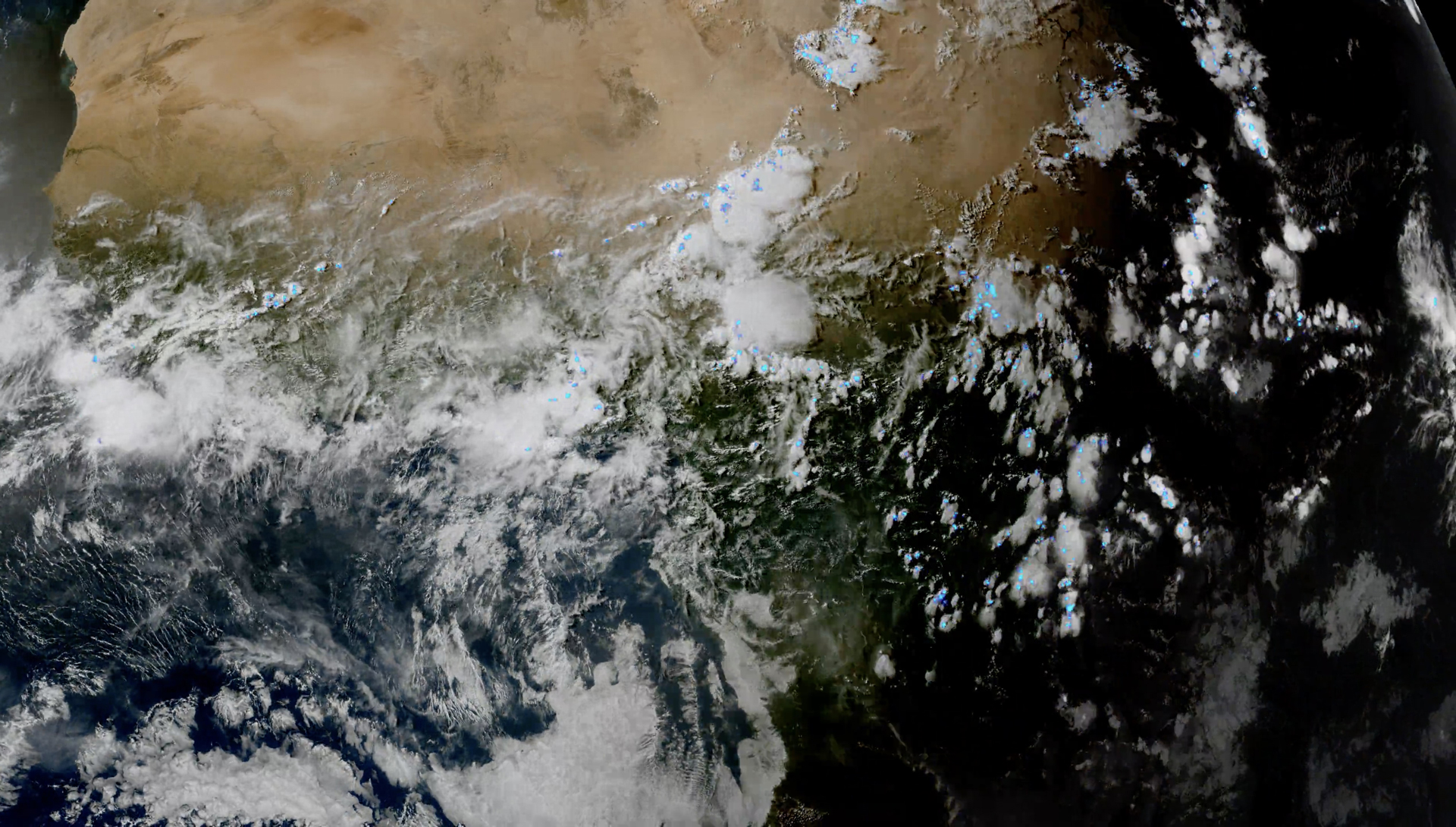
If AI models address the medium range, the most dangerous weather often unfolds within hours. On 18 May 2026 the African Union Commission and partners launched the African Meteorological Satellite Application Facility (AMSAF) in Addis Ababa. Built under the EU-funded Strengthening Early Warning in Africa (SEWA) project — part of the Global Gateway Africa–EU Space Partnership — and implemented with EUMETSAT and ECMWF, AMSAF will create regional nowcasting centres serving West, East, Central and Southern Africa, with the Niger-based African Centre of Meteorological Applications for Development (ACMAD) contributing. A technical consortium led by the Finnish Meteorological Institute, with Spain's AEMET, the University of Leeds and Morocco's national weather service, will support the effort.
The centres will use data from Meteosat Third Generation satellites to produce 0–6 hour nowcasts, and EUMETSAT has committed to expanding MTG data access across Africa by increasing bandwidth on its EUMETCast-Africa system. The aim, in EUMETSAT Director-General Phil Evans's words, is to help African countries 'take full ownership of their weather forecasting capabilities'.
Delivery: From the Forecast Office to the Phone
Even perfect forecasts fail if they never reach people. The Addis Ababa Call to Action, adopted at the Africa Early Warnings Forum on 2–4 September 2026 by close to 500 experts and officials from 44 African countries, set five priorities, including making multi-hazard early-warning systems a core public investment and closing last-mile gaps. It explicitly calls for integrating AI across the warning value chain and for rapid expansion of mobile public warning systems such as Cell Broadcast, which pushes geo-targeted alerts to every phone on a network without requiring numbers or apps.
Progress on mobile alerting is uneven. ITU reports that 45 countries worldwide have implemented mobile-based warning systems via cell broadcast or location-based SMS, with 13 more in development. Kenya is among the most advanced in Africa: on 16 March 2026 its Communications Authority validated a readiness-assessment tool for a national Cell Broadcast rollout, with an architecture in which the disaster management authority operates a central broadcast centre that routes alerts to all mobile operators. ITU material frames the effort as the 'Road to 2027', suggesting full deployment is still ahead. Malawi held an Early Warnings for All national workshop in February 2026, and Mozambique has received ITU technical assistance.
The Private and Big-Tech Layer
Commercial players are also extending reach. Google's AI-based Flood Hub now covers dozens of African countries, and in 2025 the company began offering short-term precipitation forecasts across Africa directly in Search. Startups target specific users: Ignitia, operating in Ghana, Mali and Nigeria, has served more than 450,000 subscribers — mostly farmers — with hyper-local SMS forecasts, while Kenya's Amini, which raised a US$2 million pre-seed and a US$4 million seed round in 2023, applies AI and satellite data to Africa's environmental data gap. These services can be faster and more user-friendly than public channels, but they raise questions about data ownership, alignment with official warnings, and sustainability when donor or venture funding dries up.
Risks and Open Questions
- Single authoritative voice: proliferating apps and AI products could produce conflicting messages; WMO doctrine holds that national services should remain the official source of warnings.
- Dependency: many AI models are trained and hosted abroad; without local observations and skilled staff, 'ownership' may be nominal.
- Local extremes: AI's weakness on convective storms and flash floods means satellites, radar and nowcasting remain essential.
- Financing: observing networks need recurrent budgets for maintenance and staffing, not just one-off donor installations.
- Action, not alerts: the Addis Ababa Call stresses that funds and forecasts alone are insufficient unless tied to anticipatory action plans and community preparedness.
Outlook
Africa's early-warning gap was never mainly about a lack of clever algorithms. It is a chain problem: sparse observations, under-resourced forecasters, slow dissemination and weak links to action. What is new in 2026 is that cheaper AI models, the AMSAF satellite network and mobile alerting are arriving at the same time, giving each link a plausible upgrade path. If national services can run models like Bris and AIFS on their own hardware, feed them with SOFF-funded observations, and push the results through Cell Broadcast to every phone in harm's way, the continent could move closer to the UN goal of universal early-warning coverage. The January floods in southern Africa are a reminder of the cost of falling short.
Published By | Tech Wiz