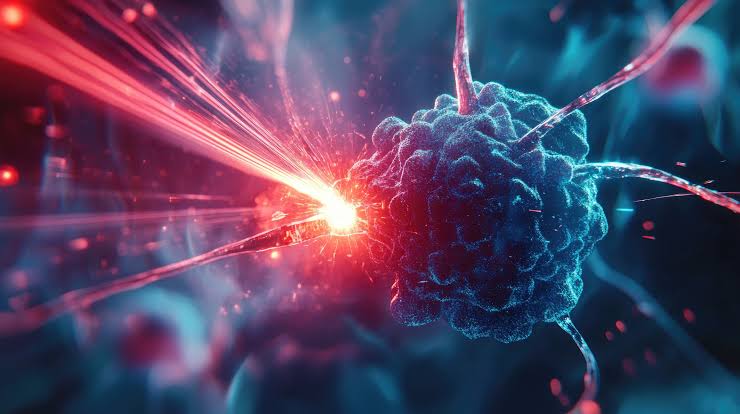
Swiss scientists built a molecular "light switch" that can flip dormant, treatment-resistant cancer cells back on, exposing them to attack. It sounds like science fiction. It's published, peer-reviewed, and already working in lung cancer cells.
ZURICH, Switzerland
Cancer's oldest, cruelest trick isn't growing. It's waiting.
Somewhere inside a patient who has finished chemotherapy, rung the bell, and been told they're in remission, a handful of tumor cells can go quiet. They stop dividing. They power down. They become "dormant" — biologically invisible to drugs designed to kill fast-growing cells, and often invisible to scans as well. Then, sometimes years or even decades later, they wake up. The cancer comes back — frequently harder to treat than before.
It's one of the most maddening mysteries in cancer medicine: between 20 and 45 percent of breast and prostate cancer patients relapse years after apparently successful treatment, and the culprit is this same dormancy. Now, a team at ETH Zurich says they've built something that could finally give doctors a way to fight back — not with a stronger drug, but with a beam of light.
THE SWITCH INSIDE THE CELL
The research, published in the Proceedings of the National Academy of Sciences (PNAS), describes a light-controlled molecular switch that can force dormant cancer cells to wake back up on command — and with enough precision that doctors could theoretically control exactly where and when it happens.
Here's the biology in plain English. Many cancer cells — particularly in lung cancer, and likely in breast and prostate cancer too — slip into their dormant, drug-resistant state by leaning on a receptor called the glucocorticoid receptor, or GR. GR is the cell's docking station for stress hormones like cortisol. Under normal circumstances, it helps regulate inflammation and keep the immune system in balance. But in a tumor cell under siege from chemotherapy, GR acts as an emergency hibernation switch, letting the cell power down its growth machinery and effectively disappear from treatment's crosshairs.
That dual role is exactly why nobody has been able to simply build a drug that blocks GR everywhere in the body: turn it off systemically, and you risk serious side effects.
So the ETH Zurich team came up with a workaround: instead of a drug that's always on, build one that only switches on when hit with a specific wavelength of light.
The team engineered "photoswitchable" molecules — compounds that physically change shape depending on which color of light they absorb — and attached them to a piece of machinery that tags GR for destruction. Shine one wavelength on the compound, and it flips into its active shape, latches onto GR, and marks it for the cell's internal garbage disposal to break down. Shine a different wavelength, or none at all, and the compound flips back into an inactive shape that leaves GR untouched.
"The effect is reversible and can be controlled precisely," said Robin Scheuplein, joint first author of the study. Because the switch only activates where light is shone, doctors could in theory illuminate just a tumor site while leaving GR's essential work elsewhere in the body completely alone.
WHAT HAPPENED IN THE LAB
In laboratory tests on human lung cancer cells, the results were striking. When researchers activated the compound with light, it destroyed the glucocorticoid receptors on dormant cells and reversed the dormancy-linked gene activity that had been keeping those cells hidden and drug-resistant. Cells that had gone quiet came back to life — and in doing so, they became vulnerable again to the very treatments that couldn't touch them while they slept. Meanwhile, the inactive form produced no measurable effect, confirming that the light was doing the work.
Put simply: scientists built a way to flip a hiding cancer cell's "invisibility cloak" off with a flashlight, and when the cloak comes off, standard cancer treatments could theoretically finish the job.
WHY THIS MATTERS
Cancer researchers have chased the dormancy problem for years because it sits at the root of one of oncology's most heartbreaking scenarios: the patient who does everything right, finishes treatment, gets the all-clear, and then relapses with a more aggressive, harder-to-treat disease. If dormant cells could be reliably woken up on a doctor's schedule, in a controlled setting alongside chemotherapy, oncologists could ambush the very cells that currently escape treatment by doing nothing at all.
That's the promise. The caveats are real, too. This is laboratory-stage research in cultured lung cancer cells — not a clinical trial, and not a treatment available today. Translating a light-activated switch into something that works inside a living human body raises substantial challenges: how deep can light penetrate tissue to reach hidden tumor deposits, how would doctors know where all the dormant cells are hiding, and how would this integrate with existing chemotherapy regimens.
EXPERT PERSPECTIVE
The dormancy problem has frustrated cancer biologists precisely because dormant cells are, by design, biologically boring — they aren't dividing, aren't consuming unusual amounts of nutrients, and don't display the hallmarks that make actively growing tumor cells targetable. What the ETH Zurich approach offers is a way to force the enemy out of hiding rather than trying to design ever-more-elaborate weapons that still can't see it. Researchers have long argued that "reawakening" dormant cells under controlled conditions — rather than trying to keep them permanently asleep — could be the more decisive strategy, since it converts an invisible threat into a visible, treatable one on the oncologist's own schedule.
WHAT THIS MEANS FOR YOU
If you or someone you love has ever been told cancer is "in remission," you already understand the quiet anxiety that word carries — the awareness that remission is not the same as cured. Research like this is aimed squarely at closing that gap between remission and cure. It won't change treatment tomorrow, or likely for years, because laboratory findings must clear additional hurdles — animal studies, safety testing, and eventually human trials — before anything resembling this reaches a hospital. But it represents a genuine shift in strategy: rather than searching for a drug powerful enough to kill every last hidden cancer cell, scientists are learning to force those cells to reveal themselves on command, using nothing more exotic than colored light.
For patients navigating a cancer diagnosis or worried about recurrence, the most useful takeaway is this: dormancy research is one of the most active frontiers in oncology right now. Advances like this light switch are a sign that the scientific window on cancer's hiding strategy is finally starting to open.
THE BOTTOM LINE
For decades, dormant cancer cells have won simply by doing nothing — sitting quietly, undetectable, until the moment they choose to strike again. ETH Zurich's light-controlled molecular switch is the first serious attempt to take that choice away from the cancer and hand it to the doctor, using a tool as simple and precise as a beam of light. It's early. It's a lab bench, not a hospital bed. But for a disease that has always relied on patience as its greatest weapon, teaching doctors how to flip that patience off on command is the kind of idea that could change everything — eventually.
Sources: PNAS, ETH Zurich News, ScienceDaily, EurekAlert!, Optics & Photonics News, News-Medical.net, StudyFinds
Published By | Tech Wiz