Written By | Torch Media Africa
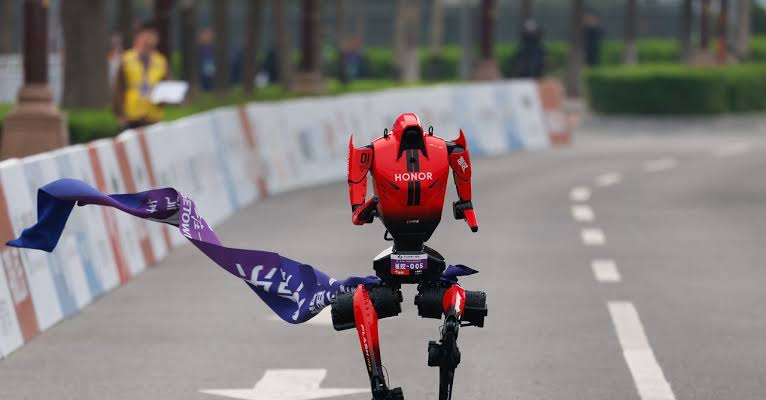
A Chinese humanoid with no hands, no face, and no fear just broke the human sprint record — and days later, the company behind it became a stock market phenomenon nobody saw coming
SCIENCE & TECH
For 17 years, Usain Bolt has owned a number that nobody — not a single human being on Earth — could touch: 12.42 meters per second, his blistering peak velocity during the 2009 World Championships 100-meter dash in Berlin, a run so fast it seemed to bend the laws of biomechanics. Bolt retired. The number stayed untouched. Sprinters trained, doped scandals came and went, and 12.42 sat there like Everest, daring anyone to try.
This week, something without a heartbeat finally beat it.
On Monday, Hangzhou-based Unitree Robotics released a 30-second video of a new humanoid machine it calls "Superman" — a name dripping with either confidence or dark comedy, depending on who you ask — thundering down an indoor track and hitting a peak speed of 12.66 meters per second, or roughly 45.6 kilometers per hour. Then, in the same clip, the same machine launched itself into a standing jump that carried it two full meters into the air, clearing the best standing high jump any human has ever recorded by nearly a foot.
It did all this with no hands. No face. No grippers. Just legs, a torso, and — apparently — a complete disregard for the electrical equipment box it appears to plow into at the end of the run.
And if that wasn't enough spectacle for one week, the company behind it turned around and became one of the wildest stock market stories of the year.
The Machine That Shouldn't Exist Yet
Unitree says Superman took just over three months to build. Three months. For context, it took human engineers decades of iterative design — and Boston Dynamics alone spent the better part of two decades — to get bipedal robots to walk without looking like they were learning for the first time on ice. Unitree says its team built a machine in barely 100 days that can, on paper, out-jump and out-sprint every recorded human athlete in history.
The specs, as released by the company: a leg length of 0.85 meters, a standing height north of 190 centimeters (about 6-foot-3), a top speed of 12.66 m/s, and a standing vertical leap of 2 meters. Unitree has been explicit that Superman is not a commercial product and not a general-purpose robot — it has no hands, no grippers, and, according to the company itself, "significant room for improvement." It exists, by Unitree's own description, purely as an experimental platform to push the limits of dynamic legged locomotion: essentially, an athlete's body with nothing plugged into the brain for anything else.
That distinction matters, because the moment the video hit social media, it was treated less like a research demo and more like a declaration of war on human athletic supremacy. Unitree's own promotional caption leaned into the drama, boasting that the machine was "breaking the limits of humanity" and had surpassed "the standing high jump and running speed records of all humans around the world."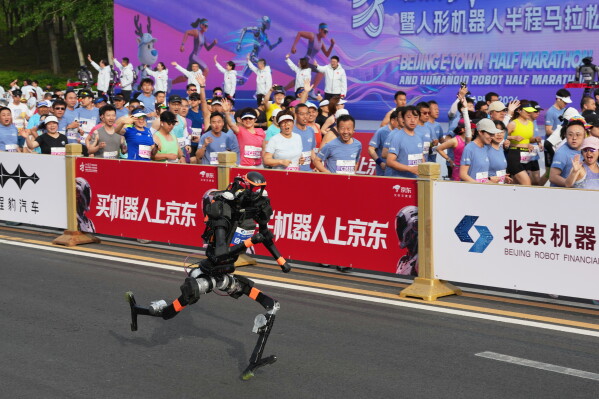
Not So Fast — Literally
Here's the catch, and it's a big one: nobody outside Unitree has verified a single number.
There was no independent timing system, no neutral third-party lab, no disclosed payload weight, no description of the running surface, and — critically — no indication of whether the run is even repeatable. Bolt's 12.42 m/s came from a single instant during a fully sanctioned, independently timed, drug-tested competitive 100-meter final in front of the world. Superman's 12.66 m/s comes from a company-produced video, shot on Unitree's own equipment, on Unitree's own track, released by Unitree's own marketing team, during a week Unitree very much wanted the world's attention.
Skeptics also point to the ending of the clip, where the robot appears to lose control after its top-speed run and crash directly into an electrical box near the edge of the venue — a blooper-reel moment that undercuts the "flawless superhuman machine" narrative and raises real questions about whether Superman can actually stop, turn, or react to an obstacle at those speeds. Detecting a hazard, slamming the brakes, and rerouting mid-sprint is an entirely different engineering problem than simply running in a straight line as fast as possible, and it's one every self-driving car company has learned the hard way.
There is also the matter of what the robot cannot do. With no hands and no grippers, Superman cannot pick up a box, open a door, or perform literally any of the tasks that make humanoid robots commercially interesting to warehouses, factories, or homes. Every ounce of engineering effort clearly went south of the waist. It is, in effect, a very expensive pair of robotic legs wearing a torso as a hat.
The IPO That Broke Shanghai
If the robot itself is a headline, the business story running alongside it is the real earthquake.
Just one day before Superman's video dropped, on August 18, Unitree Robotics — officially Yushu Technology Co. — made its long-awaited debut on Shanghai's STAR Market, China's Nasdaq-style exchange for tech companies. The company priced its initial public offering at 150.8 yuan per share, raising 6.1 billion yuan (about $904 million) in the process.
Then trading opened, and things got absurd.
Shares rocketed as much as 629% above the IPO price, touching roughly 1,100 yuan before settling to close up around 460% on the day — one of the largest first-day pops for any listing on the exchange in recent memory. The closing price valued Unitree at roughly 342 billion yuan (north of $47 billion), instantly vaulting it past other recently listed Chinese tech darlings like MetaX Integrated Circuits and Moore Threads Technology.
The demand behind the offering was, by any measure, historic. Retail investors in Shanghai oversubscribed the IPO by more than 8,000 times — a record for the STAR Market, which has hosted some of China's most closely watched tech listings since it opened in 2019. Analysts at KraneShares, which tracks the sector through ETFs like KSTR and KOID, called it a watershed moment for how public markets are pricing the humanoid robotics race.
Unlike many of its cash-burning competitors in the West, Unitree is actually profitable — a rarity in a sector still dominated by prototypes, promises, and burn rates that would make a Silicon Valley VC wince. The company reported 1.7 billion yuan in 2025 revenue with healthy margins and says it has delivered roughly 18,000 robots to date. Market research firm Smart Analytics Global ranked Unitree the world's second-largest humanoid robot maker by shipment volume in the first half of 2026, with unit shipments surging 170% year-over-year to about 5,900 machines — good for roughly 31% of the entire global market.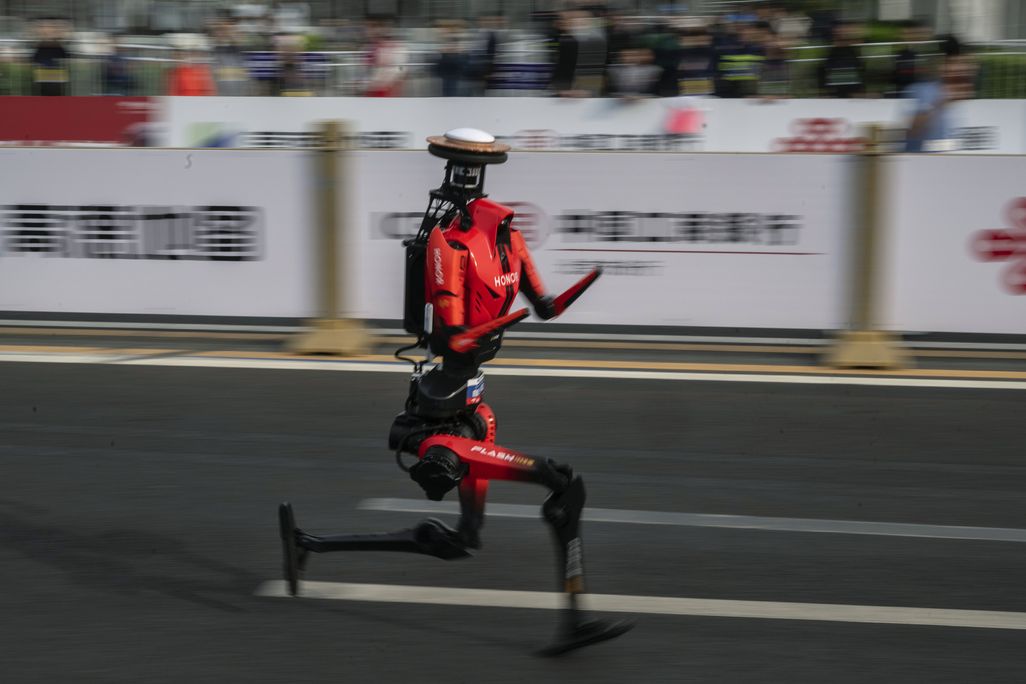
Why China Is Winning This Round
The Unitree story lands in the middle of an increasingly loud, increasingly nationalistic race to dominate humanoid robotics, and right now, the scoreboard tilts heavily toward Beijing. While Tesla continues to iterate on its Optimus robot in relatively controlled demo settings and hasn't yet begun meaningful commercial shipments, Chinese manufacturers — Unitree chief among them — are already selling machines, generating revenue, and now tapping public capital markets to fund the next leap.
Industry watchers have noted that Chinese firms made up the majority of humanoid robot exhibitors at recent major U.S. tech showcases, and Unitree's kung-fu-performing, backflipping robots have already become minor viral celebrities, having appeared everywhere from factory floor demos to a Chinese Lunar New Year television gala. The Superman platform, whatever its verification problems, is best understood as the next chapter in that branding campaign: a company that has figured out that dramatic, meme-able video clips are worth more in market attention than a thousand quiet engineering white papers.
What the Experts Are Actually Saying
Robotics analysts covering the Superman release have been notably more measured than Unitree's own marketing copy. The consensus emerging in trade coverage is that the achievement, if real and repeatable, is a genuinely impressive feat of actuator and control engineering — legged robots capable of sustained high-speed running are notoriously difficult to build because of the dynamic balance problems involved, and doing it in three months would be remarkable by any engineering standard.
But experts are equally quick to note that "fastest robot ever recorded on a company's own promotional footage" and "faster than Usain Bolt in a fair, timed, competitive comparison" are two very different claims, and conflating them is exactly the kind of framing that turns a genuine engineering milestone into a marketing stunt. Whether Superman's figures survive independent scrutiny — assuming any outside lab ever gets access to test it — remains an open question, and for now, the world has only Unitree's word and Unitree's footage to go on.
What This Means for You
You are probably not going to have a Superman robot in your living room anytime soon — it has no hands, cannot fetch anything, and by its own maker's admission is a research platform, not a product. But the underlying trend matters more than any single viral clip. Humanoid robotics has quietly crossed from "cool demo" territory into "public market phenomenon" territory, with real revenue, real shipment numbers, and now a $47 billion valuation attached to a company that, ten years ago, was a scrappy startup nobody outside robotics circles had heard of.
That has ripple effects well beyond China. Expect competitors in the U.S., Europe, and elsewhere in Asia to feel renewed pressure to show not just impressive demos but actual commercial traction, actual profitability, and actual delivery numbers — the very things that made investors willing to bid Unitree's stock up nearly sevenfold in a single trading session. If you work in manufacturing, logistics, or any field that robotics companies have their eye on automating, the message from this week is blunt: the machines are getting faster, the capital funding them is getting bigger, and the timeline everyone assumed — "humanoid robots are a decade away" — just got a very public, very well-funded reason to move up.
The Bottom Line
Superman may never leave the lab. Its numbers may never be independently verified. It might spend its entire existence as a viral video and a footnote in Unitree's IPO prospectus. But the two stories together — a robot that appears to outrun history's fastest human, and a company that just became one of the most explosively valued tech listings of the year — tell a single, unmistakable story: the humanoid robotics race isn't a distant future anymore. It's a market, it's moving fast, and this week, it just laid down a very loud marker for who's currently ahead.



