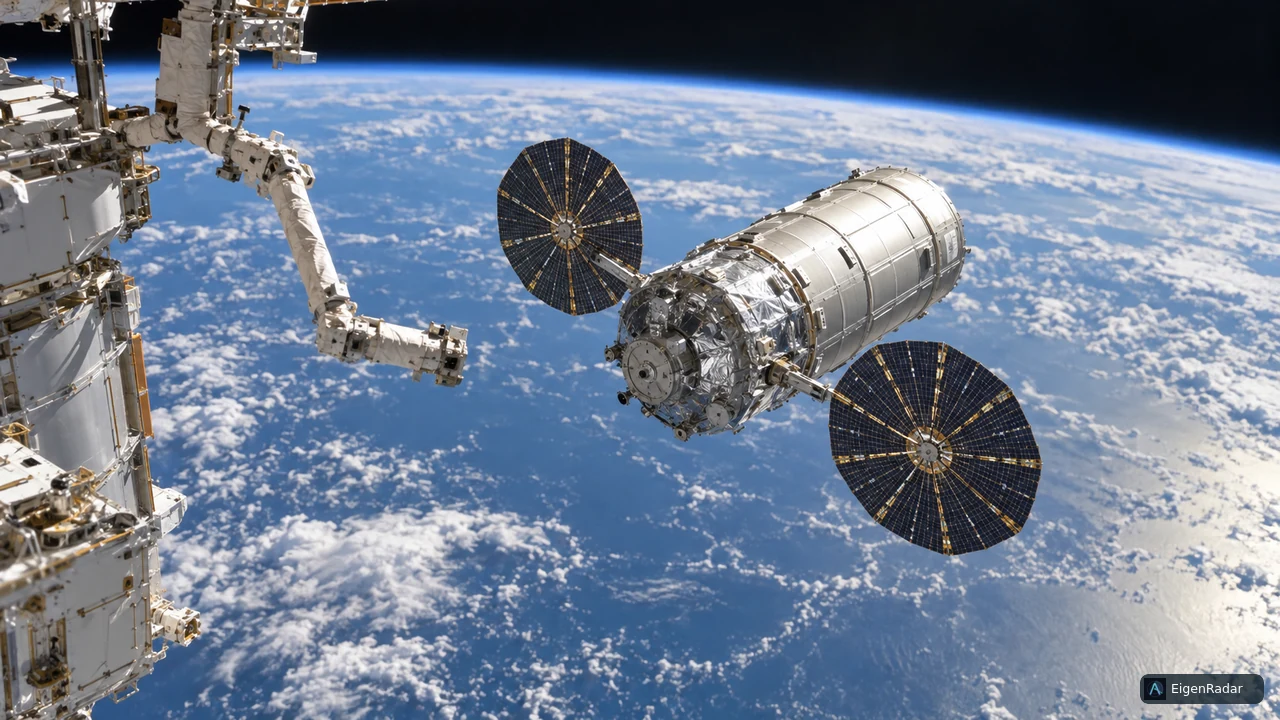
A cargo capsule that looks like routine freight is really a flying laboratory, packed with artificial retinas, beating-heart models and brain organoids that could change how we fight blindness, heart disease and Alzheimer's.
SCIENCE & TECH
Roughly 250 miles above your head, a gleaming white SpaceX Dragon capsule is closing in on the International Space Station today, and the stuff inside could one day help blind people see. Launched on Tuesday morning from Florida, the cargo ship is due to dock itself to the orbiting outpost at about 11 a.m. Eastern time on Thursday, with NASA's live coverage starting at 9:15 a.m.
On paper, this is the 35th commercial resupply mission SpaceX has flown for NASA, and it hauls roughly 6,300 pounds, or about 2,860 kilograms, of supplies and equipment. In reality, it is something far more exciting: a bundle of biology experiments that treat weightlessness not as a hazard to be survived but as a manufacturing advantage to be exploited.
Among the cargo are hardware for building artificial retinas one ultra-thin layer at a time, living 3D models of human heart tissue, a mysterious new type of glass, and so-called brain organoids, tiny clumps of human neural cells that scientists hope will unlock secrets of diseases like Alzheimer's, Parkinson's and multiple sclerosis. Oh, and the astronauts get their final pair of giant roll-out solar arrays.
Liftoff on Tuesday: Falcon 9 Delivers, Right on Time
The mission, known as CRS-35, lifted off on Tuesday, 13 October 2026, at around 6:33 a.m. Eastern time from Space Launch Complex 40 at Cape Canaveral Space Force Station in Florida. NASA described the launch as on time, with a Falcon 9 rocket doing the heavy lifting. Some outlets recorded the liftoff a minute or two later, but all agree the ascent went smoothly.
About nine minutes after leaving the pad, the Dragon capsule separated from the rocket's second stage, opened its nosecone and began a carefully choreographed series of thruster burns to chase down the station. Dragon flies itself. There is no pilot and no joystick; the capsule will approach the space-facing port of the station's Harmony module and dock autonomously, while astronauts, including NASA's Anil Menon and the Canadian Space Agency's Joshua Kutryk, keep watch from inside.
Once attached, Dragon is expected to remain at the station for about a month. When it leaves, it will do something almost no other cargo ship can: come home. Russia's Progress, Japan's HTV-X and Northrop Grumman's Cygnus XL all burn up on the way down. Dragon is the station's only operational freighter that can bring experiments and broken hardware back to Earth, splashing down under parachutes in the Pacific Ocean off the California coast.

Building Eyes in Space: The Artificial Retina Experiment
The headline act is an investigation called LambdaVision-1. The company behind it, LambdaVision, is a biotech start-up trying to restore sight to people with conditions such as age-related macular degeneration and retinitis pigmentosa, two diseases that steal vision and, for now, have no cure.
The idea is audacious. LambdaVision builds artificial retinas from hundreds of ultra-thin layers of bacteriorhodopsin, a light-activated protein. Stack those layers precisely and you get a film that reacts to light much like the photoreceptors in a healthy eye. The trouble on Earth is gravity. Sedimentation and buoyancy tug at the liquid ingredients as each layer is built, causing uneven coatings, wasted material and a serious headache for anyone hoping to scale up production.
In microgravity, those pulls largely vanish. According to reporting by Retinal Physician, citing the ISS National Laboratory, retinas made on the station have shown better uniformity, optical performance and reproducibility than those made on the ground, along with greater stability and biocompatibility, while using less raw material. The work runs on a compact, automated production system inside Space Tango's CubeLab hardware, and this is far from the company's first rodeo: LambdaVision has now flown nine investigations to the ISS over about a decade.
NASA's own description of the new experiment is that it will test manufacturing artificial retinas in space one thin layer at a time, and that reduced settling may produce more uniform layers that could improve implant performance. Those careful words matter. Nobody is claiming a cure has been found. But the potential is huge.
"We've taken a lot of the risk out of demonstrating the value of manufacturing in space," LambdaVision CEO Nicole Wagner has said, adding that the company is now thinking about "how we scale in orbit and what's next." A further ISS investigation is planned later this year to boost production volume, and LambdaVision has said it eyes commercial stations such as Starlab and Vast's Haven once the ISS retires.
Beating Hearts and Tiny Brains
The retinas are not travelling alone. Another payload, Stellar Spheroids, will study how microgravity changes the growth and function of 3D models of human heart tissue. Researchers want to know whether weightlessness helps the tissue form more advanced blood-vessel networks, a long-standing obstacle in lab-grown organs. Heart tissue models that behave more like the real thing could make large-scale drug testing faster, cheaper and safer, including for the astronauts of tomorrow.
Then there is MINDS, the experiment sure to grab imaginations. It studies brain organoids, tiny clusters of human cells that mimic aspects of brain tissue, to understand the inflammation tied to neurodegenerative diseases. The twist is the use of what NASA calls "organoid villages", which combine cells from multiple people in the same culture. That lets scientists compare how different genetic backgrounds respond side by side, under identical conditions, in a single experiment. Researchers hope the results could reveal new treatment targets for Alzheimer's, Parkinson's and multiple sclerosis.
To be clear, these are not thinking brains, and nobody should expect sci-fi horror. Organoids are simple, laboratory-grown tissue models. Their value is that they let researchers watch human disease processes unfold without experimenting on people.
A Glass Unlike Any Other
A fourth investigation, ELF-Unconventional Glass 2, takes a different path. Researchers will melt glass made from non-traditional elements and watch how the molten material behaves in weightlessness, without a container's walls or gravity-driven flow interfering. The solid samples will then return to Earth for analysis. Better glass could mean sharper optical fibres and tougher lenses, and microgravity offers a rare chance to see how new compositions form from scratch.
The Last Solar Wings
Not everything in Dragon's trunk is biology. The capsule is also carrying the final pair of ISS Roll-Out Solar Arrays, known as iROSAs, to be installed on the station. NASA says they complete the orbiting laboratory's power-system upgrade, which supports critical operations, including its eventual safe and controlled deorbit.
That last phrase is a quiet reminder that the station, in service for more than 25 years, is heading toward retirement. The upgrade ensures the old girl has the power she needs for the final chapters of her life. Over that quarter-century, scientists from more than 110 countries have conducted over 4,000 microgravity experiments aboard her.
The Not-So-Glamorous Cargo
Space travel is not all retinas and stardust. NASA's overview lists a collapsible contingency urinal, along with supporting hardware, as a demonstration unit supporting the Artemis III moon mission. Also aboard are a toilet dose pump, a toilet pretreatment quality sensor and a small robotic tool for station maintenance.
Dragon is also carrying a large foam clamshell, flown empty, designed to bring home a failed Canadarm2 robotic-arm joint that was replaced during a June 30 spacewalk. Returning in mid-November will be that joint for analysis and refurbishment, a spacesuit for ground refurbishment, a fluid and pressure-control pump assembly from the urine processor, and a filtration unit from the water processor.
Expert Perspective
Why does the retina experiment stand out? Because it tests a bigger idea: that some products may simply be better made in orbit. As Wagner's comments suggest, the early years of ISS research were about proving that manufacturing in microgravity is possible. The next stage is proving it can be done at a scale and cost that make commercial sense. NASA's wording is deliberately measured, saying reduced settling "may" produce more uniform layers and "could" improve performance. The companies and agencies involved are promising evidence, not miracles.
Independent scientists will also want to see the data from these new flights, and published peer review, before drawing firm conclusions. Space-made does not automatically mean better-in-the-clinic, and any artificial retina must still clear years of safety testing and regulatory approval. LambdaVision itself notes that the automation, fault detection and quality control developed on the ISS are key to meeting regulatory requirements.
What This Means for You
If you or someone you love is living with macular degeneration or retinitis pigmentosa, this mission is a reason for cautious hope, not an immediate treatment. A therapy built from space-made implants is still some way off, and nothing flying today is a product you can buy.
For everyone else, the lessons are broader. Drug-testing platforms made from human tissue could one day cut reliance on animal studies and speed new medicines to market. Brain-organoid research could, over time, sharpen our understanding of diseases that affect millions of families. And better power for the ISS keeps one of humanity's most productive laboratories running right up to its final day.
There is a taxpayer angle too. Every pound of cargo launched under NASA's commercial resupply contracts is a bet that private industry can deliver science to orbit reliably and repeatedly. Thirty-five missions in, SpaceX's Dragon has become the workhorse of that bet.
The Bottom Line
By lunchtime on Thursday, if all goes to plan, Dragon will be locked onto the station and the crew will begin unpacking. Within weeks, retina layers will be growing, heart tissue will be pulsing in its incubator, and tiny organoid villages will be quietly revealing how brain disease takes hold. A month after that, the capsule will drop into the Pacific, carrying the first precious results home.
It is easy to look at a cargo run and see only a box delivery. Look closer, and you will see a glimpse of a future in which the best place to build the next generation of medical devices is a few hundred miles straight up. We will be watching the docking, and so should you.
Published By | Tech Wiz