Written By | Torch Media Africa
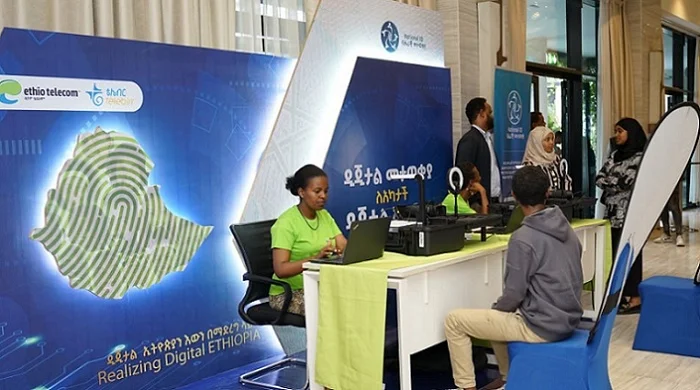
M-PESA's growth is happening against a much larger incumbent: Telebirr, the mobile money arm of state-owned Ethio Telecom, counted 58.61 million subscriptions at the end of 2025
Technological Transformation
Five years after Prime Minister Abiy Ahmed's government ended one of Africa's last state telecom monopolies, Ethiopia's digital economy is compounding on three fronts at once: mobile money competition is intensifying, the incumbent operator has taken its first steps onto a public stock exchange, and a national digital identity system is becoming the backbone that banks, telcos, and government services increasingly require to function. Together these developments mark a shift from a liberalization announced on paper in 2021 to one now visible in subscriber numbers, share prices, and enrollment counters — even as Ethiopia's broader startup ecosystem remains small and its digital economy still early in its build-out.
From Monopoly to Real Competition
Safaricom Ethiopia, the consortium led by Kenya's Safaricom that won the country's first private telecoms license in May 2021 and launched service in 2022, has moved from market entrant to a genuine second force in Ethiopian telecom. The operator closed the quarter ending December 31, 2025 with 12.2 million three-month active customers, a 71.7% year-on-year increase, and by February 2026 had surpassed 12 million users overall as M-PESA adoption accelerated. Safaricom was granted a mobile money license in Ethiopia in May 2023 and launched M-PESA services that August; in the fiscal year to mid-2026, active M-PESA subscribers jumped 119.4% to 5.2 million, processing 442.2 million transactions worth roughly $221.4 million. Safaricom has publicly targeted a seven-fold subscriber increase in Ethiopia by 2030, aiming for around 70 million users — an ambitious goal that has nonetheless left some Safaricom investors in Kenya uneasy about the pace of capital being deployed into the Ethiopian build-out relative to near-term returns.
M-PESA's growth is happening against a much larger incumbent: Telebirr, the mobile money arm of state-owned Ethio Telecom, counted 58.61 million subscriptions at the end of 2025. Ethio Telecom's most recent annual performance report, covering the 2025/26 Ethiopian fiscal year, showed earnings growth of 47.5% and a subscriber base surpassing 90 million — underscoring that while Safaricom has broken the monopoly, Ethio Telecom remains by far the dominant operator across both voice/data and mobile money. Ethio Telecom's own strategy, branded "Next Horizon: Digital & Beyond 2028," targets mobile broadband coverage reaching 85% of the population alongside continued growth of Telebirr.
A State-Owned Giant Goes Public
The most structurally significant development of 2026 may be Ethio Telecom's move onto public markets. Following PM Abiy's October 2024 announcement that 10% of Ethio Telecom's shares would be sold to the public, the offer ran from October 2024 to January 2025, drawing 47,377 Ethiopian participants who purchased 10.7 million ordinary shares worth 3.2 billion birr, with purchases restricted to Ethiopian citizens and payable through the telco's own Telebirr platform. On May 26, 2026, Ethio Telecom became the first state-owned company to list on the newly established Ethiopian Securities Exchange (ESX), with shares trading around 345 birr by late May. The government's stated plan is to eventually sell a further 45% of the company to private and foreign investors, retaining a 45% state stake — a sequencing, domestic retail offering first and foreign capital later, that mirrors approaches used elsewhere on the continent to build local buy-in before opening to outside investors. The ESX listing gives Ethiopia, for the first time, a domestically tradable equity benchmark for its telecom and digital economy, and a template regulators may reuse for further state-enterprise privatizations.
Fayda: The Digital ID Becoming Mandatory Infrastructure
Running alongside telecom liberalization is Ethiopia's national digital identity program, Fayda, which has moved from a voluntary registration drive into mandatory infrastructure for banking. A policy requiring Fayda for banking transactions took effect in Addis Ababa on January 1, 2025, expanded to major cities from July 1, 2025, and reached nationwide implementation from January 1, 2026, with all bank account holders required to link accounts to a Fayda ID by December 31, 2026. In December 2025, the state-owned Commercial Bank of Ethiopia told customers they would lose access to banking services after specified deadlines unless they submitted their 16-digit Fayda Account Number, and banks more broadly have spent the back half of the year harmonizing customer records with the national ID database as part of a National Bank of Ethiopia push to use Fayda for know-your-customer verification.
Telecom operators have become the primary enrollment channel. Ethio Telecom's 2025/26 annual performance report shows the company has registered nearly 32 million citizens for Fayda since joining the enrollment effort in April 2024 — about 69% of all registrations nationwide — including 20.19 million new registrations and 17.17 million Foundational Identification Numbers issued during the 2025/26 fiscal year alone. The company has also printed 9.35 million ID cards against roughly 9.4 million orders, a near-99% fulfillment rate. As of late July 2026, Ethiopia had issued 47.8 million digital IDs overall, and Safaricom has now also signed on to run enrollment in seven regions, turning both of the country's telecom operators into arms of a national identity rollout that officials say is intended to reach nationwide legal identity coverage and, longer term, to underpin services well beyond banking, including healthcare and education — a pilot already integrated biometric data for 640,000 post-secondary students.
Fintech and E-Commerce: Early but Building
Ethiopia's broader digital economy sits well behind mobile money and identity infrastructure in maturity. The country's five-priority digital transformation strategy, first set out in 2020, targets digital ID, digital payments, e-governance, e-commerce, and cybersecurity, with fintech treated as a pillar of economic transformation. By 2026, industry trackers count 29 fintech startups each valued above $2 million, led by firms including Kacha, Arifpay, Sunpay, and SantimPay, alongside roughly 40 e-commerce startups and close to 570 businesses operating in e-commerce and digital services more broadly — though most remain small, without meaningful revenue at scale. Independent startup-ecosystem rankings placed Ethiopia 120th of 125 nations assessed in 2026, with an ecosystem value near $1.1 billion (ranked 84th of 125) and annual ecosystem growth of about 4.4%, figures that illustrate a digital economy still in its early build-out phase relative to more established African tech hubs such as Nigeria, Kenya, or Egypt.
Partnerships aimed at closing that gap have picked up through the year: Ethio Telecom and British International Investment began exploring a partnership in April 2026 to expand Ethiopia's digital economy, and industry events such as ICE Connect 2026 have focused specifically on pushing Ethiopian e-commerce forward. The common thread across these initiatives is that connectivity and identity infrastructure — the two areas where 2026 has produced the most concrete progress — are being treated as prerequisites for the fintech and e-commerce layer Ethiopia still needs to build.
Outlook
Ethiopia's telecom and digital-identity story in 2026 is less about any single breakthrough and more about several slow-moving liberalization threads finally producing measurable results at the same time: a foreign-backed competitor with double-digit-million users, a state monopoly turned publicly traded company, and a biometric ID system moving from optional convenience to a banking requirement enforced through account freezes. The open questions for the next phase are whether Safaricom's aggressive subscriber targets prove sustainable for its investors, whether the promised 45% foreign tranche of Ethio Telecom materializes on the timeline officials have floated, and whether the fintech and e-commerce layer — still ranked among the weakest in Africa on ecosystem-value metrics — can convert Ethiopia's newly built connectivity and identity rails into the kind of digital commerce growth seen in more mature African markets.



