Deep Space, Constellation Norma
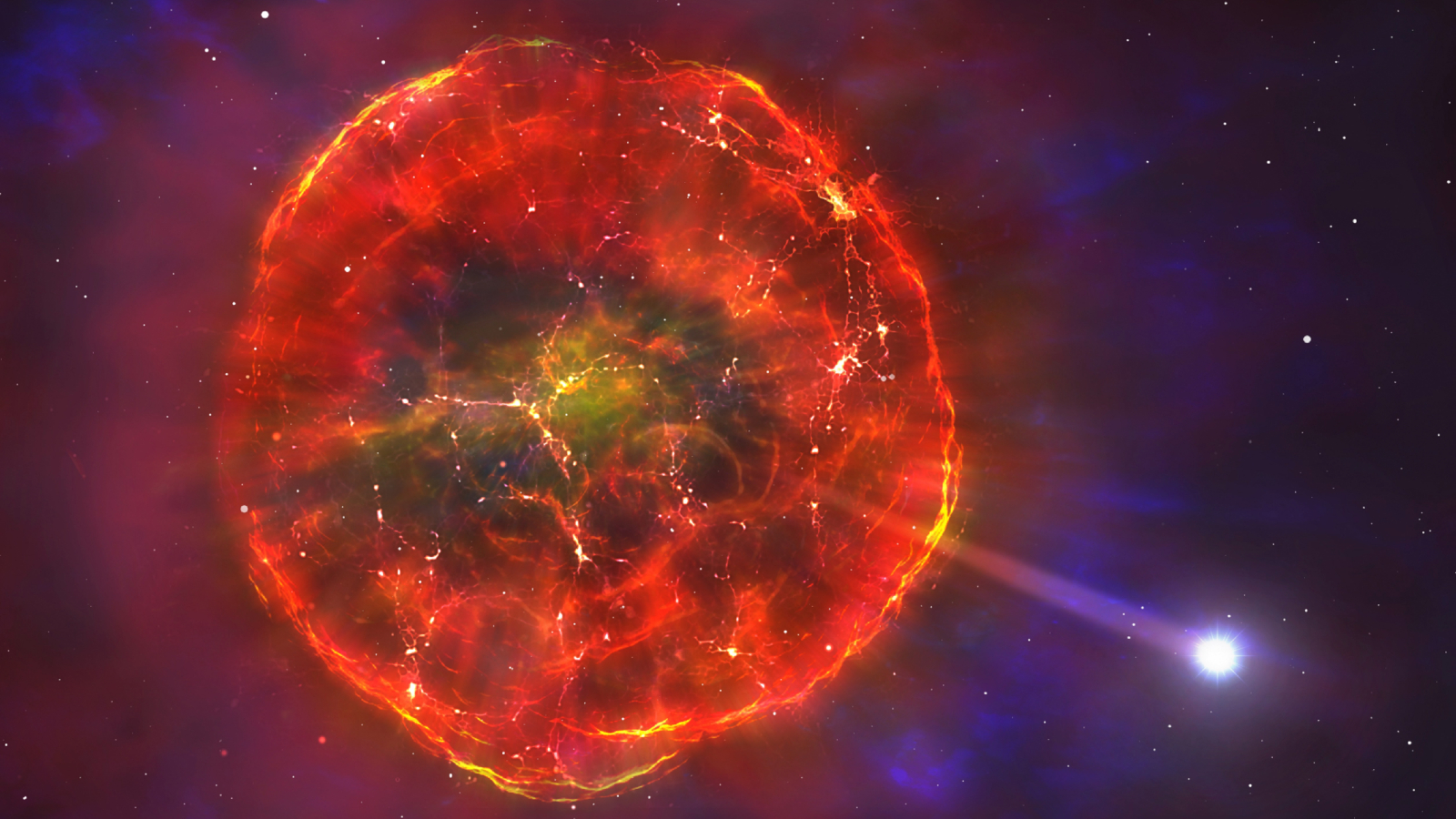
Somewhere out past the familiar stars of our galaxy sits an object so strange it barely deserves to be called a star anymore. It's called 1E 1547.0-5408, and it's a magnetar — the collapsed, city-sized corpse of a star that once dwarfed our sun, now spinning in the dark with a magnetic field so extreme that it would strip the electrons clean off every atom in your body from a distance farther than the Moon. For years, astronomers have quietly pointed their most sensitive instruments at this object and a handful of others like it, hoping to catch it in the act of doing something no laboratory on Earth has ever managed: bending light using nothing but empty space itself.
This month, in a paper published in the journal Nature on August 5, an international team of astrophysicists announced they may have finally done it. If their result holds up — and that "if" is doing a lot of work, as you'll see — it would be the first direct evidence for a phenomenon called vacuum birefringence, predicted in 1936 by Werner Heisenberg, one of the founding fathers of quantum mechanics, and his collaborator Hans Euler. It would mean that what we call "empty space" is, at the quantum level, a roiling soup of particles that don't technically exist — and that under the right conditions, that soup can grab hold of light and twist it.
What Scientists Actually Saw
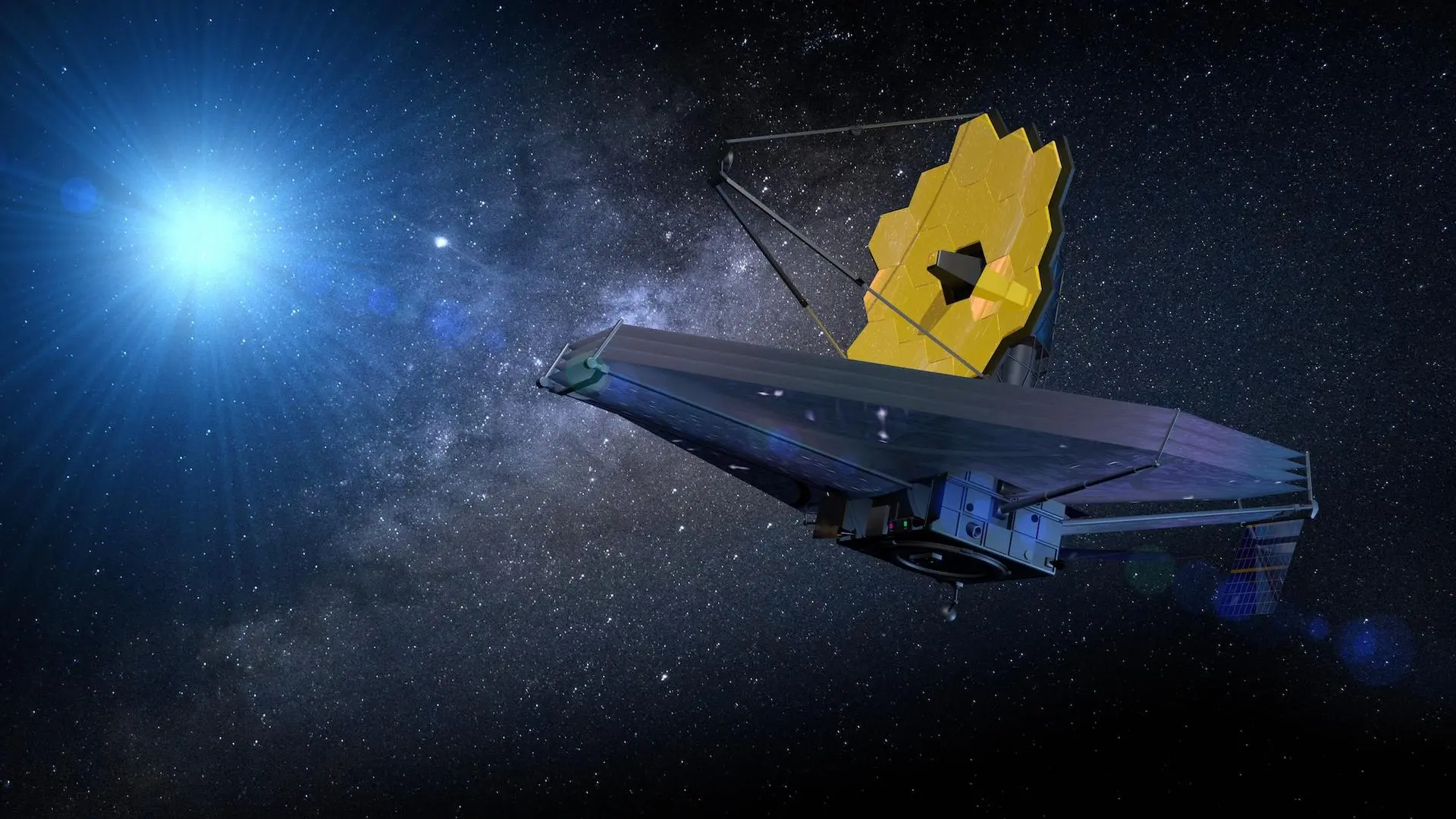
The discovery didn't come from a single dramatic observation but from more than 140 hours of painstaking, coordinated surveillance. Between March and April of last year, researchers trained NASA's IXPE space telescope — the Imaging X-ray Polarimetry Explorer, purpose-built to measure the orientation of X-ray light — on the magnetar, while simultaneously running observations through NASA's NICER instrument and CSIRO's giant Murriyang radio telescope dish in Australia. It was the first time anyone had combined radio and X-ray polarization measurements of a magnetar in a single coordinated campaign, giving the team a far more complete picture than any single instrument could provide alone.
What they found was polarization — essentially, a measurement of how aligned the light waves coming off the magnetar are — at levels dramatically higher than anything seen from similar objects. Light emerging from the object's upper and lower magnetic "emission cones" showed polarization degrees of roughly 40% and 80% respectively, according to the research team, nearly three times greater than polarization levels typically observed from comparable sources. That's the signature theorists have predicted vacuum birefringence should leave behind: light getting twisted not by dust, or gas, or any physical obstruction, but by the empty space itself, warped by a magnetic field strong enough to make the vacuum behave like a lens.
"Detecting vacuum birefringence requires a magnetic field that is over 100 million times stronger than any we've ever made on Earth," said Dr. Marcus Lower, an astrophysicist at Swinburne University of Technology who worked on the research. "Thankfully, nature has provided us with magnetars, which are the perfect cosmic laboratories to go looking for this effect." No particle accelerator, no laser lab, no facility humans have ever built can generate a magnetic field anywhere close to what a magnetar produces naturally just by existing — which is precisely why physicists have had to wait nearly a century, and travel thousands of light-years in their imaginations, to even attempt this test.
The Bizarre Physics of "Nothing"
To understand why this matters, you have to let go of the idea that empty space is actually empty. According to quantum electrodynamics — the wildly successful theory describing how light and charged particles interact — a true vacuum isn't a void at all. It's teeming with what physicists call "virtual particles": electron-positron pairs that spontaneously pop into existence out of nothing, exist for an almost unimaginably brief instant, and then annihilate each other and vanish again, over and over, everywhere, all the time, including in the space between you and this sentence right now.
Under normal circumstances, this quantum froth is invisible and irrelevant — its effects average out to nothing detectable. But Heisenberg and Euler theorized that in the presence of an extraordinarily powerful magnetic field, that sea of virtual particles would become briefly, subtly organized, lining up in a way that creates two different "speeds" for light depending on its polarization direction. That mismatch is birefringence — the same basic optical effect that makes calcite crystals split a single beam of light into two, or that lets your polarized sunglasses cut glare, except here the "crystal" doing the splitting is empty space itself, sculpted by a magnetic field into something that behaves like a lens. It's one of the strangest and most beautiful predictions to fall out of 20th-century physics: that nothing, under enough pressure, starts acting like something.
Not So Fast, Say the Skeptics
Here's where the tabloid version of this story has to slow down and be honest: not everyone in the field is convinced the case is closed. A companion analysis, published separately in April of this year by an independent group of researchers, took the exact same IXPE dataset and ran it through a different geometric model of how the magnetar's magnetic field is shaped and oriented — and came away far less certain. Their conclusion: the same polarization signal that looks like a vacuum birefringence smoking gun under one set of assumptions could, under a different but equally defensible set of assumptions, be explained without invoking any exotic quantum vacuum effect at all.
The core of the disagreement isn't about the data itself — both teams are looking at the same 140-plus hours of observations — but about how to model the incredibly complicated, twisted geometry of the magnetic field lines around a magnetar, something no one can observe directly and can only infer indirectly from the light that escapes. Get that geometry model even slightly wrong, and a signal that looks like unambiguous evidence of Heisenberg's 90-year-old prediction can just as easily be explained by more mundane astrophysical processes happening in the magnetar's superheated atmosphere. As one assessment of the debate put it, the high polarization observed is certainly consistent with vacuum birefringence — but "consistent with" and "proof of" are two very different scientific claims, and right now, the data can't yet fully separate them.
Confirming the effect beyond reasonable doubt, researchers say, will likely require one of three things: a higher-confidence measurement of polarization dropping to a minimum at a very specific "vacuum resonance" energy that only the quantum effect would produce, a larger sample of magnetars all showing the same telltale signature so it can't be dismissed as one object's quirk, or — the dream scenario for experimental physicists — a laboratory measurement here on Earth that independently corroborates what's being seen 9,000 light-years away. None of those three things exists yet.
Why a 90-Year-Old Prediction Still Matters
It's worth pausing on just how long this chase has been running. Heisenberg is a household name mostly for his uncertainty principle — the idea that you can't simultaneously know a particle's exact position and exact momentum — but his 1936 work with Euler on vacuum birefringence was, in its own way, just as radical. It was one of the earliest concrete predictions to fall out of the then-brand-new field of quantum electrodynamics, and it has sat there, untested, for nine decades, waiting for either technology or nature to catch up to the theory. Laboratory attempts to detect the effect using the most powerful lasers and magnets humans can build have gotten tantalizingly close but never quite there — the fields we can generate on Earth remain millions of times too weak. Magnetars, in that sense, are doing physics a favor that no government grant or research budget could ever buy: providing, for free, a natural laboratory more extreme than anything humanity could construct in the next century.
If the effect is eventually confirmed beyond doubt, it wouldn't just check a box on a very old to-do list. It would be direct, observational proof that quantum electrodynamics — one of the most rigorously tested theories in all of physics, but one built almost entirely on laboratory-scale experiments — holds up even in the most extreme magnetic environments the universe can produce. That matters for understanding not just magnetars themselves, but the fundamental behavior of light and matter at the outer edges of what physics currently understands.
Expert Perspective
Physics World, one of the field's most closely watched trade publications, framed the finding cautiously in its own analysis, posing the question in its headline as "Has vacuum birefringence been seen at long last?" rather than declaring victory outright — a framing that captures where most of the physics community currently sits: intrigued, encouraged, but not yet ready to rewrite the textbooks. Commentary from Sense About Science similarly described the result as evidence that "edges physicists toward" Heisenberg's prediction, rather than evidence that clinches it. The consistent message from researchers not directly involved in either team: this is one of the most exciting hints in a 90-year hunt, but a hint is still a hint.
What This Means for You
You will almost certainly never notice vacuum birefringence in your daily life — the magnetic fields required are roughly 100 million times stronger than anything humans have built, and light only bends detectably around objects like magnetars that exist trillions of miles away. But the underlying story is a reminder of something genuinely strange about the universe you live in: the "nothing" that fills the space between every atom in your body, every object in your house, and every star in the night sky is not actually nothing. It's a churning, invisible field of particles blinking in and out of existence faster than any instrument could ever directly photograph — and every few decades, if you're very lucky and very patient, the universe hands you a natural experiment extreme enough to prove it.
The Bottom Line
Nine thousand light-years away, a dead star's magnetic field may be doing something Werner Heisenberg predicted before World War II had even started — twisting light using nothing but the fabric of empty space. The evidence is the best anyone has ever gathered, built on 140 hours of coordinated observation across three of the world's most sensitive instruments. But science, done properly, doesn't declare victory on a single paper, and a rival analysis has made clear that the geometry of a magnetar's magnetic field is complicated enough to leave room for doubt. What happens next — more magnetars, sharper measurements, maybe even a lab breakthrough here on Earth — will determine whether 2026 goes down as the year physicists finally caught empty space in the act, or just the year they got tantalizingly close.
Published By | Tech Wiz