SCIENCE & TECH
For almost ninety years, one of the strangest predictions in all of physics has sat unproven in textbooks, daring anyone to actually go out and check it: that the vacuum of space — nothing, emptiness, the void — is secretly not empty at all. That it seethes, invisibly, with pairs of particles blinking in and out of existence trillions of times a second. And that under a strong enough magnetic field, that ghostly churn should bend and twist light passing through it, the same way a chunk of glass or a crystal does.
Nobody could ever build a magnet strong enough on Earth to test it. So a team of astronomers did something bolder: they used the universe's own magnet instead. And this month, in the pages of the journal Nature, they announced that they may have finally caught "empty" space in the act.
The 90-Year-Old Cold Case
The idea traces back to Werner Heisenberg, one of the founding architects of quantum mechanics, and his collaborator Hans Heinrich Euler, who worked out the mathematics in the 1930s. Quantum theory says the vacuum isn't a true void. It's constantly and briefly generating "virtual" particle-antiparticle pairs — mostly electrons and their antimatter twins, positrons — that flicker into existence and annihilate each other again almost instantaneously, too fast and too faint to ever detect directly.

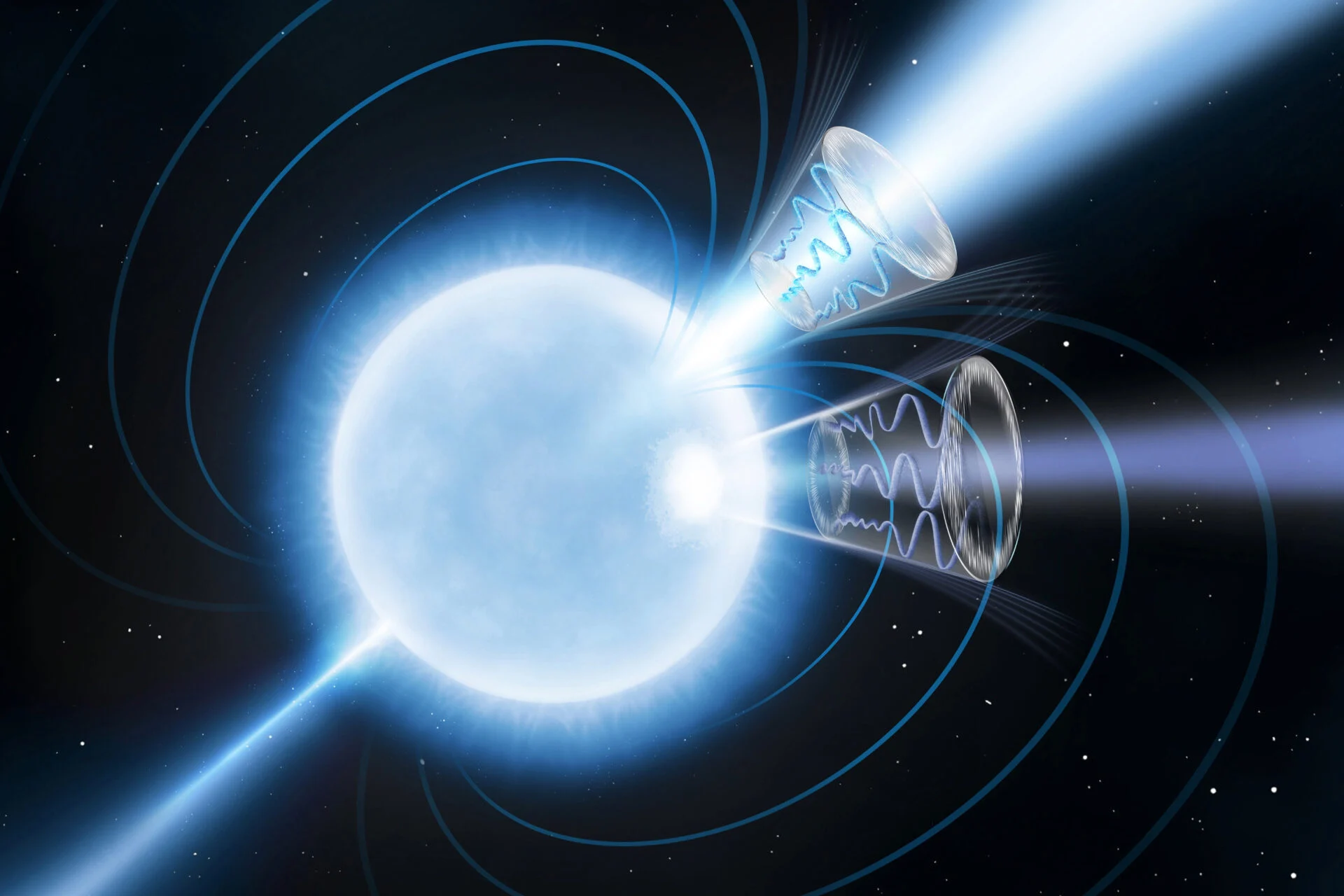
Under normal conditions, this quantum froth is invisible and irrelevant. But Heisenberg and Euler predicted that if you dropped that vacuum into an extraordinarily powerful magnetic field, those virtual particle pairs would snap into alignment with the field, turning empty space itself into something that behaves like an optical material — specifically, a birefringent one, meaning it refracts light differently depending on the light's polarization. Light passing through would come out polarized in a detectable way, a fingerprint of the vacuum's hidden, seething quantum structure.
Physicists gave the effect a name: vacuum birefringence. And then they spent the better part of a century unable to test it, because as Dr. Marcus Lower of Swinburne University of Technology in Australia — one of the astronomers behind the new discovery — put it, "detecting vacuum birefringence requires a magnetic field that is over 100 million times stronger than any we've ever made on Earth." Every particle accelerator, every superconducting magnet, every high-energy physics lab on the planet, and none of them could get remotely close.
Turning a Dead Star Into a Laboratory
So the research team looked past Earth entirely, to an object almost too extreme to be real: a magnetar.
Magnetars are a rare and violent breed of neutron star — the collapsed, city-sized cores left behind when a massive star dies in a supernova, crushed down until a teaspoon of its material would weigh billions of tons. Ordinary neutron stars are already strange enough. Magnetars are the extreme outliers even among them, wrapped in magnetic fields so powerful that if one passed within a couple hundred thousand miles of Earth, it could scramble the magnetic stripes on every credit card on the planet.
The team focused on a specific magnetar named 1E 1547.0−5408, a rapidly rotating neutron star whose surface magnetic field is estimated at over a trillion times stronger than Earth's own — and roughly, by Dr. Lower's estimate, more than 100 million times stronger than anything humans have ever generated in a lab. If Heisenberg and Euler were right, this was exactly the kind of environment where their prediction should show up loud and clear.
To check, the international team combined data from three different instruments: NASA's Imaging X-ray Polarimetry Explorer (IXPE), which specializes in measuring the polarization of X-rays; NASA's NICER telescope, which observes the star's thermal X-ray emission; and the Parkes/Murriyang radio telescope in Australia, which tracked the magnetar's radio pulses. Coordinating observations across X-ray and radio wavelengths let the team cross-check whether any polarization signal they found in the X-rays lined up with the star's known magnetic field geometry, mapped independently through its radio emissions.
What They Found
The results, published August 5 in Nature, were striking. The X-rays streaming off the magnetar showed an extremely high degree of polarization — around 65% at 2 keV, the energy range where the neutron star's surface thermal emission dominates, and climbing to nearly 80% at certain points in the star's rotation. Critically, the direction of that X-ray polarization was locked to the magnetar's magnetic field axis in essentially the same way the star's radio wave polarization was — a coincidence far too precise, the researchers argue, to be explained by anything other than the light itself being reshaped as it passed through the intensely magnetized vacuum surrounding the star.
In plain terms: the space around the magnetar was acting like a lens, and there was nothing there to act as a lens except the quantum vacuum itself.
"Because of the magnetic field's strength, Heisenberg's virtual particles become aligned with the direction the field is pointing," Dr. Lower explained, describing how the alignment of those fleeting particle pairs imprints itself onto the polarization of light passing through the region.
The team is calling it the strongest direct astrophysical evidence yet for vacuum birefringence — arguably the first real observational glimpse of a quantum electrodynamics effect that has existed only on paper since the 1930s.
Why Physicists Are Buzzing
It's worth pausing on how unusual this is as a scientific result. Most headline-grabbing physics discoveries come from purpose-built experiments — enormous particle colliders, laser facilities, or space telescopes engineered from scratch to chase a specific signal. This one came from pointing existing instruments at a naturally occurring object that happens to be a better physics lab than anything humans could ever construct.
That's part of why researchers are excited beyond the headline result itself. Confirming vacuum birefringence would be a direct experimental test of quantum electrodynamics (QED) — the extraordinarily well-tested theory describing how light and matter interact — in a regime so extreme it's simply inaccessible any other way. It's one thing to trust QED's predictions because the math is elegant and the theory has passed every lab test we can throw at it; it's another to actually watch one of its stranger consequences play out on a dying star 10,000-plus light-years away.
Researchers involved in the work have also framed it as validation for a broader strategy: using extreme astrophysical objects — magnetars, black holes, neutron star mergers — as natural laboratories for physics conditions that will likely never be replicable on Earth, not in this generation and maybe not ever. As one summary of the work put it, this is a case of "the universe doing the experiment" for us, because we simply lack the tools to run it ourselves.
The finding also isn't standing alone — it lands in the same month that astronomers have separately reported unusual quantum-adjacent behavior in laboratory materials, including a possible way to switch on hidden magnetism in ruthenium dioxide, a material long thought to be non-magnetic. Taken together, researchers say, 2026 has been an unusually productive stretch for spotting quantum effects hiding in plain sight, whether in a crystal on a lab bench or in the magnetosphere of a collapsed star.
The Caveats
Scientists studying the result are, appropriately, urging some caution before declaring the 90-year-old mystery fully closed. Vacuum birefringence is an inference drawn from polarization measurements and their alignment with the magnetar's known field geometry — it isn't something you can see directly, the way you might watch a chunk of glass visibly bend a laser beam in a classroom demonstration. Alternative explanations for high X-ray polarization around magnetars have been proposed before, generally involving complex physics happening at or near the star's surface rather than in the surrounding vacuum itself, and part of the reason this study is generating so much attention is that its authors argue their combined X-ray-and-radio approach does a better job ruling those alternatives out than previous attempts.
Independent researchers will likely spend the coming months and years scrutinizing the analysis, hunting for similar signals around other magnetars, and looking for ways to further stress-test the conclusion — which is exactly how it should go for a result this significant.

What This Means for You
No, this discovery won't change anything about your daily life tomorrow morning. You won't download an app for it, and it won't show up in your electricity bill. But it matters in a quieter way: it's a reminder that some of the strangest, most abstract ideas in physics — concepts that sound more like philosophy than science, like "empty space isn't really empty" — are turning out to be literally, measurably true, confirmed not in a billion-dollar collider but by carefully watching a star that's been dead for tens of thousands of years.
It's also a small triumph for a very human kind of patience. Heisenberg and Euler wrote down this prediction in the 1930s, fully aware that nobody alive at the time had any conceivable way to test it. Ninety years, several generations of physicists, and an enormous amount of accumulated instrumentation later, someone finally could.
The Bottom Line
Vacuum birefringence has gone from a nine-decade-old theoretical curiosity to the subject of one of 2026's most talked-about physics papers, thanks to a rare magnetar, three coordinated telescopes, and an international team willing to treat a dead star as the laboratory Earth could never build. If the result holds up to further scrutiny, physicists will have their first direct astrophysical confirmation that the vacuum of space is, in a very real sense, alive with quantum activity — bending light, right in front of us, in a place we always assumed had nothing there at all.
Published By | Tech Wiz