Written By | Torch Media Africa
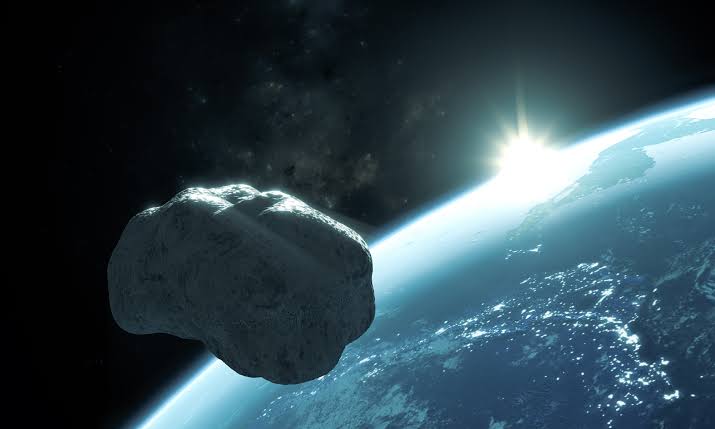
Kamo'oalewa isn't a moon in the traditional sense — it doesn't orbit Earth the way our actual Moon does
China's Tianwen-2 spacecraft has arrived at the tiny asteroid Kamo'oalewa after a 400-day, billion-kilometer chase — and the first pictures are already blowing up a five-year-old theory about its true origin
BEIJING/PASADENA
For five years, scientists have quietly believed that Earth has been shadowed by a chunk of its own Moon — a tiny, elusive rock called Kamo'oalewa that traces a strange, looping path around our planet without ever technically orbiting it. Now, after a journey of roughly a billion kilometers and 400 days through the void, a Chinese spacecraft has finally arrived close enough to find out the truth. And the early evidence suggests the textbooks may need a rewrite.
China's Tianwen-2 probe, launched from the Xichang Satellite Launch Center on May 29, 2025, reached its target in early July 2026, settling into position roughly 20 kilometers from the asteroid known officially as 469219 Kamo'oalewa. The China National Space Administration released the first close-up image of the object on July 6, and it's a strange sight: a small, elongated, potato-shaped rock tumbling silently through space, roughly the length of a football field, that has been hiding one of the solar system's more intriguing secrets in plain sight practically since Earth acquired it as a quasi-satellite.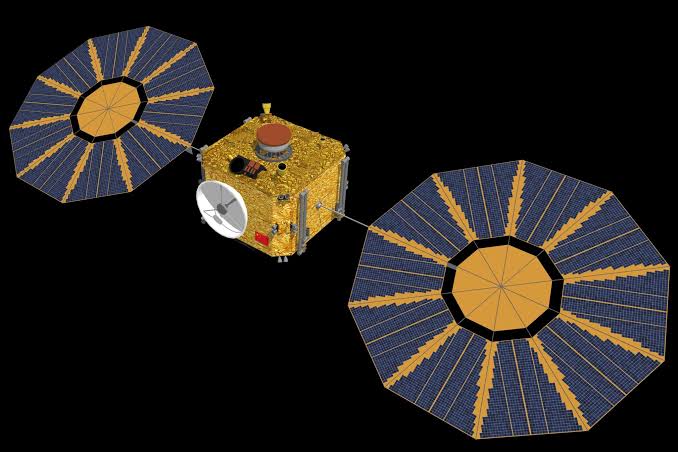
China's Tianwen-2 spacecraft
What Exactly Is a "Quasi-Moon"?
Kamo'oalewa isn't a moon in the traditional sense — it doesn't orbit Earth the way our actual Moon does. Instead, it's what astronomers call a "quasi-satellite": an object that shares an orbital rhythm with Earth around the Sun in such a way that, from our planet's perspective, it appears to loop and dance nearby for extended stretches without ever being gravitationally captured. It was first discovered in 2016 by the Pan-STARRS survey telescope in Hawaii, and its name — pulled from a Hawaiian creation chant — roughly translates to "the oscillating celestial object."
At an estimated 40 to 100 meters across (roughly the size of a small office building), Kamo'oalewa is faint, small, and notoriously difficult to observe from Earth, even with powerful telescopes. That's exactly why a dedicated spacecraft mission was necessary to actually settle the biggest question surrounding it: where did the thing actually come from?
The Moon-Fragment Theory That Ruled for Five Years
Since shortly after its discovery, the leading scientific hypothesis held that Kamo'oalewa was a genuine chip off the old block — a fragment blasted off the far side of the Moon by some ancient, violent asteroid impact millions of years ago, one that happened to end up in a stable-ish orbital relationship with Earth rather than drifting off into deep space or falling back to the lunar surface. That theory rested heavily on ground-based spectroscopic data: light bouncing off Kamo'oalewa's surface showed a reflectance pattern that closely matched space-weathered lunar soil, the kind of surface material you'd expect from something that spent eons baking on the Moon before getting launched into its current orbit.
It was a compelling, almost poetic idea — a literal piece of Earth's Moon, quietly following us through space for who-knows-how-long, waiting to be identified. Researchers scoured potential lunar impact craters, including the young, prominent Giordano Bruno crater on the Moon's far side, hunting for the exact impact event that might have launched Kamo'oalewa on its journey.
The Plot Twist: New Data Says "Not So Fast"
But science doesn't wait for a good story to stay true, and Kamo'oalewa's moon-fragment narrative has taken a serious hit in just the past few weeks. Around the same time Tianwen-2 was closing in on its target, researchers published a preprint on July 1 drawing on new James Webb Space Telescope spectral data, combined with laboratory simulations, that points in a very different direction. According to that analysis, Kamo'oalewa's surface composition closely resembles highly space-weathered LL chondrite meteorites — a common class of stony space rock believed to originate from the main asteroid belt between Mars and Jupiter — rather than genuine lunar material.
That doesn't necessarily kill the Moon-origin theory outright. The scientists behind the new analysis were notably careful in how they phrased their conclusions, writing that while their data supports an LL chondrite-dominated surface, they "do not completely close the door" on a lunar composition. Space weathering — the slow bombardment of micrometeorites and solar radiation that alters a surface over millions of years — can make it genuinely difficult to distinguish between a heavily altered lunar sample and a heavily altered asteroid sample using spectral data alone. Other researchers have proposed competing dynamical origin stories entirely, suggesting Kamo'oalewa might have arrived at its current quasi-satellite orbit via a gravitational quirk called the ν6 secular resonance, membership in the "Flora family" of main-belt asteroids, or even a 3:1 orbital resonance with Jupiter — mechanisms that would point firmly toward an asteroid-belt origin and away from the Moon entirely.
In other words: right as Tianwen-2 arrived on the scene, the entire scientific debate about what this thing even is blew wide open again. Which makes the timing of China's mission almost perfect.
The Mission: A Three-Way Sampling Gambit
Tianwen-2's job now is to settle the argument with hard, physical evidence rather than remote spectral guesswork. Over the coming months, the spacecraft will drop to an operational altitude of around eight kilometers above Kamo'oalewa's surface, using its suite of cameras, navigation sensors, and radar instruments to build a detailed map of the asteroid's shape, composition, and terrain — partly to satisfy scientific curiosity, and partly to hunt for the safest, most scientifically valuable spot to actually touch the thing.
Because Kamo'oalewa is so small, and its gravity so weak, traditional landing approaches are essentially useless. Instead, Tianwen-2 is equipped to attempt sample collection using up to three different techniques depending on what its surveys reveal: a "hovering" sampling method, a quick touch-and-go maneuver similar to what NASA's OSIRIS-REx mission used at asteroid Bennu, and — if the surface proves suitable — an anchoring-and-attachment approach that would let the spacecraft physically grip the asteroid to collect material. Mission planners are targeting a haul of somewhere between 200 and 1,000 grams of surface material, a modest amount by Earth standards but potentially field-defining for planetary scientists once it's back in a lab.
That sample won't arrive on Earth any time soon. Current mission planning has Tianwen-2 departing Kamo'oalewa around April 2027, after which it will use a return capsule to deliver the collected material back to Earth via reentry in late November 2027 — while the main spacecraft itself continues onward toward a second target, the main-belt comet 311P/PANSTARRS, for an extended bonus mission.
Not the Only Spacecraft in the Neighborhood
Tianwen-2 isn't operating alone in this particular corner of the solar system this month. In a remarkable coincidence of timing, Japan's Hayabusa2 spacecraft — already famous for successfully returning samples from asteroid Ryugu back in 2020 — has been conducting an extended-mission flyby of another near-Earth asteroid, Torifune, around the same window in July 2026. Between the two missions, scientists are getting an unusually rich, near-simultaneous look at multiple small solar system bodies that have historically been far too faint and distant to study in this kind of detail.
Expert Perspective: Why This Rock Actually Matters
It would be easy to dismiss a 40-to-100-meter space rock as scientific trivia, but planetary scientists have been pushing hard for exactly this kind of mission for years, and for good reason. Near-Earth objects like Kamo'oalewa sit at the intersection of several major scientific questions: how the solar system's rocky building blocks formed and evolved, how impacts have shaped both the Moon and Earth over billions of years, and — perhaps most practically — how humanity should think about planetary defense against future asteroid impacts.
If Kamo'oalewa really did come from the Moon, it would be an entirely unprecedented category of object: essentially a natural, uncrewed sample-return mission that already happened millions of years ago, just waiting for humans to catch up and collect the pieces. That would give scientists direct physical access to lunar material from a region of the Moon — potentially the far side — that Apollo astronauts never sampled. If, on the other hand, it turns out to be a garden-variety chondritic asteroid fragment that merely settled into an unusual orbit, that's still valuable: it would help refine models of how the vast population of near-Earth asteroids ends up in these quasi-satellite dances with our planet in the first place, and how common — or rare — genuine lunar ejecta might be floating around nearby space.
Either way, having an actual physical sample beats spectral guesswork every time. Ground- and space-based telescope observations, even from an instrument as powerful as James Webb, can only tell you so much about a surface baked by billions of years of space weathering. A sample in a lab, examined atom by atom under controlled conditions, tends to settle debates that remote sensing alone cannot.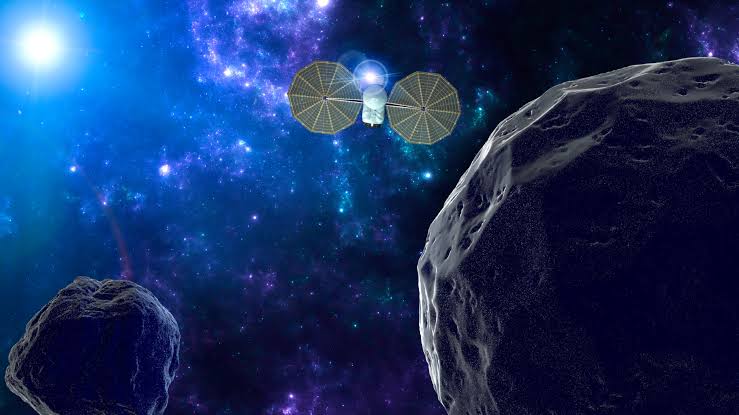
What This Means for You
Unless you're a planetary geologist, Kamo'oalewa's origin story might not seem to have much bearing on daily life — but the broader mission it's part of does. Every successful asteroid sample-return mission, from Japan's Hayabusa missions to NASA's OSIRIS-REx to now China's Tianwen-2, sharpens humanity's understanding of the population of small rocky bodies zipping around near Earth's orbit. That knowledge feeds directly into planetary defense planning: the tools and techniques used to characterize, approach, and potentially redirect a threatening asteroid someday all trace back to missions exactly like this one, which double as practice runs.
There's also the pure scientific payoff of understanding our own Moon better. If any of the sample turns out to be genuine lunar ejecta, it would represent one of the more unusual paths a piece of the Moon has ever taken to end up in a laboratory on Earth — arriving not via astronaut boot or robotic lander, but by first getting blasted into an eons-long game of orbital hide-and-seek before finally being chased down by a spacecraft.
The Bottom Line
The first pictures are in, the composition debate has been reopened rather than closed, and the actual sample won't reach Earth until late 2027 — meaning the real answer to "what is Kamo'oalewa, really?" is still months, if not years, away. But for the first time since this strange little quasi-moon was spotted a decade ago, scientists finally have a spacecraft close enough to start finding out for certain, rather than squinting at reflected light from tens of millions of kilometers away. Whatever Tianwen-2 ultimately drags back to Earth, it's likely to rewrite at least one chapter of how we understand the rocky, restless neighborhood surrounding our planet.



