Written By | Torch Media Africa
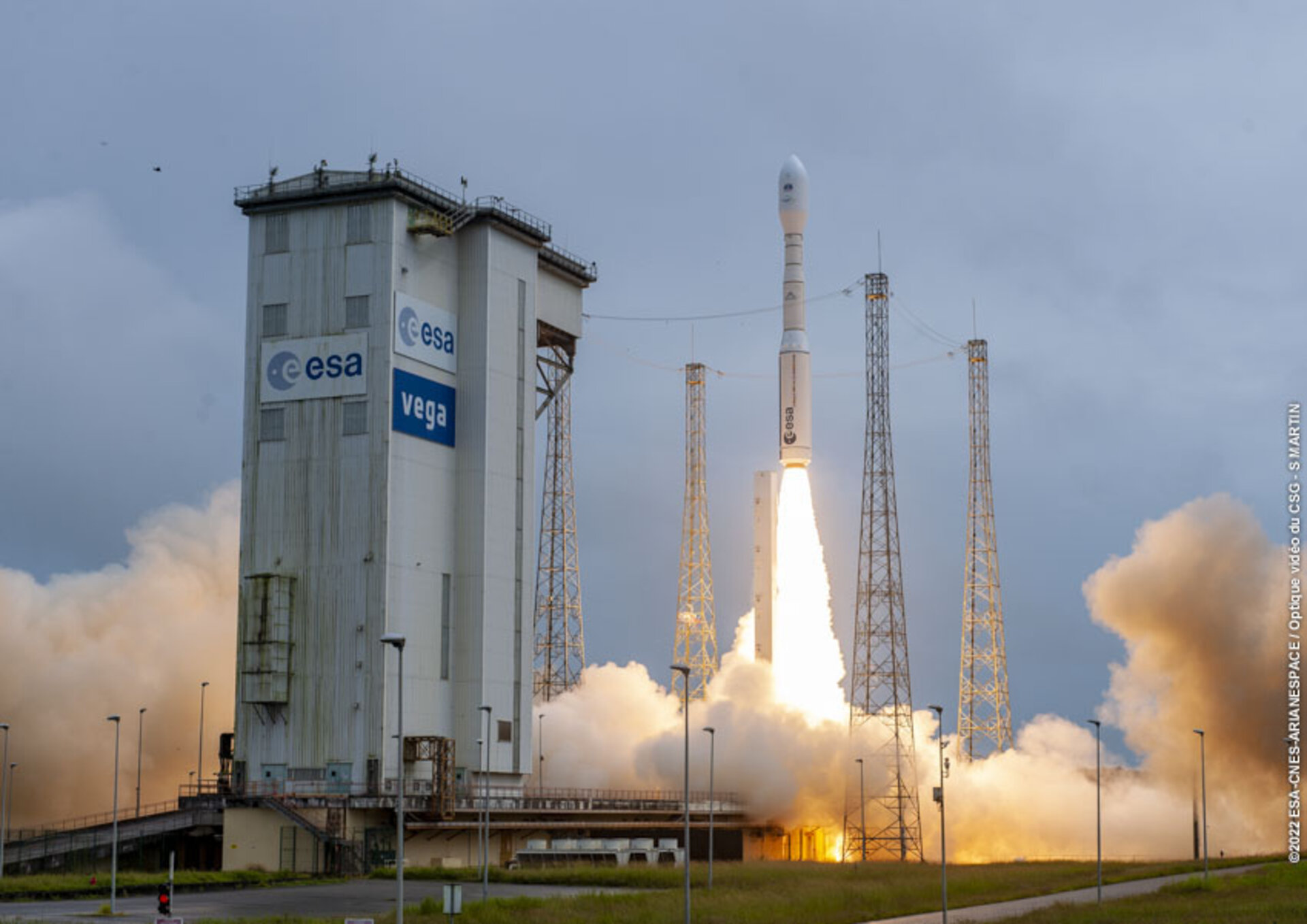
At 03:21 CEST a Vega-C rocket blasts off from the jungle to photograph it — and what it finds could tell us how much longer our crops can take the heat.
Every leaf, blade of grass and wheat stalk on the planet is leaking a faint red light you have never seen. At 03:21 CEST a Vega-C rocket blasts off from the jungle to photograph it — and what it finds could tell us how much longer our crops can take the heat.
SCIENCE & TECH
The countdown clock at Europe's Spaceport is running, the jungle is loud with insects, and sitting on top of a 35-metre Italian rocket are two satellites that between them are about to do something no machine has ever done. One of them is going to watch the entire planet glow.
Not metaphorically. Literally.
At 22:21 local time tonight — 03:21 on Tuesday morning in Paris and Berlin, 01:21 UTC — a Vega-C rocket operated by Italy's Avio S.p.A. is scheduled to lift off from the ELV pad at Kourou on the coast of French Guiana. The window is instantaneous. There is no "we'll try again in ten minutes." It goes at 01:21 UTC or it does not go tonight.
Riding inside the fairing are the 1,143-kilogram Copernicus Sentinel-3C, a workhorse environmental satellite, and a smaller, stranger passenger: a 397-kilogram spacecraft called FLEX, the Fluorescence Explorer. FLEX has one job, and it is the kind of job that sounds like a misprint until a scientist explains it to you. FLEX is going to measure the invisible light that plants give off while they are feeding.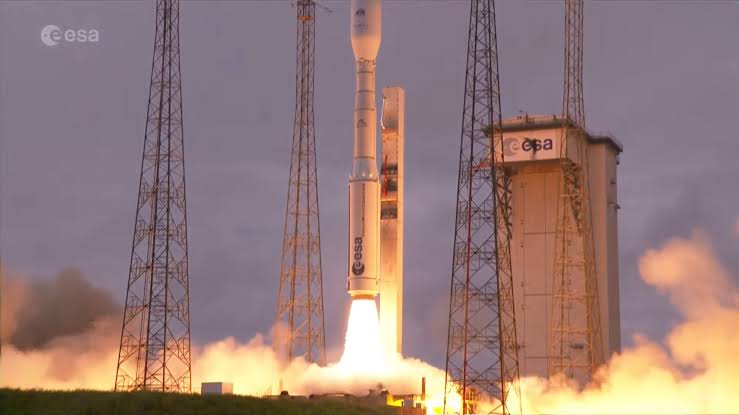
Vega C Rocket taking off
Here is the thing almost nobody outside a plant physiology department knows. When sunlight hits a leaf, the chlorophyll inside grabs that energy and uses most of it to run photosynthesis — the chemical trick that turns light, water and carbon dioxide into sugar and oxygen, and which every single thing you have ever eaten ultimately depends on.
But the machinery is not perfect. A tiny sliver of that captured energy never makes it into the sugar. It leaks back out as light, re-emitted at longer, redder wavelengths. Scientists call it solar-induced fluorescence. Everyone else would call it a glow.
It is happening right now, on every lawn, in every forest, across every rice paddy and maize field on Earth. It is happening on the houseplant in the corner of your living room. You cannot see it because your eyes are nowhere near sensitive enough and because the reflected sunlight bouncing off the same leaf is thousands of times brighter. But it is there.
"Behind this green façade," as the European Space Agency put it in a briefing published on 10 September, "plants are secretly glowing."
And that glow is not decoration. It is a read-out. It is the exhaust port of a running engine, and if you can measure it, you can tell whether the engine is working properly.
Satellites have been photographing vegetation for more than fifty years. They are very good at telling you how green something is. They are much worse at telling you whether it is actually doing anything.
A field of wheat that is three days into a heatwave still looks green from orbit. A forest that has quietly stopped fixing carbon because the groundwater is gone still looks green from orbit. By the time the colour changes — by the time leaves brown and wilt and the damage is visible from 800 kilometres up — the harvest is already lost and the carbon budget has already been blown.
Fluorescence changes first. Drought, nutrient starvation, heat, pests and herbicide damage all interfere with the photosynthetic machinery, and the fluorescence signal shifts as the stress develops, before the plant visibly gives up.
That is the promise. ESA is careful to flag the catch, and it is a real one. The agency's own materials warn bluntly that the glow "is complicated." Fluorescence does not simply drop whenever a plant is in trouble. Depending on whether the plant is in the early or late stages of drought or chemical damage, the signal can go up as easily as down. A single number, read in isolation, can mislead you completely.
Which is exactly why FLEX is not flying alone.
FLEX will fly in tandem formation, 40 to 100 kilometres ahead of a Copernicus Sentinel-3 satellite, in a sun-synchronous orbit at 814 kilometres altitude, inclined 98.64 degrees, with a 27-day repeat cycle. Sentinel-3 carries instruments that measure clouds, aerosols, water vapour, land-surface temperature and colour.
That matters enormously. To pull a faint red glow out of a scene that is drenched in reflected sunlight, you need to know precisely what the atmosphere between you and the leaf was doing at that moment. Sentinel-3 supplies the correction. FLEX supplies the signal. Neither works properly without the other.
The instrument doing the actual looking is called FLORIS — the Fluorescence Imaging Spectrometer, built by Leonardo in Italy, mounted on a satellite built by Thales Alenia Space in France. It works across the 500 to 780 nanometre range, but the numbers that matter are the fine ones. In the two oxygen absorption bands — O2-A between 759 and 769 nanometres, and O2-B between 686 and 697 — FLORIS samples every 0.1 nanometres. That is the spectral equivalent of reading the serial number on a coin from the far end of a football pitch.
Those oxygen bands are the trick. Because oxygen in the atmosphere swallows sunlight at those exact wavelengths, they act as dark windows in the solar spectrum. Any light coming up out of them that should not be there is the plant's own emission. That is how you separate a whisper from a shout.
The output will be global maps of vegetation fluorescence at roughly 300 metres by 300 metres per pixel. Individual fields. Individual patches of forest. Not continents — farms.
Tonight's flight is designated VV30, and it is a more delicate piece of choreography than a typical launch. The Vega-C will fly a northerly track out of Kourou, climbing into that sun-synchronous orbit at around 810 kilometres.
From liftoff to final payload separation the mission runs 116 minutes. The AVUM+ fourth stage reignites at T+55 minutes 28 seconds. Sentinel-3C lets go at T+1 hour 49 seconds. FLEX — the passenger everybody is watching — does not separate until T+1 hour 56 minutes 3 seconds, nearly an hour later. Then the upper stage performs a fifth and final burn to dispose of itself, in line with modern debris-mitigation practice.
For Avio, the stakes are institutional as well as scientific. This is only the second Vega-C flight since the Italian company took full responsibility for Vega launch services from Arianespace, and only the second Vega-C launch of 2026 after the SMILE mission on 18 May. The rocket's record reads seven successes in eight attempts. The single failure — the loss of the Pleiades Neo 5 and 6 satellites on 21 December 2022 — still hangs over the programme, even though the five flights since then, including Sentinel-1C, all worked.
Mission control sits at ESA's European Space Operations Centre in Darmstadt, Germany, where teams have been rehearsing what the agency described on 11 September as "a team of teams like never before" — because commanding two very different spacecraft into formation on the same night is not a normal LEOP. Science data will come down over X-band, telemetry and commands over S-band, through dedicated ground stations in Svalbard, Norway. Processing happens at ESA's ESRIN centre in Frascati, Italy.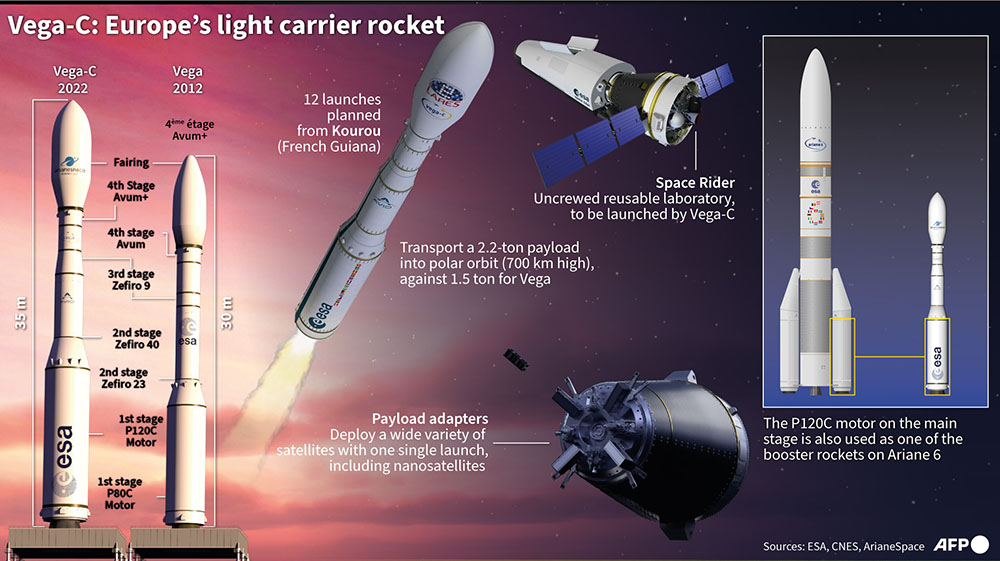
FLEX was selected as ESA's eighth Earth Explorer mission back in 2015 — the agency's line of pioneering, science-first spacecraft, each one built to answer a question nobody else was answering.
Getting here took more than a decade of proving the concept could work at all. Dirk Schuettemeyer, ESA's campaign coordinator, described the airborne validation campaigns that preceded the satellite as the moment "we can test these new ideas related to plant physiology that can be detected by airborne instruments, paving the way for the FLEX instrument under development." Teams flew spectrometers over test fields, including deliberately mutated plants with known photosynthetic defects, to confirm that the glow really did report on the machinery underneath.
The spacecraft itself is modest by flagship standards: 1.5 by 4.9 by 1.6 metres in orbit, 400 kilograms, a deployable solar array delivering 950 watts at end of life, a 57.6 amp-hour lithium-ion battery. Design life is 3.5 years plus a three-month commissioning phase — deliberately sized to cover at least three full seasonal vegetation cycles in both hemispheres.
That is the honest framing, and it is worth stating plainly rather than overselling. FLEX is not a twenty-year monitoring platform. It is a proof that a new kind of measurement is possible, and a first dataset for the scientists who will build on it. If it works, successors follow. If the signal turns out to be too noisy or too ambiguous to interpret, that is a finding too — an expensive one, but a real one.
Two things, and they are not abstract. The first is food. The world's population keeps growing, and the demand for food and animal feed grows with it, on a planet where the growing seasons are getting less predictable. An instrument that can flag crop stress across a whole continent weeks before the damage is visible is, in principle, an early-warning system for harvest failure. Not a magic one — FLEX will not tell a farmer in Punjab or Iowa to irrigate on Tuesday. But it could tell a government, a grain trader or a humanitarian agency that a region's photosynthetic output is falling off a cliff while the fields still look fine in a photograph. In a world that has watched food prices spike on the back of droughts nobody saw coming, that is worth a great deal.
The second is carbon, and this one is bigger. Land plants absorb a very large share of the carbon dioxide humans emit every year. Every climate projection you have ever read depends on an estimate of how much they will keep absorbing as the planet warms. That estimate is built substantially on models — on assumptions about how photosynthesis responds to heat and drought — rather than on direct global measurement, because until now there has been no way to measure planetary photosynthesis directly.
If the real number is lower than the models assume — if stressed vegetation is quietly switching off faster than expected — then the carbon budget humanity thinks it has is smaller than advertised. If it is higher, there is a little more room than feared. Either way, we would finally be measuring rather than guessing.
That is the question sitting on top of a rocket in a South American jungle tonight.
Vega-C has a good but not spotless record. The launch window is instantaneous. Two satellites have to survive a 116-minute ascent and separate cleanly nearly an hour apart. Then FLEX has to find and hold a formation with a partner spacecraft, and FLORIS has to pull a signal out of the noise that is so faint most instruments would never know it was there.
A lot has to go right. But if it does, then some time in the next few months, for the first time in the history of our species, we will get a picture of the Earth that shows not what is green, but what is alive and working.
The plants have been glowing for four hundred million years. Tonight we finally build something that can see it.



