Technological Transformation
A Nation the Size of a Cable Landing Station
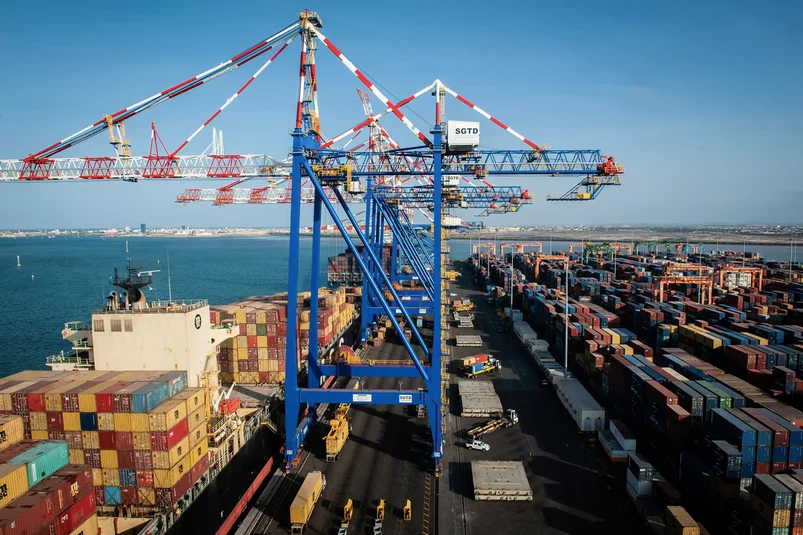
Djibouti has fewer than 1.2 million people and almost no arable land, but it sits at one of the busiest chokepoints in global data traffic, where dozens of subsea cables linking Europe, the Middle East and Asia converge on their way toward the rest of Africa. Over the past two years the government has moved deliberately to convert that accident of geography into a digital-economy strategy, stacking submarine cable investment, carrier-neutral data centers, a new national AI strategy and a fresh national digital identity platform on top of the port and logistics business that has long anchored the economy. The result is a small country trying to become an outsized regional infrastructure hub — a strategy that carries real revenue potential and equally real concentration risk.
Ten-Plus Cables and Counting
By early 2026, Djibouti had secured and activated more than a dozen major submarine cable systems, according to regional connectivity trackers, including the pan-African 2Africa system and the SEA-ME-WE 6 cable linking Southeast Asia through the Middle East to Europe. Coverage of the buildout has taken to calling Djibouti "Africa's Silicon Valley" for its cable density — a characterization that overstates the country's software and startup base but accurately captures its position as a physical relay point. Public reporting puts cumulative investment in Djibouti's twelve submarine cable systems at more than $200 million, funding that has gone into landing stations, terrestrial backhaul and the physical security of a network that much of East and Northeast Africa now depends on for international bandwidth.

That dependency is becoming more formal. In early 2026, Djibouti Telecom, Ethio Telecom and Sudan's Sudatel formalized the Horizon Fiber Initiative, a high-capacity terrestrial fiber corridor designed to link Djibouti's cable landing stations directly with Ethiopia and Sudan. The initiative is meant to convert Djibouti's coastal cable capacity into inland connectivity for two of the region's largest, and most bandwidth-starved, economies — Ethiopia alone has more than 130 million people and historically limited direct access to international cable capacity. Regional analysts have described the arrangement as central to a broader shift in which Ethiopia, Somalia and Djibouti are increasingly treated as a single digital corridor rather than three separate telecom markets.
Data Centers Follow the Cables
Cable capacity is only useful if there is somewhere nearby to plug into it, and Djibouti's data center sector has expanded accordingly. The Djibouti Data Center (DDC), built alongside the Djibouti Telecom cable landing station, has become the anchor facility for international carriers seeking a gateway into Africa. China Telecom Global has named DDC a strategic hub for its pan-African expansion, and in early 2026 China Mobile International signed an agreement giving it access to DDC's cable landing station infrastructure, with plans to establish its own colocation facilities and cross-connects near the landing points for cable systems including AAE-1, SEA-ME-WE 3, SEA-ME-WE 5, EASSy, SEACOM, EIG and the dedicated Yemen-Djibouti, Djibouti-Ethiopia and Djibouti-Somalia links. Separately, PAIX is constructing a new carrier-neutral data center in Djibouti with roughly 50,000 square feet of usable space and up to 5 megawatts of critical power, with the first phase targeted to open in 2026 to serve internet service providers, cloud platforms, financial institutions and other enterprise tenants seeking a foothold at the region's connectivity crossroads.
A National AI Strategy, From a Standing Start
In January 2026, Djibouti's Ministry Delegate for the Digital Economy and Innovation began drafting the country's first National AI Strategy, working with the UN Economic and Social Commission for Western Asia (ESCWA) and UNESCO. Djibouti officials pressed the effort further at the World Summit on the Information Society in Geneva in 2026, holding talks with the International Telecommunication Union and Smart Africa aimed at translating the country's connectivity advantages into an operational AI ecosystem rather than leaving them as pure transit infrastructure. The AI roadmap is explicitly framed as part of Vision Djibouti 2035, the government's long-range plan to remake the country into what officials call a "Smart Nation," and it comes with an acknowledged challenge: building a policy framework capable of guiding investment and attracting technology partners in a market that, by regional standards, still has a thin base of technical talent and venture capital.
A New Layer of Digital Identity
Djibouti has also moved on the more basic digital-public-infrastructure front. The head of state unveiled a Mobile ID platform at the closing ceremony of the country's National Digital Identity Forum in early 2026, positioning it as the next stage of Djibouti's digital-government push after years of preparatory work under the World Bank-supported Digital Foundations Project. The mobile identity rollout is designed to let citizens authenticate for government and financial services from a phone rather than in person, a shift that matters in a country where a meaningful share of the population still lacks convenient access to physical administrative offices outside the capital.

The Connectivity Base Underneath the Strategy
None of this infrastructure ambition changes the fact that Djibouti's own domestic internet economy remains modest in absolute terms. DataReportal's Digital 2025 snapshot put the country at 765,000 internet users in January 2025, an internet penetration rate of 65% of the total population, up only 1.4% from a year earlier, alongside 618,000 active cellular mobile connections, equivalent to 52.5% of the population. Mobile money is still in an early, fragmented stage: Djibouti Telecom's D-Money wallet and Salaam Bank's privately run Waafi wallet are interoperable with each other, and an October 2025 interconnection between D-Money and BCIMR extended access to individuals, professionals, enterprises and merchants — but adoption remains far behind the mobile-money penetration seen in East African peers such as Kenya or Tanzania, with D-Money's own app showing only tens of thousands of downloads.
Vision 2035 and the Diversification Bet
The digital push sits inside Djibouti's broader Vision 2035 development plan, which set an original target of lifting average real GDP growth to 8-10% a year between 2013 and 2035 and explicitly named ICT as one of the sectors — alongside logistics, finance, tourism and fisheries — meant to diversify an economy still heavily dependent on port and transit revenue from landlocked Ethiopia's trade. The ICT component of Vision 2035 has run in two five-year phases since 2014; the current phase is focused on boosting inclusion, connectivity and regional integration, with the private sector positioned as the primary funder of new infrastructure rather than the state. The Ministry of Digital Economy and Innovation's newer digital-transformation roadmap extends that ambition further, aiming to make digital technology the organizing layer of Djibouti's economic, administrative and social development by 2035.
A Chokepoint Cuts Both Ways
Regional analysts have started describing Djibouti's cable concentration in more cautious terms than the marketing material suggests. Commentary from the Horn Review and other regional outlets has flagged the emergence of Djibouti as what one analysis called a "cyber chokepoint" — a single geographic pinch-point through which a disproportionate share of East African and Horn of Africa international bandwidth now flows, with the same concentration that makes Djibouti valuable to carriers also making outages, cable damage or deliberate disruption there unusually consequential for the wider region. That risk sits alongside the more conventional commercial one: Djibouti is competing for the same transit and colocation business courted by Kenya's Mombasa, Egypt's Mediterranean landing points and a growing list of other African cable hubs, meaning today's cable count is not a permanent advantage.
Conclusion
Djibouti's technology strategy is unusual among African digital-transformation stories in that it is built almost entirely on physical infrastructure and geographic position rather than a homegrown startup or software sector. Twelve-plus submarine cables, a cluster of carrier-neutral data centers, a fresh national AI strategy and a new mobile identity platform together represent a coherent bet that a country too small to build a large consumer tech market can still capture outsized value as the plumbing for everyone else's. Whether that bet pays off will depend less on Djibouti's own digital adoption curve, which remains modest, than on whether Ethiopia, Somalia and the wider Horn keep routing their data through Djibouti's landing stations rather than around them.
Published By | Tech Wiz