Written By | Torch Media Africa
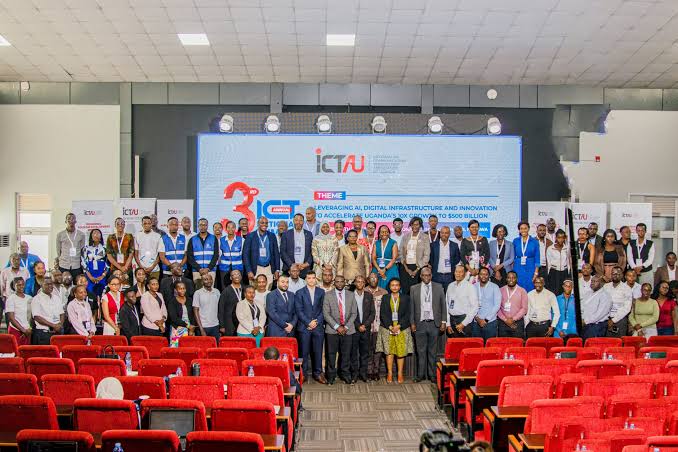
At the 3rd National ICT Summit in Kampala, ministers set out an ambition to grow the economy tenfold by 2040 on the back of artificial intelligence and digital infrastructure.
KAMPALA
Uganda spent the first week of September making an argument about its own future: that artificial intelligence, digital public infrastructure and a reformed innovation ecosystem can carry a roughly US$50 billion economy to US$500 billion by 2040.
The argument was made most directly at the 3rd National ICT Summit, held from 2 to 4 September at the National ICT Innovation Hub in Nakawa and organised by the ICT Association of Uganda. Its theme left little room for ambiguity: "From Connectivity to Intelligence: Leveraging AI, Digital Infrastructure and Innovation to Accelerate Uganda's Ten-Fold Growth to a USD 500 Billion Economy by 2040."
The summit was opened by Justine Kasule Lumumba, Minister for ICT and National Guidance, representing President Yoweri Museveni. Lumumba pressed two themes. The first was home-grown solutions: Uganda, she argued, needs to build digital products of its own rather than importing them, and needs to widen the number of citizens who can participate in doing so. The second was the role of higher education. She called on universities and other tertiary institutions to become far stronger centres of research and innovation, with ICT taking a larger role in transforming the wider economy.
THE NUMBER BEHIND THE AMBITION
The most useful contribution came from Dr Aminah Zawedde, Permanent Secretary at the Ministry of ICT and National Guidance, who put the target in arithmetic terms. Moving from roughly US$50 billion to US$500 billion requires sustained annual growth of about 15 per cent, every year, for the better part of fifteen years.
That figure deserves to be stated plainly, because it frames everything else. Uganda's current growth projections sit in the 6 to 8 per cent range, with the higher end contingent on oil production that was this week pushed back again to June 2027. Fifteen per cent sustained over more than a decade would be an extraordinary performance by any historical standard — the sort of run achieved by a small number of East Asian economies during their industrialisation phases, and rarely since.
Zawedde identified ICT as a strategic contributor to closing that gap, through digital infrastructure, innovation and technology-driven productivity, and pointed to specific progress: aggregated procurement of government IT systems, the establishment of six regional ICT hubs to support innovation outside Kampala, and the automation of business registration. Each of these is a real administrative improvement. Whether they compound into a 15 per cent growth rate is a different question, and the honest framing of the arithmetic by a sitting permanent secretary is more valuable to the debate than the headline target itself.
WHAT UGANDA IS ACTUALLY BUILDING
Beneath the summit rhetoric there is a concrete governance agenda. Uganda's AI policy work is coordinated across three institutions: the Ministry of ICT and National Guidance, the Uganda Communications Commission and the National Information Technology Authority (NITA-U). The ministry has been consulting stakeholders from government, academia, the private sector and the innovation ecosystem on a national emerging technologies strategy, focused on strengthening digital infrastructure, building local skills and setting rules for the ethical use of AI. A national AI landscape assessment has been published, and Uganda has convened a national stakeholders' dialogue on ethical AI governance in partnership with UNESCO.
Data governance sits at the centre of this. Officials have been explicit that standardising how data is collected across government is a precondition for useful AI — models trained on fragmented or unreliable public data will produce fragmented and unreliable outputs — while privacy and security protections have to be built in rather than retrofitted. Zawedde has framed AI as a tool with potential to drive innovation, improve service delivery and create economic opportunity, which is the standard formulation; the harder work is in the standards documents rather than the speeches.
The connectivity base is more substantial than it was even two years ago. Uganda now counts more than 47 million active mobile subscriptions, over 18 million internet users and more than 20 million smartphones connected to mobile networks. Those figures represent genuine progress, though the gap between subscriptions and users, and between smartphones and meaningful daily internet use, is where the real digital divide lives. Rural access, affordability of data and device costs remain the binding constraints for most of the population — which is precisely why the six regional hubs and the emphasis on skills matter more than another data centre in Kampala.
There is also a workforce dimension. The Uganda Institute of Information and Communications Technology, which participated in the summit, has framed its role as producing a digitally skilled, industry-ready workforce. That is the least glamorous part of the agenda and probably the most decisive: AI capacity in a country is finally a function of how many people can build, deploy, audit and maintain systems, not of how many strategies have been launched.
THE STARTUP BOTTLENECK
A separate but connected process ran just before the summit. On 31 August, Smart Africa, working with the Ministry of ICT and National Guidance, convened a national stakeholder validation workshop in Kampala to review the findings of Uganda's Digital Entrepreneurship and Innovation Country Assessment. The workshop brought together public institutions, regulators, academia, entrepreneurs, innovation hubs and ecosystem support organisations, and it produced a more specific list of asks than the summit did.
Four priorities emerged. The first is advancing the Startup Bill, long-discussed legislation intended to create a clearer legal environment for early-stage companies. The second is strengthening science, technology and innovation policy and regulation. The third is improving access to regulatory sandboxes so innovators can test products across sectors — particularly relevant in fintech and health, where regulatory uncertainty has stalled otherwise viable products. The fourth, and arguably the most immediately actionable, is using public procurement deliberately to create markets for local startups.
That last point connects directly to Lumumba's call for home-grown solutions. Government is the largest single buyer of software and digital services in Uganda. If aggregated procurement of government IT systems is designed to favour scale and international vendors, it will work against the domestic ecosystem the same ministry says it wants to build. If it is designed with carve-outs and reference-customer pathways for local firms, it becomes the single most powerful instrument available. The tension between these two objectives is not yet resolved in public policy.
The workshop was convened under the Africa-Europe Digital Innovation Bridge (AEDIB 2.0), which supports African countries in developing digital entrepreneurship ecosystems through policy dialogue and regional collaboration.
THE CONTEXT NOBODY MENTIONED
Any assessment of Uganda's digital ambitions has to account for a fact that the summit programme did not address: 2026 has been a difficult year for the country's information environment. In June, the army chief ordered the closure of Nation Media Group's Uganda operations — the Daily Monitor, NTV Uganda, Spark TV, KFM and Dembe FM — following an overnight raid, with security forces besieging the Namuwongo headquarters for days.
This matters for the AI agenda in a concrete rather than merely rhetorical way. Investors assessing digital infrastructure projects price political risk. Researchers deciding where to base work weigh academic and journalistic freedom. Ethical AI governance frameworks derive their credibility from the surrounding institutional environment — a data protection regime is only as strong as the willingness of the state to be bound by it. A country asking universities to become stronger centres of research, and asking global partners to fund digital infrastructure, is making claims about openness that its recent record complicates.
WHAT TO WATCH
Several markers over the coming months will indicate whether the September announcements translate into delivery. The first is the Startup Bill: whether it reaches Parliament in this session, and whether the version tabled retains the sandbox and procurement provisions the ecosystem asked for. The second is the national emerging technologies and AI strategy — whether it is published with enforceable standards and named institutional owners, or arrives as a framework document. The third is the six regional ICT hubs: whether they report usage, cohorts and outputs, or remain buildings.
The fourth is Uganda Innovation Week, scheduled for Kampala in November, which will offer the year's clearest picture of the startup ecosystem's actual depth — how many companies, at what stage, with what funding. And the fifth is data: whether NITA-U and the ministry publish the standardised, open government datasets that any credible national AI capability has to be built on.
The US$500 billion figure will be debated for as long as it is official policy. But the more interesting number from the summit was Zawedde's: 15 per cent a year. It is the kind of target that forces a conversation about what would actually have to change, and that is a more productive place for the discussion to sit than a headline about 2040.



