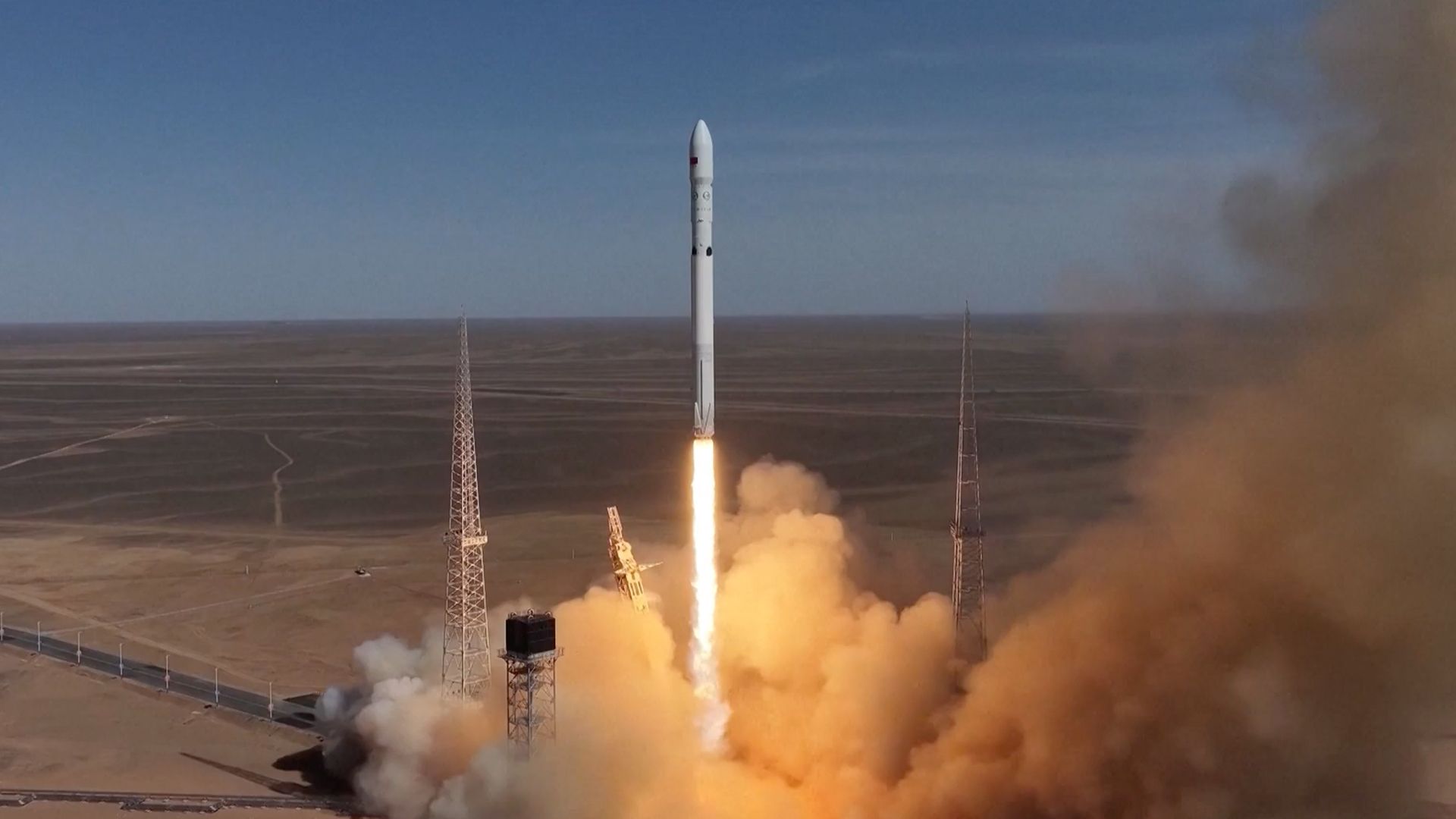
Dongfeng Commercial Space Innovation Pilot Zone, China
In the pitch-black predawn hours of August 19, a scrappy Beijing startup called LandSpace did something no private company outside of Elon Musk's SpaceX has ever managed: it launched an orbital-class rocket, sent its upper stage to space, and brought the booster home to a soft, controlled, upright landing on solid ground.
The rocket was called Zhuque-3 — "Vermilion Bird," named for a mythical fire deity of the Chinese zodiac — and for eight minutes it turned a patch of northwestern Chinese desert into the most closely watched few acres on the planet. Cameras mounted on the booster itself captured the final, terrifying seconds: the 66-meter, stainless-steel giant plunging back toward Earth engines-first, reigniting its methane-fueled engines in a blinding orange flash, and settling onto four spindly landing legs in a cloud of dust — upright, intact, and very much not exploded.
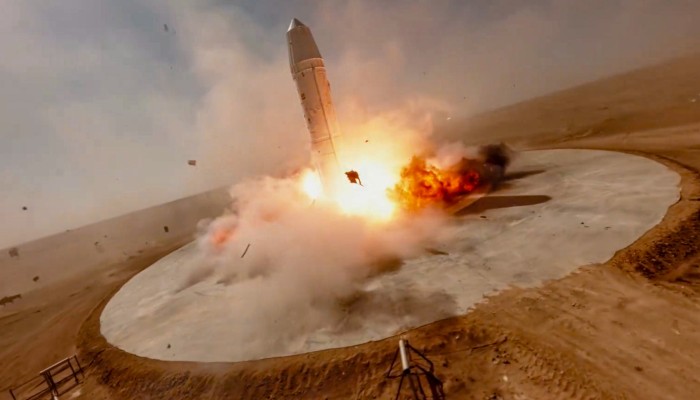
That last detail matters more than it sounds. Eight and a half months earlier, on December 3, 2025, this exact same rocket did almost the same thing — reached orbit perfectly on its very first try — and then blew itself to pieces on the landing pad when its engines suffered what LandSpace politely called "abnormal combustion" during the final braking burn. Video of that failure went viral: a rocket the size of an apartment building, vertical and steady one second, then swallowed whole by a fireball the next. This time, there was no fireball. There was just a rocket, standing there, having apparently defeated physics.
The Company Nobody Saw Coming
If you haven't heard of LandSpace, you're not alone — and that's sort of the point. While the world's cameras have spent the last decade fixed on SpaceX's Starship test flights and Blue Origin's slow-motion rise, a quieter race has been unfolding inside China's increasingly deregulated commercial space sector, and LandSpace has emerged as its most credible contender.
The company was founded in 2015, not by an aerospace engineer but by a 32-year-old former investment banker named Zhang Changwu, who cut his teeth at HSBC and Banco Santander before deciding rockets were a better use of his time than derivatives. In 2023, LandSpace became the first company anywhere in the world — ahead of every Chinese state-owned rival — to put a methane-fueled rocket into orbit, when its smaller Zhuque-2 beat SpaceX's Starship to the punch on liquid-methane propulsion. Zhuque-3 is the follow-up: a scaled-up, fully reusable answer to Falcon 9, built specifically to go head-to-head with the rocket that has quietly become the backbone of the entire global space economy.
The numbers explain why China is racing so hard to catch up. SpaceX's Falcon 9 now launches roughly three times a week — more than 150 missions a year — because its boosters are reused dozens of times each, driving launch costs down to a fraction of what they were a decade ago. Every other spacefaring nation on Earth, including China's own state space program, has been forced to watch that cost advantage compound, launch after launch, year after year. Beijing has responded by throwing its commercial sector into overdrive: easing IPO rules specifically for reusable-rocket companies, greenlighting a reported 900-billion-yuan national push into commercial space infrastructure, and watching as no fewer than three separate Chinese firms — LandSpace, along with rivals developing the Long March 10B and Long March 12B — chase reusability by three different methods simultaneously.
What Actually Happened Up There
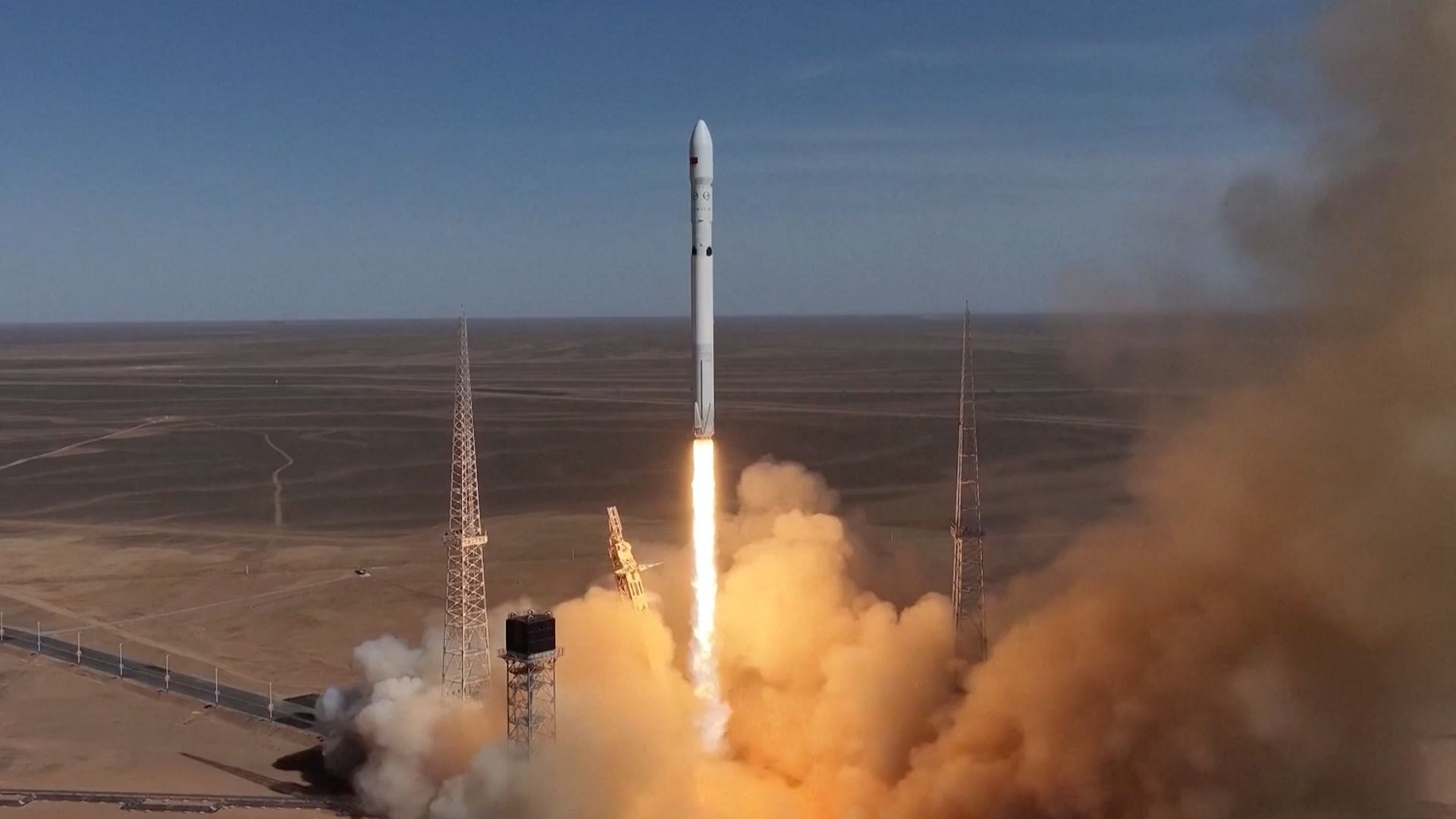
Zhuque-3 lifted off from the Dongfeng Commercial Space Innovation Pilot Zone at 7:35 a.m. Beijing time (7:35 p.m. Tuesday on the U.S. East Coast), powered by nine Tianque-12A engines burning liquid methane and liquid oxygen — a "methalox" combination prized because it burns cleaner than the kerosene fuel of older rockets, leaves less soot to clean off a reusable booster, and is, notably, the same fuel choice SpaceX made for Starship. Combined, those nine engines produced nearly 6,000 kilonewtons of sea-level thrust, enough to loft roughly 18,300 kilograms — about 40,000 pounds — to low Earth orbit, putting Zhuque-3 in a similar weight class to a Falcon 9.
After separating from its second stage, which continued on to deliver its payload to orbit, the spent first-stage booster did something almost balletic: it flipped itself around, reignited a subset of its engines to slow its fall, extended four landing legs, and used a final short burn to bleed off the last of its speed before touching down dead-center on a hardened pad. LandSpace called it, without much modesty, "China's first-ever successful recovery attempt of the first stage of an orbital-class launch vehicle using landing legs, and China's first successful booster recovery on land." State broadcaster Xinhua echoed the framing almost word for word, underlining just how much national pride is riding on this single scorched rocket.
For LandSpace, the win closes a brutal eight-and-a-half-month gap between triumph and disaster. Engineers reportedly spent the intervening months poring over telemetry from the December explosion, adjusting the engine restart sequence and landing-leg deployment timing to iron out whatever caused the "abnormal combustion" that doomed the first attempt. Whatever they changed, it worked — on just the second try, a feat that took SpaceX itself years and multiple spectacular explosions to achieve with Falcon 9 in the mid-2010s.
Not Quite SpaceX Yet — But Closing Fast
It would be easy to overstate what just happened, and space analysts are being careful not to. A single successful landing is not the same as operational reusability. SpaceX didn't just land a Falcon 9 booster once in 2015 and call it done — it spent the following decade building the infrastructure, inspection processes, and refurbishment pipeline needed to actually refly boosters dozens of times each, reliably, on a schedule tight enough to support three launches a week. LandSpace has landed Zhuque-3's first stage exactly once. Whether that particular booster can be refurbished and flown again — whether it even survived the landing in good enough shape to try — remains an open question the company has not yet answered publicly. LandSpace has previously said it hopes to attempt reflying a recovered Zhuque-3 booster by the end of this year, though that target predates Wednesday's landing and could shift.
Even Elon Musk has been watching. In comments posted to X last October, ahead of Zhuque-3's first flight, Musk noted that LandSpace appeared to have "added aspects" of his own Starship design "to a Falcon 9 architecture" — a backhanded compliment that acknowledged the Chinese rocket's clear technical inspiration while needling the company for borrowing liberally from both of SpaceX's playbooks at once. Whether flattery or warning, the comment underscored how closely SpaceX itself is tracking Chinese progress.
Still, the trajectory is unmistakable. As recently as five years ago, no country besides the United States had ever landed an orbital-class rocket booster intact. Today, China has two separate approaches showing real signs of life: LandSpace's vertical-legs method, mirroring Falcon 9 almost exactly, and a competing "net capture" system used by the state-linked Long March 10B, which snagged its own booster out of the air over open ocean on a floating platform earlier this year. Having two credible, independently developed reusability programs running in parallel is precisely the kind of redundancy that let SpaceX iterate its way to dominance — and it's now happening inside China's borders simultaneously.
Why the Rest of the World Should Care
For readers who don't follow rocketry, the stakes here are less about national bragging rights and more about your wallet, eventually. Reusable rockets are the single biggest reason satellite internet, GPS-dependent apps, weather forecasting, and even your phone's mapping data have all gotten cheaper and more capable over the past decade — because launching things to space got dramatically less expensive once boosters stopped being thrown away after a single use. Right now, that cost advantage belongs almost entirely to one company, in one country. A credible second and third source of reusable launch capacity — especially ones backed by a government willing to spend hundreds of billions of yuan to make it happen — would mean more competition, more launch capacity, and, eventually, lower prices for the satellite constellations, space stations, and lunar missions of the next decade.
There's a geopolitical dimension too. Launch capacity is increasingly viewed as a strategic asset, not just a commercial one — it underpins military reconnaissance satellites, secure communications, and a nation's ability to put hardware into orbit without relying on a rival power. A world where the United States no longer holds a near-monopoly on reusable heavy-lift capability is a meaningfully different strategic landscape than the one that has existed since 2015.
Expert Perspective
Space analysts covering the launch were careful to frame Wednesday's success as significant but preliminary. Writing in the immediate aftermath, aerospace trade outlet SpaceNews noted that the successful recovery "highlights a major breakthrough in the country's reusable rocket technology" while cautioning that LandSpace has yet to demonstrate the turnaround speed and refurbishment cost savings that make reusability actually pay off commercially, rather than just technically. Coverage from NASASpaceFlight.com similarly emphasized that landing a booster and reflying a booster are two very different engineering problems, and that LandSpace's real test — the one that will determine whether Wednesday's landing was a fluke or a foundation — comes the next time this exact piece of hardware tries to fly again.
What This Means for You
If you use satellite internet, rely on GPS for driving directions, or have ever wondered why your weather app got so much more accurate over the past few years, you have cheap, reusable rockets to thank — and you stand to benefit further as more companies figure out how to build them. Increased competition in the launch market tends to trickle down into lower costs for the satellite operators who ultimately pass savings on to consumers, whether that's your Starlink bill, your phone's data plan, or the next generation of GPS-guided everything. It's also a reminder that the "space race" never actually ended in 1969 — it just changed contestants, and the finish line now runs through a Chinese desert as much as a Florida coastline.
The Bottom Line
LandSpace didn't just land a rocket this week. It answered, decisively, the question of whether China's commercial space sector could recover from a very public, very explosive failure and come back stronger eight months later. Zhuque-3's next flight — whenever it comes, and however many of the same engines it uses — will tell the world whether Wednesday was the beginning of China's Falcon 9 moment, or just a very expensive, very photogenic one-off. Either way, SpaceX now has company in a club that, until this week, had exactly one member.
Published By | Tech Wiz