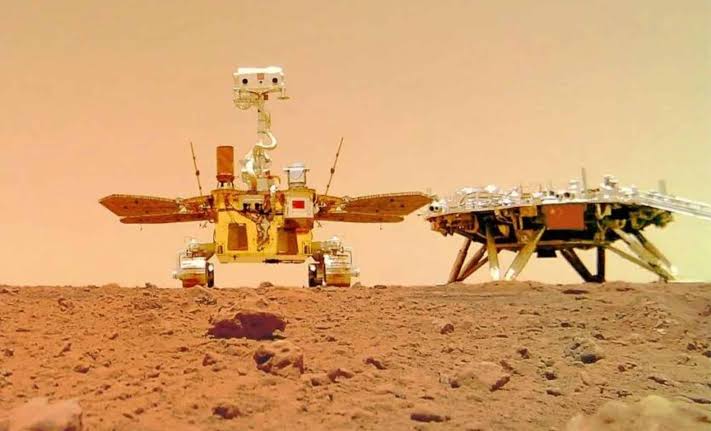
A spacecraft armed with four drill-tipped robotic arms is now in close proximity to a boulder-sized rock that may be a shard of the Moon, blasted into space by a prehistoric collision — or something else entirely. China's Tianwen-2 mission is about to settle the argument the only way that counts: by grabbing a piece of it and bringing it home.
Staff Space & Technology Desk
Earth Has a Tiny, Secret Companion — and Nobody Agreed on What It Is
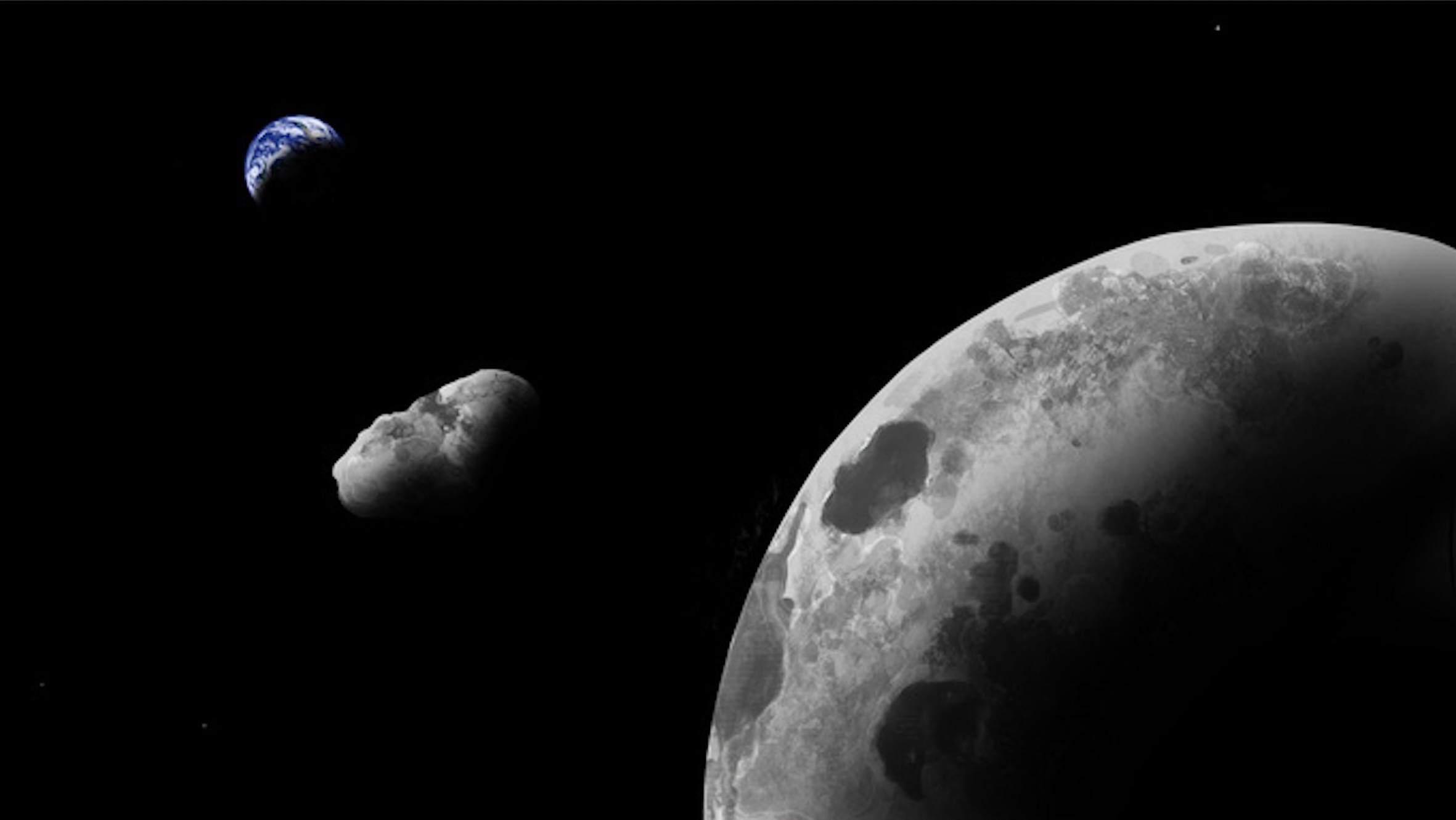
Roughly 40 to 100 meters across — small enough to fit inside a sports stadium, large enough to flatten a city — a rock called 469219 Kamoʻoalewa has been quietly riding shotgun with Earth for the last 500 years, and it's about to get its first close-up visit. Discovered by the Pan-STARRS telescope in Hawaii in 2016 and named for a mythical offspring who travels alone, Kamoʻoalewa belongs to a rare class of objects called quasi-satellites: asteroids that technically orbit the Sun, not Earth, but whose orbits are gravitationally tangled with ours closely enough that they appear to loop around our planet like a wobbly, distant moon.
It won't stay that way. Orbital simulations show Kamoʻoalewa slipped into this peculiar dance with Earth about five centuries ago and will drift back out of it within another 300 years, making it a strange and temporary visitor by cosmic standards — one that scientists are determined not to let leave without learning everything they can about where it came from.
And where it came from is genuinely up for debate, in a way that rarely happens with objects this well studied. China's space agency isn't sending a spacecraft halfway across the solar system to settle a minor academic curiosity — it's racing to resolve one of the more provocative puzzles in recent planetary science before a key piece of evidence quite literally flies away.
A Piece of the Moon, or a Very Convincing Impostor?
The leading theory, championed by researchers including teams at the University of Arizona and published in the journal Communications Earth & Environment, holds that Kamoʻoalewa is a fragment of the Moon itself — debris kicked into space by the impact that carved out the Moon's 13.7-mile-wide Giordano Bruno crater somewhere between one million and ten million years ago. The evidence is spectral: Kamoʻoalewa's reflected light closely matches the signature of heavily space-weathered lunar material, including in-situ readings from China's own Yutu rover and laboratory measurements of soil samples brought back by the Chang'e-5 mission. Orbital-dynamics modeling backs up the story, showing that while most debris launched from the lunar surface can't reach Kamoʻoalewa's current orbit, a rare but real subset of trajectories can.
It's a romantic idea — a literal chip off the Moon, drifting through the void for a million years before settling into a slow orbital waltz with the planet that broke it off. But a study published this year in Nature Communications throws a serious wrench into that narrative. The new research argues that Kamoʻoalewa's reddish, weathered appearance — the very trait used to link it to the Moon — can also be produced by ordinary asteroids that have simply spent a very long time getting sandblasted by the space environment. The team's analysis suggests Kamoʻoalewa more likely hails from the Flora family of asteroids in the main asteroid belt, sharing a composition closer to the well-studied asteroid Itokawa, just with a far more extreme weathering pattern layered on top.
In other words: the asteroid might look like a moon rock without actually being one — and the only way to know for certain is chemistry, not color. No spectrometer pointed from millions of miles away can resolve that argument. A sample in a lab on Earth can.
The Heist: Drill-Armed Robots and a Maneuver Nobody Has Tried
That's where Tianwen-2 comes in. Launched in May 2025 and operated by the China National Space Administration, the spacecraft spent roughly thirteen months in transit before closing in on Kamoʻoalewa earlier this month, with amateur radio observers tracking and decoding its telemetry as it approached. Reports describe the spacecraft moving through its orbit-insertion and rendezvous sequence in the window around early June into early July, kicking off a remote-sensing campaign — running roughly from July through September — in which Tianwen-2 will map the asteroid's surface, shape, and composition from progressively closer altitudes, descending in stages from roughly 20 kilometers down to just 600 meters, before committing to a sampling attempt.
The spacecraft is carrying a suite of instruments built specifically for this kind of forensic work: a visible-and-infrared imaging spectrometer to read the asteroid's mineral signature, a thermal radiation spectrometer, multiple cameras, a detection radar capable of probing beneath the surface, a magnetometer, and particle analyzers to sample the asteroid's immediate environment, backed by dedicated laser and optical navigation sensors to guide the final approach.
Then comes the genuinely audacious part. Tianwen-2 is equipped with two completely different sampling techniques. The first, a touch-and-go maneuver in which the spacecraft briefly kisses the surface to scoop up loose material, mirrors methods already proven by NASA's OSIRIS-REx at asteroid Bennu and JAXA's Hayabusa2 at Ryugu. The second has never been attempted on any asteroid in history: an anchor-and-attach approach using four separate robotic arms, each tipped with its own drill, designed to physically grip the asteroid and bore directly into its surface. Between the two methods, mission planners are targeting a haul of 200 to 1,000 grams of material — modest by Earth standards, priceless by planetary-science ones.
If the sampling succeeds, current projections point to the material reaching Earth as early as late 2026, with some estimates extending into 2027 depending on the return trajectory chosen. Either way, the rock that has spent half a millennium quietly shadowing our planet will finally answer, conclusively, where it actually came from.
A Bigger Mission — and a Bigger Statement
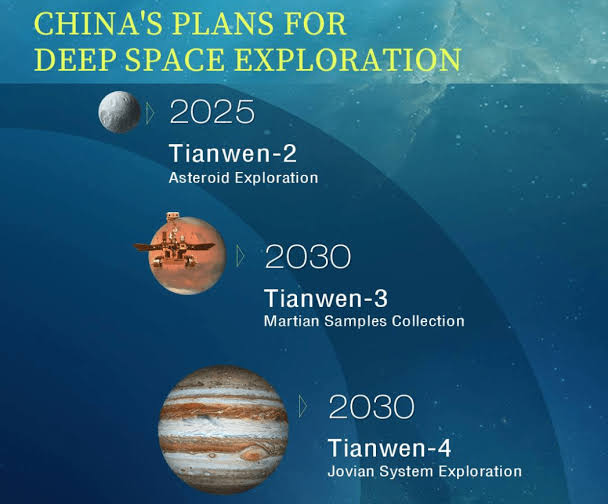
Kamoʻoalewa isn't even Tianwen-2's final stop. Once the spacecraft completes its work at the quasi-satellite and — if all goes to plan — ejects a return capsule carrying its samples toward Earth, the main spacecraft bus will continue on an extended journey toward the main-belt comet 311P/PanSTARRS, a bizarre object that has displayed comet-like activity despite orbiting in the asteroid belt, with arrival projected for 2035. That makes Tianwen-2 a genuine two-for-one planetary mission, visiting two fundamentally different classes of small bodies on a single spacecraft.
It's also a marker of how far China's deep-space program has come. A successful sample return from Kamoʻoalewa would put China in an extremely small club of nations that have successfully grabbed and returned material from a near-Earth asteroid, alongside Japan's Hayabusa and Hayabusa2 missions and NASA's OSIRIS-REx. Combined with China's recent lunar sample-return successes via the Chang'e program — the very data this mission is now using to argue against a lunar origin for Kamoʻoalewa — Tianwen-2 cements Beijing's space agency as a serious, independent player in the deep-space sample-return game once dominated solely by the U.S. and Japan.
What Scientists Are Saying
Planetary scientists tracking the mission have been careful to note that the lunar-origin debate isn't simply a matter of one study overturning another — it's exactly the kind of ambiguity that sample-return missions exist to resolve. Spectral data gathered from a distance, no matter how sophisticated, can support multiple competing interpretations; isotopic ratios and mineral grains examined in a laboratory generally cannot. Researchers involved in the dynamical modeling that originally proposed the lunar-ejecta theory have acknowledged the orbital pathways required are rare, even as they argue they remain physically plausible — a textbook example of a hypothesis that's testable, falsifiable, and now, finally, about to be tested.
That's precisely why mission scientists have framed Tianwen-2's arrival not as confirmation of either theory, but as the start of the only phase of this investigation that can actually produce a definitive answer.
What This Means for You
It's easy to file a quasi-satellite sample-return mission under "interesting but irrelevant" — nobody's daily life changes because of where a 100-meter rock came from. But the stakes reach further than trivia. Near-Earth objects like Kamoʻoalewa are exactly the category of body that planetary-defense programs study to understand what's drifting through our cosmic backyard, how these objects move, and what they're made of — knowledge directly relevant to predicting and someday deflecting a genuinely dangerous impactor. If Kamoʻoalewa really is lunar debris, it would also mark the discovery of an entirely new category of near-Earth object — moon shrapnel — implying there could be more undetected fragments quietly sharing Earth's orbital neighborhood, a population current asteroid surveys aren't yet designed to find.
There's a geopolitical layer too: sample-return missions are among the hardest feats in spaceflight, and China successfully pulling one off at an asteroid — on the heels of its lunar far-side sample returns — is a tangible marker in the broader space competition between Beijing, Washington, and Tokyo, with implications for everything from future lunar resource claims to which country's labs get first crack at analyzing genuinely novel planetary material.
The Bottom Line
For half a thousand years, a small, strange rock has been silently shadowing Earth's orbit without anyone on the planet knowing it was there until 2016 — and without anyone fully agreeing on its origin since. China's Tianwen-2, bristling with cameras, spectrometers, and four drill-tipped robotic arms built for a maneuver no spacecraft has ever attempted, is now close enough to finally answer the question with chemistry instead of conjecture. Whether the verdict turns out to be "piece of the Moon" or "well-traveled asteroid impostor," the sample capsule expected to parachute back to Earth as early as late 2026 will carry the first physical proof either way — and either answer will rewrite a small but genuinely strange corner of what we know about our own cosmic neighborhood.
Published By | Tech Wiz