TECH
Chad has long ranked among the least-connected countries in Africa, hampered by its landlocked geography, vast rural distances and thin fiber infrastructure. But 2025 and 2026 have brought a cluster of developments — a national satellite-internet license, a $1.5 billion digital strategy, a new entrant challenging the country's telecom duopoly, and a government push to route public payments through mobile money — that together mark the most concentrated push toward digital transformation Chad has attempted in years. The story is not one of a mature tech ecosystem, but of a country using new tools to attack a genuinely difficult connectivity problem.
Satellite Internet as a Shortcut Around Geography
Chad's core connectivity challenge is structural: as of 2022, only around 12 percent of the population was online, and building fiber to reach the country's dispersed rural population is prohibitively expensive, with new fiber-optic lines costing at least $30,000 per mile to lay. That economic reality is precisely why the government's decision to license Starlink has drawn attention. Chad approved a Starlink operating license on November 12, 2024, and the service went live commercially on July 3, 2025, making Chad the 24th African market for the satellite provider. By early 2026, Starlink was operating in more than 25 African countries, but few of them face Chad's combination of geographic scale and thin existing infrastructure. The service promises speeds of up to 220 Mbps with low latency — a substantial upgrade in a country where roughly 15 percent of rural residents have any internet access at all, compared with about 50 percent of urban residents. For rural clinics, schools and small businesses far from any fiber trunk, satellite access offers a way to leapfrog years of terrestrial infrastructure build-out.
Tchad Connexion 2030: A $1.5 Billion Bet on Connectivity
Satellite access is only one piece of a larger government strategy. In 2025 Chad's government formally launched "Tchad Connexion 2030," a $1.5 billion digital investment program designed to deliver quality internet access to the majority of Chadians by the end of the decade and to modernize public administration in parallel. The strategy is explicitly aligned with Chad's broader National Development Plan 2024-2030, adopted in May 2025, positioning digital connectivity as a cross-cutting pillar of the country's post-transition economic agenda rather than a stand-alone technology initiative. The African Development Bank has incorporated this ambition into its own 2026-2031 Country Strategy Paper for Chad, which places special economic zones at the heart of its private-sector-support pillar and targets mobilizing an additional $150 million in foreign direct investment by 2031 — funding that Chadian officials hope will flow partly into digital and telecom infrastructure alongside more traditional sectors.
Chad has also been actively courting international partners on the infrastructure side. The government has been negotiating a digital-cooperation partnership with Azerbaijan focused on building a national data center, modernizing core infrastructure and expanding e-government services. Separately, the United Nations Economic Commission for Africa has worked directly with Chad's Ministry of Telecommunications, Digital Economy and Digitalization of Administration to help develop a National Data Governance Strategy, part of a broader continental push — which Chad has formally joined — toward unified data governance and AI-readiness standards across Africa.
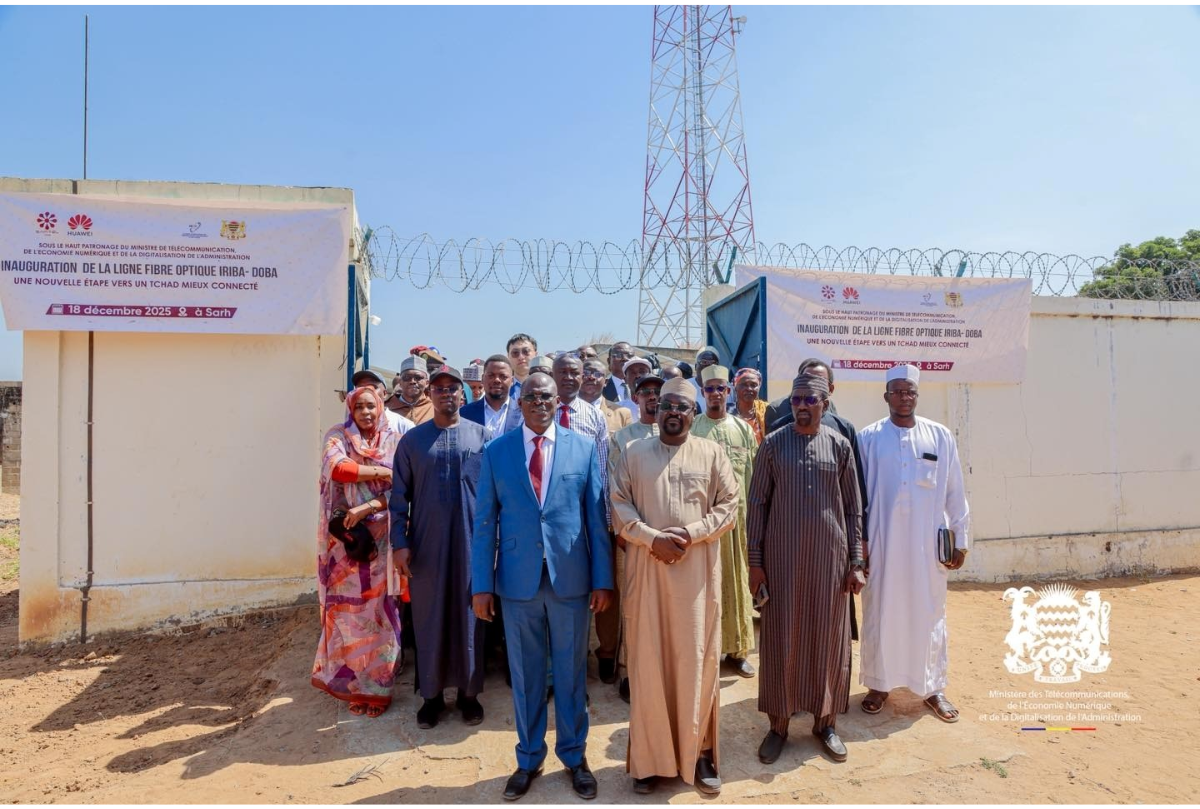
Chad Invests €175 Million to Expand National Data Center, Fiber, and Wireless Networks
Breaking Up the Telecom Duopoly
For years, Chad's mobile market has been split between just two operators, Airtel and Moov Africa. That is set to change with the commercial debut of Salam Mobile, a subsidiary of the state-owned incumbent Sotel, which has secured spectrum and is preparing a 2026 launch expected to undercut the incumbents on entry-level data pricing. If successful, Salam's entry would be the first structural change to Chad's mobile market in years, potentially accelerating both price competition and coverage expansion. The sector regulator, the Autorité de Régulation des Communications Électroniques et des Postes (ARCEP), has also seen its legal mandate updated, with Chad's National Transitional Council adopting a law amending Article 13 of the regulatory framework governing ARCEP's oversight of licensing, competition and service quality in the telecom sector.
Despite the market's limitations, mobile penetration itself has grown substantially: Chad recorded more than 14 million mobile subscriptions by 2024, with penetration approaching 80 percent of the population — evidence that voice and basic data access has spread far more widely than fixed broadband or, notably, financial services.
Mobile Money Finally Gets Government Backing
Financial inclusion remains one of the clearest gaps between Chad's mobile penetration and its digital-economy potential: only an estimated 10 to 15 percent of Chadian adults hold a bank or mobile money account, well below the more-than-30-percent average across Sub-Saharan Africa. The government has moved to close that gap from the top down. On February 8, 2026, Chadian authorities signed a five-year, renewable framework agreement with Moov Money, Airtel Money, Konoom Mobile Money and Cashi-Tchad to route government revenue collection and public expenditure payments through mobile money channels — a significant vote of confidence in digital payments infrastructure from the state itself, and a move likely to accelerate account adoption simply by making mobile wallets necessary for interacting with government. Complementing that push, Chad has separately added 3,000 new payment terminals as part of a broader digitalization of public finances.
The mobile money and fintech landscape is also diversifying. In 2025, regulators licensed Konoom as Chad's first fully locally owned mobile money company, a milestone for domestic ownership in a sector that has historically been dominated by telecom-operator-linked wallets. Internationally, the IFC — a member of the World Bank Group — announced a partnership with Cashi in 2026 to expand digital payment infrastructure into Central Africa, with Chad positioned as one of the initial markets for that expansion. Taken together, these developments describe a fintech sector that remains modest by regional standards but is now attracting both domestic entrepreneurship and international development finance for the first time at meaningful scale.
A Nascent but Emerging Digital Ecosystem
Chad's broader startup and digital-governance ecosystem remains at an early stage relative to hubs like Lagos, Nairobi or Cairo, and the country has not yet articulated a fully public national digital-identity program comparable to those rolling out elsewhere on the continent. What Chad does have, however, is a rare alignment of factors pushing in the same direction simultaneously: a government-backed connectivity strategy with real capital behind it, a satellite option that sidesteps the country's most binding infrastructure constraint, a telecom market about to see its first new entrant in years, and — perhaps most importantly — a state that has decided to use its own payment obligations to jump-start mobile money adoption rather than waiting for organic uptake. None of these steps alone would transform Chad's digital economy, but together they represent the most coordinated digital push the country has mounted, and one that regional development institutions are now actively backing with strategy papers and financing commitments through the end of the decade.
Outlook
The test for Chad's digital transformation agenda will be execution against genuinely difficult fundamentals: a small tax base, a large rural population, and infrastructure costs that remain among the highest per-capita on the continent. But the combination of Starlink's satellite entry, the Tchad Connexion 2030 investment program, new telecom competition, and a government-mandated push into mobile money gives Chad a more credible starting point for digital inclusion in 2026 than it has had at any point in the past decade.
Published By | Features Editor