SCIENCE AND TECH
It reads like a true-crime story shrunk down to the scale of a single cell: a predator stalks its prey, kills it, and in the chaos of the crime scene leaves behind a piece of itself — a fragment of genetic material that then tries, and fails, to start a new life inside its victim's corpse.
Except the predator here is a bacterium roughly a thousandth of a millimeter long, the "victim" is one of the planet's most important methane-producing microbes, and the getaway genetic material is something biologists call a "jumping gene." Researchers at the Max Planck Institute for Marine Microbiology in Bremen, Germany, say they have captured — for the first time ever, under a microscope — direct visual proof that these jumping genes can leap not just around within a single organism's genome, but straight across the boundary between two entirely different species. Predator to prey. No middleman required.
The findings, first published in the journal Scientific Reports and freshly making waves across the science press this month, are forcing biologists to reconsider a question that sits at the very foundation of evolutionary theory: how, exactly, do new genetic traits move between organisms that aren't having offspring together?
MEET THE CAST: A TINY KILLER AND ITS METHANE-MAKING VICTIM
The story begins, unglamorously enough, with a lab culture that smelled faintly of oranges. Microbiologist Jens Harder and his colleagues, Jana Kizina and Almud Lonsing, were studying a slow-growing community of bacteria and archaea that had been enriched from the environment to break down limonene — the aromatic compound responsible for citrus scent — into methane and carbon dioxide, one of the many microbial pathways that quietly shapes Earth's carbon cycle.
Buried in that community, the team noticed something odd. The single most abundant organism in the culture was a tiny predatory bacterium called Candidatus Velamenicoccus archaeovorus — a microbe that survives, unusually, by hunting and feeding on other microorganisms rather than simply absorbing nutrients from its environment. Its apparent prey was Methanothrix soehngenii, widely regarded as one of the single most important methane-producing organisms on the planet, a filamentous microbe found everywhere from wastewater treatment plants to natural wetlands. And crucially, individual cells within those Methanothrix filaments were turning up dead.
The obvious question: was the predator bacterium responsible? To find out, the researchers needed to prove that molecular material from Candidatus Velamenicoccus archaeovorus had actually made its way inside the dead Methanothrix cells — direct forensic evidence placing the suspect at the scene.
THE DISCOVERY: A GENE THAT REFUSED TO DIE
While sequencing the genome of the predator bacterium, Harder stumbled onto something interesting: a jumping gene, technically known as an intron — a stretch of genetic material capable of splicing itself out of RNA and inserting itself elsewhere, using its own built-in molecular scissors (an enzyme called a ribozyme). These self-splicing introns are a well-documented biological phenomenon within a single genome. What had never been directly observed, anywhere, was intron RNA surviving outside a cell altogether — let alone showing up inside the cells of a completely different species.
That absence of prior evidence was exactly why Harder decided to go looking. Using specialized nucleic acid probes developed at the institute — tools precise enough to detect vanishingly small quantities of RNA inside individual bacterial cells — the team scanned both the living predator cells and the dead prey cells under fluorescence microscopy.
What they found, published as glowing turquoise signals against the purple-stained backdrop of Methanothrix cells, was unmistakable: intron RNA originating from the predatory bacterium, sitting inside the corpses of its victims. The hunter's genetic fingerprint, left behind in the dead.
"Caught red-handed," is how the Max Planck Institute framed it in its own announcement of the findings — though with an ironic twist. The intron hadn't successfully colonized its new host. It had jumped at the exact moment its carrier killed the cell it was trying to invade, meaning the intron's escape attempt ended, in the researchers' words, as "a leap into an empty cell." A jumping gene, caught mid-flight, arriving at a house with nobody home.
WHY THIS BREAKS THE OLD RULEBOOK
For decades, evolutionary biologists have operated on a working assumption about how genetic material manages to hop between unrelated species — a process known as horizontal gene transfer, as opposed to the "vertical" transfer of genes from parent to offspring. The conventional wisdom held that jumping genes needed a ride: they would hitch along inside the genome of a virus, or tuck themselves into a plasmid — a small, mobile loop of DNA that bacteria are known to swap between each other — in order to physically cross from one organism into another.
What the Bremen team observed breaks that rule. There was no virus involved. No plasmid. Just a naked strand of RNA, unprotected by any viral shell or bacterial vehicle, apparently capable of surviving outside a cell long enough to invade a new one entirely on its own.
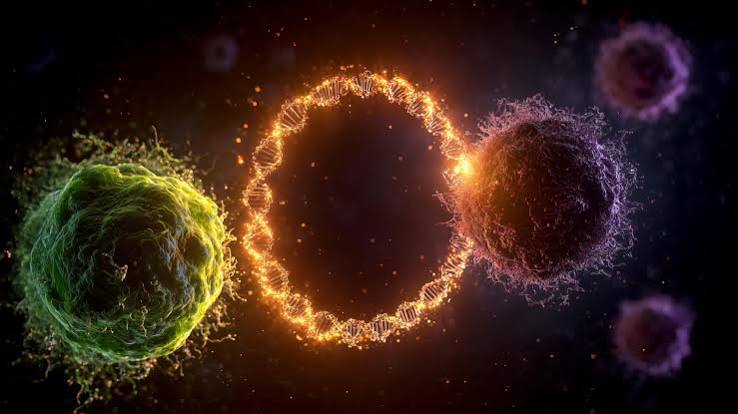
The reason it could survive at all comes down to shape. Ordinary RNA molecules are long, linear chains that get chewed apart almost instantly once released from a cell — living cells are full of enzymes whose entire job is to shred stray genetic material before it can cause trouble. But the intron RNA the Bremen team found forms a closed circle, with no loose ends for those degrading enzymes to grab onto. That circular structure appears to make it remarkably tough — tough enough, apparently, to persist inside a dead cell rather than being instantly destroyed.
"The stability of intron RNA in its ring form is a distinctive feature," said Jens Harder, the study's senior author, in the institute's statement on the findings. "In humans, circular RNA molecules influence many metabolic processes, and their role in tumour development is currently the subject of intensive research. Applications in RNA vaccines, for example against the Covid virus and certain forms of cancer, are also in the pipeline. Our study has shown that in microorganisms jumping genes can be transferred to other species via their circular RNA."
That's a striking parallel for a discovery that started with pond-scum microbiology: the same circular-RNA structure now attracting intense interest in human cancer research and next-generation vaccine design turns out to be the very feature that let a jumping gene survive its own predator's kill.
THE BIGGER PICTURE: RETHINKING HOW EVOLUTION SPREADS ITS BETS
Horizontal gene transfer might sound like a niche microbiology topic, but its fingerprints are all over the tree of life. Scientists have long known, for instance, that certain genetic elements have jumped between wildly unrelated animal species — a phenomenon documented in creatures ranging from cattle to reptiles to marsupials — reshaping assumptions about how quickly new traits, from antibiotic resistance in bacteria to entirely novel biological functions, can spread through ecosystems without waiting generations for those changes to be passed down the family tree.
If jumping genes don't strictly need a viral or plasmid chaperone to cross between species — if the raw genetic material itself can sometimes make the leap, so long as it's chemically stable enough to survive the trip — that reopens the question of just how common, and how fast, this kind of genetic mixing might actually be happening in nature, right now, in every drop of pond water, every gut microbiome, every square foot of soil on Earth.
It also adds a new predator-prey dimension to a process usually discussed in more abstract terms. Most horizontal gene transfer research focuses on cooperative or accidental exchanges — bacteria swapping resistance genes, viruses accidentally packaging host DNA. This study suggests that predation itself — one microorganism actively killing and consuming another — might double as an unintentional genetic delivery mechanism, with an assassin's own mobile genetic elements occasionally hitching a ride into the victim's remains.
WHAT THIS MEANS FOR YOU
It's fair to ask why a jumping gene in an orange-scented bacterial culture from a lab in northern Germany should matter to anyone outside a microbiology department. The honest answer is that this kind of fundamental discovery rarely has an immediate, everyday consequence — but it chips away at assumptions underpinning fields that very much do.
Understanding how genetic material moves between species matters directly to public health, particularly the ongoing global fight against antibiotic-resistant bacteria, since horizontal gene transfer is the primary mechanism by which resistance genes spread between different types of bacteria in hospitals, farms, and the environment. It matters to biotechnology and medicine, given the circular RNA structures central to this discovery are the same category of molecule now being explored for next-generation vaccines and cancer therapies. And it matters to the basic scientific story of where any of us — human, animal, or microbe — actually came from, since the human genome itself is now known to be riddled with genetic sequences that arrived, at some point in evolutionary history, from entirely unrelated organisms.
Methanothrix soehngenii, the microbe playing the "victim" role in this study, is also not some obscure laboratory curiosity. It's one of the dominant methane-producing organisms in engineered environments like wastewater treatment digesters and landfill systems, as well as natural wetlands — meaning any factor that kills off or genetically alters populations of this microbe has knock-on relevance for methane emissions monitoring and biogas energy production, both increasingly important as the world looks for ways to manage greenhouse gases.
WHAT COMES NEXT
The Bremen team's discovery, while striking, documents a single observed instance — the researchers themselves are careful to frame it as the "first direct observation" rather than proof the phenomenon is widespread. The obvious next questions for the field: How often does this actually happen in nature, outside a controlled lab enrichment? Does the jumping gene ever succeed in colonizing a living host cell, rather than only being observed arriving in already-dead ones? And are there other classes of circular RNA, beyond self-splicing introns, capable of the same trick?
Answering those questions will likely take years of further fieldwork and lab experiments across different predator-prey microbial pairs. But the door the Bremen researchers have pried open is already forcing a rewrite of the textbook explanation for one of biology's oldest mysteries: how new genetic material finds its way into genomes that never inherited it the old-fashioned way.
THE BOTTOM LINE
Evolution has always had more tricks up its sleeve than the tidy, parent-to-offspring story most of us learned in school. This new study adds a genuinely unsettling wrinkle to that picture: somewhere out in the microbial world, right now, genetic material may be jumping ship from predator to prey in the split-second aftermath of a kill — a molecular stowaway riding a wave of its own chemical stability into a new host, sometimes successfully, sometimes, as the Bremen team caught on camera, arriving just a little too late.
Published By | Tech Wiz