Written By | Torch Media Africa
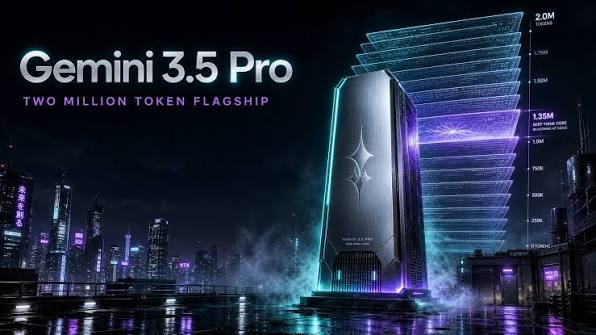
While you were sleeping, Google unleashed its most powerful brain ever built and Xi Jinping walked onto a stage in Shanghai to declare China's AI moment has arrived. Two events.
SHANGHAI / MOUNTAIN VIEW
Friday was supposed to be just another Friday. Instead, it became the single most consequential 24 hours in the short, chaotic history of artificial intelligence — and almost nobody saw it coming until it was already happening.
In Mountain View, California, Google DeepMind finally flipped the switch on Gemini 3.5 Pro, the long-delayed successor that engineers reportedly tore down and rebuilt from scratch after discovering the original version choked on recursive tool-calling and couldn't reliably draw a decent vector graphic. Six thousand miles away, in a cavernous exhibition hall in Shanghai, Chinese President Xi Jinping stepped up to a podium at the 2026 World AI Conference and did something he has never done in the event's eight-year history: showed up in person to deliver the keynote himself.
Two superpowers. Two stages. One unmistakable message — the race to dominate artificial intelligence has stopped being a Silicon Valley story and become the defining geopolitical contest of the decade.
THE MODEL GOOGLE ALMOST DIDN'T SHIP
Gemini 3.5 Pro was supposed to land in June. It didn't. According to multiple industry reports, Google DeepMind scrapped its original build after engineers discovered structural failures deep in the model's ability to chain together tool calls autonomously and generate clean SVG image outputs — the kind of embarrassing cracks that don't show up in a demo but blow up in production. Rather than ship something half-broken, the company reportedly tore the architecture down to the studs and started over, an almost unheard-of move for a flagship model already trailing its rivals.
The gamble left Google red-faced for weeks. Alphabet's stock reportedly shed as much as $225 billion in market value at one point as reports of a DeepMind talent exodus and a stalled release swirled, and rumors circulated that Google had quietly begun rationing its own compute, even reportedly slowing Gemini access for partners like Meta while it scrambled to get the new model over the finish line.
Now it's here, and the specs are the kind that make rival labs nervous. Gemini 3.5 Pro ships with a two-million-token context window — enough to swallow an entire codebase, a stack of legal contracts, or several full-length novels in a single prompt without blinking. Layered on top is a "Deep Think" extended reasoning mode, a slower, more deliberate thinking process the model can invoke for gnarly math, multi-step coding tasks, and problems that require actually working something out rather than pattern-matching an answer. There's a catch: Deep Think is reportedly gated behind Google's $250-a-month "Ultra" subscription tier, putting the sharpest version of the company's flagship brain out of reach for casual users and small developers.
The timing could not be tighter. Gemini 3.5 Pro arrives just six days after OpenAI's GPT-5.6 and nine days after xAI's Grok 4.5 — meaning three of the industry's biggest labs have crammed their flagship releases into a single two-week window. Benchmarking firms tracking the "Artificial Analysis Intelligence Index" have Gemini's predecessor, 3.1 Pro, already sitting near the top of most reasoning leaderboards; if the jump to 3.5 is anywhere near as large as Google is promising internally, the rankings could reshuffle within days.
XI TAKES THE STAGE — AND THE MICROPHONE
While Google was fighting to get its model out the door, China was preparing a message of its own. The 2026 World Artificial Intelligence Conference, running July 17 through 20 in Shanghai, is the largest edition yet: more than 140 forums, over 1,100 exhibitors, roughly 1,400 invited guests, and by some counts more than 300 products making their global debut on the show floor.
What made this year different wasn't the size. It was the man standing at the podium. Xi Jinping has never personally opened the World AI Conference since Shanghai launched it in 2018 — he has sent surrogates, video messages, and written remarks, but never himself. This year he showed up, delivered the keynote in person, and used it to frame artificial intelligence as nothing less than a "rare historic opportunity" for China, pledging that Beijing would pursue growth through "encouraging open source, openness, collaboration and sharing."
Buried inside the diplomatic language was a sharper strategic play. Alongside the conference, China convened a "High-Level Meeting on Global AI Governance," widely read by analysts as Beijing's attempt to stand up a rival framework to the Western-led AI governance conversations dominated by the U.S. and EU — explicitly pitched toward the Global South, where China has spent years building infrastructure and diplomatic goodwill through initiatives like the Belt and Road program. Instead of asking to join the table the U.S. and its allies have built, China spent this week building its own.
A REPORT CARD NOBODY WANTED TO SEE
As if the day needed another headline, the Future of Life Institute dropped its 2026 AI Safety Index this week, grading the industry's biggest labs on how seriously they're taking the risks of the technology they're racing to build. The results were not flattering. Anthropic topped the field — with a grade of C+. Google DeepMind and OpenAI both landed a C. Meta scored a D+. And xAI, DeepSeek, and Mistral, according to the index, effectively failed outright.
Read that again: the best grade handed out to any company building frontier AI systems in 2026 was a C+. Not a single lab scored a B, let alone an A, on an index specifically designed to measure whether these companies are managing the risks of the technology now racing toward two-million-token context windows and autonomous multi-step reasoning.
The juxtaposition landed like a gut punch: on the very day the industry celebrated its most powerful models yet, an independent watchdog was publicly grading the same companies as, at best, mediocre stewards of the risks involved.
WHY THIS ISN'T JUST ANOTHER PRODUCT LAUNCH
It would be easy to file Gemini 3.5 Pro under "yet another AI model update" — tech companies ship new versions constantly, and the news cycle has grown numb to announcements of bigger context windows and smarter reasoning modes. But three things happening on the same day change the calculus.
First, the compressed release window. Having GPT-5.6, Grok 4.5, and Gemini 3.5 Pro all launch within roughly a nine-day span means, for the first time, consumers and enterprises can directly compare the very best each major lab has to offer almost side by side, rather than comparing a fresh release against a stale six-month-old competitor. That kind of clustering rarely happens by accident — it suggests labs are increasingly racing to each other's calendars rather than their own.
Second, the scale of the financial stakes now attached to a single product delay. A reported $225 billion swing in Alphabet's market value tied to rumors about Gemini's rebuild is a reminder that these aren't just research projects anymore — they're the single largest driver of value (and volatility) for some of the most valuable companies on Earth.
Third, and most significant long-term, is the governance split forming in real time. With China standing up its own global AI governance forum in parallel with — not in response to — a Western-dominated conversation, the world may be heading toward two competing rulebooks for how AI gets built, deployed, and restrained, rather than one. That has implications far beyond who has the snappiest chatbot.
THE SMALL MODEL NOBODY'S TALKING ABOUT
Almost lost in the noise of billion-dollar model launches was a smaller but arguably more quietly disruptive release: PrismML's Bonsai 27B, which reportedly compresses a 27-billion-parameter model down to a 3.9-gigabyte footprint capable of running directly on an iPhone 17 Pro at around 11 tokens per second. If that holds up, it's a meaningful data point in a separate, equally important race — not for the biggest model in a data center, but for genuinely useful AI that runs entirely on the phone in your pocket, with no cloud connection, no subscription, and no data leaving the device.
EXPERT PERSPECTIVE
AI safety researchers have been warning for months that the industry's release cadence has outpaced its ability to evaluate what it's shipping. The Future of Life Institute's index — put together by a panel of independent AI safety academics — explicitly cited "existential safety" planning, or the lack of it, as a recurring weak spot across nearly every major lab graded, regardless of how sophisticated their public-facing models have become. Industry analysts covering the model releases have similarly noted that benchmark leadership now changes hands every few weeks rather than every few months, a pace that leaves little time for independent researchers to stress-test a model's real-world behavior before the next one arrives to replace it.
WHAT THIS MEANS FOR YOU
If you use AI tools for work, expect the ground to keep shifting under your feet. A two-million-token context window sounds abstract until you realize it means dumping your entire email archive, your company's whole codebase, or a year of financial filings into a single conversation and asking questions across all of it at once — genuinely new territory for what these tools can do for research, coding, and analysis. But the best version of that capability, Deep Think, is locked behind a $250-a-month tier, a price point that puts frontier reasoning out of reach for most individuals and small businesses, deepening a capability gap between well-funded users and everyone else.
On the geopolitical side, the emergence of parallel AI governance tracks — one centered in Washington and Brussels, another now explicitly being built in Beijing — means the rules governing how AI gets developed and deployed may increasingly depend on which part of the world you're in, rather than converging on a single global standard. That's worth watching regardless of whether you ever open a chatbot.
And if the safety grades are any indication, it's worth remembering that "most capable" and "most responsibly built" are not currently the same list — the industry's own watchdogs say so.
THE BOTTOM LINE
July 17, 2026, will likely be remembered less for what Gemini 3.5 Pro can technically do and more for what the day revealed: an industry moving so fast that a single 24-hour window can contain a flagship model launch, a historic presidential keynote, a parallel governance framework, and a sobering safety report card, all at once. The AI race isn't slowing down to catch its breath. If anything, Friday proved it's just getting started.



