Written By | Torch Media Africa
Riders adopt electric bikes because of the daily numbers, not ideology
East & West Africa
In most of Africa, the most important vehicle is not a car, a bus or a minibus. It is the 125cc motorcycle taxi, called a boda boda in East Africa, an okada in Nigeria and a zémidjan in Benin. About 25 million motorcycles are in use across the continent. A typical commercial rider covers 150 to 200 kilometres a day, and fuel takes up much of what they earn. Electrification is moving fastest in this segment, and the reasons have more to do with business models and energy infrastructure than with climate policy.
This article examines the electric two-wheeler sector in 2026. The main argument is that Africa's e-mobility transition is being financed and built as an energy utility, not as a vehicle market. The bikes are relatively easy. The difficult parts are batteries, swap stations, electricity tariffs and standards.
A US$415 million signal
Spiro is the clearest example of the model. The company began in Benin and Togo. On 1 June 2026 it announced a US$215 million equity round backed by Impact Fund Denmark and Equitane. That came four months after a US$50 million debt facility from Afreximbank, Nithio and the Africa Go Green Fund, and under a year after a US$100 million equity round led by Afreximbank's Fund for Export Development in Africa (FEDA). Including a US$63 million GuarantCo/Société Générale debt package in 2023 and a US$50 million Afreximbank loan in 2024, Spiro has disclosed more than US$415 million in funding since 2023. That makes it one of the most heavily capitalised hardware companies in African tech.
The company's operating figures have grown just as quickly. Spiro says it has deployed more than 100,000 electric motorcycles and built more than 2,500 battery-swap stations in seven countries: Kenya, Rwanda, Uganda, Togo, Benin, Nigeria and Cameroon. Riders have completed more than 30 million swaps. A year earlier the company reported 80,000 bikes and 1,500 stations in six markets. The new capital will pay for more stations, solar-powered swap sites with battery storage, manufacturing, and expansion into Ethiopia and the Democratic Republic of Congo.
The funders matter as much as the amounts. Development finance institutions, an export-credit bank and climate funds are lending to this sector on terms normally used for infrastructure. That suggests they see swap networks less as a startup bet and more as a new kind of distributed fuel-retail network.
The rider's arithmetic
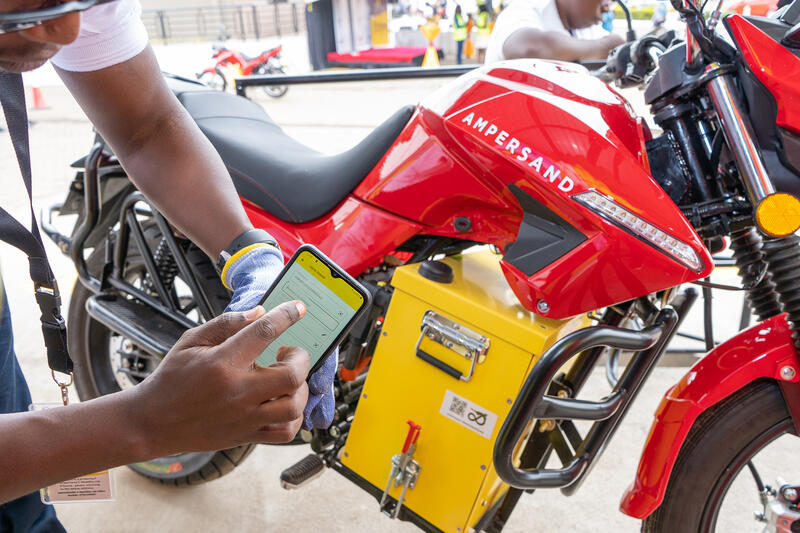
Riders adopt electric bikes because of the daily numbers, not ideology. Spiro says its bikes sell for about US$800, roughly 40% less than a comparable petrol model. It says battery swapping cuts per-kilometre operating costs by about 30%, saving a rider up to US$3 a day on fuel and maintenance. For someone earning perhaps US$8 to US$15 a day, that is a large increase in take-home pay. Swapping also avoids the main drawback of plug-in charging. A depleted battery is replaced with a charged one in about two minutes, so the rider does not lose working time.
The business model has two revenue streams: an upfront sale or lease-to-own payment for the bike, and recurring pay-as-you-go fees for swaps. In effect, the operator sells energy by the swap the way a petrol station sells fuel by the litre. Once the bike is sold, revenue depends on station density and battery utilisation. This is why the sector looks like a utility. Margins come from keeping batteries in use and stations busy. It is also why the business needs so much capital: every new rider requires several batteries in circulation behind them.
Kenya: from pilot to policy
Kenya is the largest and most data-rich market. Its National Electric Mobility Policy, launched in February 2026 along with green number plates for EVs, puts two-wheelers first. The policy cites about 24,000 electric motorcycles sold in 2025 and projects just over 63,000 a year by 2027. An analysis of national registrations reported by CleanTechnica found 25,277 electric motorcycles registered in 2025, about 15.3% of new motorcycle registrations by December. More than 15,000 of them were Spiro bikes, and Spiro runs more than 400 swap stations in Kenya. Different trackers report different totals, a common problem in a young sector, but all show strong growth.
Competition is intensifying. Roam assembles electric motorcycles and buses at a Nairobi plant with stated capacity above 50,000 units a year. Ampersand raised US$7 million in late 2025 to grow its fleet to 13,000 bikes by late 2026. Arc Ride has raised US$33.3 million. M-KOPA, the asset-finance company, has put more than 5,000 electric bikes on Kenyan roads, and China's Yadea, the world's largest e-two-wheeler maker, has entered the market. Ride-hailing platforms such as Bolt have run leasing programmes with Roam, Ampersand and M-KOPA.
The regulator is adjusting the rules as the sector grows. In a gazette notice dated 18 September 2026, the Energy and Petroleum Regulatory Authority (EPRA) removed the 15,000 kWh monthly cap on its special e-mobility electricity tariff and replaced it with an 'Energy Consumption Threshold', backdated to 1 July 2025. The tariff is KSh16 per kWh at peak and KSh8 off-peak. Under the cap, large swap and charging operators risked being moved to commercial rates as they grew. EPRA's 2025/26 data shows e-mobility tariff customers rising from 115 to 543. Tax policy is less stable. The Finance Bill 2026 proposed changing electric motorcycles and certain batteries from zero-rated to VAT-exempt. That would stop operators reclaiming input VAT and could raise costs. The Electric Mobility Association of Kenya has asked for incentives to be consistent and predictable.
Rapid growth has also caused problems. In March 2026 CleanTechnica reported battery shortages and queues at swap stations in Nairobi, where demand had outgrown battery inventory. For a rider, twenty minutes in a queue cancels much of the time advantage that made swapping attractive. Kenya's experience shows that once the bikes sell, the binding constraint becomes battery stock and capital.
Rwanda and Ethiopia: policy by mandate
Rwanda and Ethiopia have used regulation to force the shift. Since January 2025, Kigali has registered only electric motorcycles for public transport. Existing petrol moto-taxis may keep operating, but no new ones can be registered. Moto-taxis account for about a fifth of trips in the capital. Electric motorcycle imports went from 4 in 2019 to 5,781 in 2024. Electric bikes made up only about 4.1% of Kigali's licensed commercial fleet in late 2022, and recent roadside counts suggest they now sometimes outnumber petrol bikes. These counts are informal, not official census data. Zero VAT and import-duty exemptions on EVs and components, together with discounted electricity for charging stations, support Rwanda's target of a 38% emissions cut by 2030.
Ethiopia went further in 2024 by banning imports of internal-combustion passenger vehicles. Duties are now 15% on fully built EVs, 5% on semi-knocked-down kits and zero on fully knocked-down kits assembled locally. Government figures put the EV fleet at about 100,000, close to 6% of a 1.7-million-vehicle stock, up from under 1% two years earlier. The reasons are mainly about energy security and foreign exchange. Ethiopia reportedly spent about US$4.6 billion on fuel imports across 2023 and 2024, while it has large hydropower generation. Infrastructure is behind, however, with fewer than 100 public charging stations in early 2026. Spiro's planned entry would bring the two-wheeler swap model to a market where policy has so far focused on cars.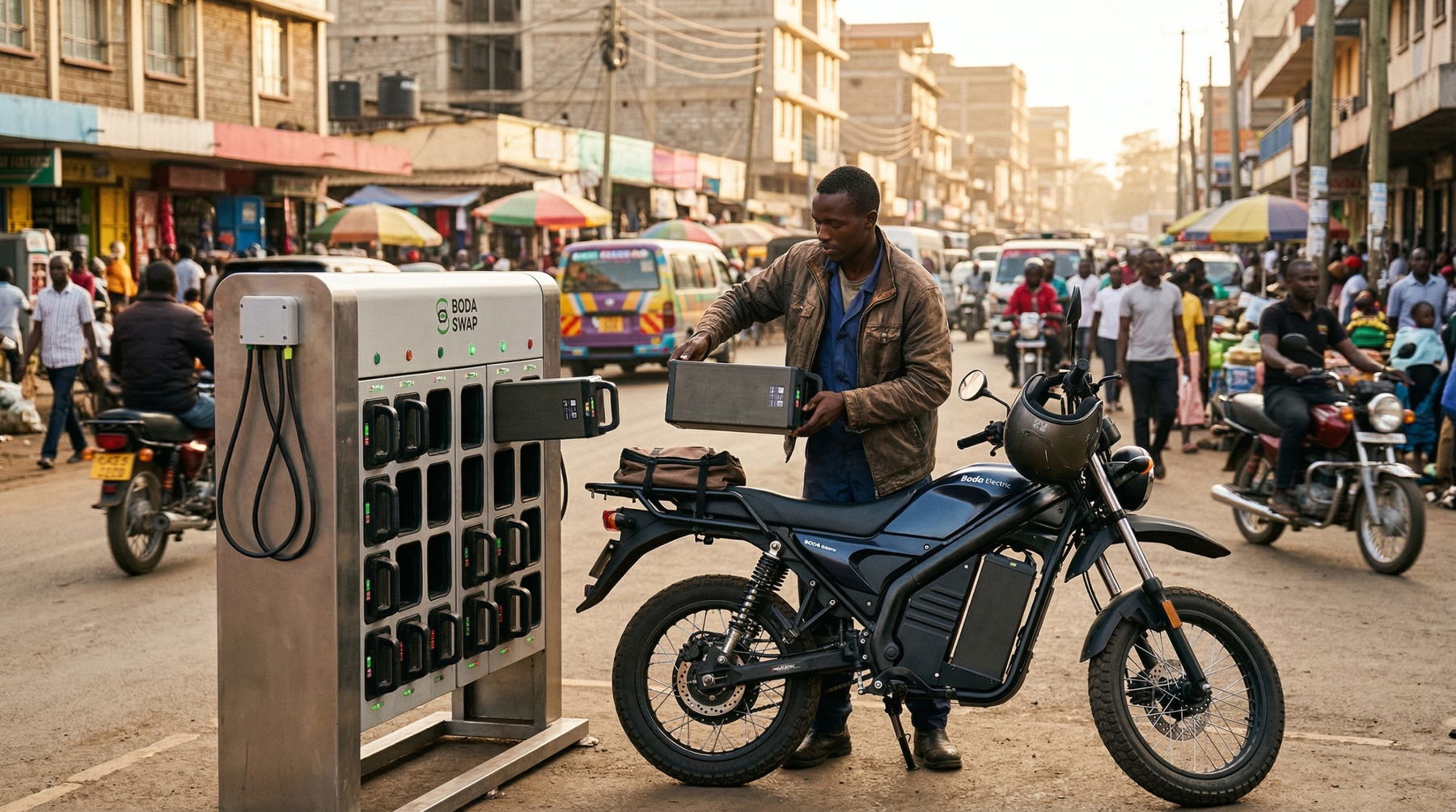
West Africa: where the model started
Benin and Togo were the first markets for battery-swapped motorcycle taxis at scale. Both have large zémidjan fleets and import all their fuel. Their experience shows that the model does not require a large economy. It requires dense urban demand, a reliable enough grid or solar backup, and a government willing to treat the operator as an energy partner. Nigeria is the region's biggest prize and its toughest test. The fuel-subsidy removal of 2023 sharply raised petrol prices and made electric bikes more competitive, but unreliable grid power means swap stations need solar and storage. Spiro now assembles bikes in Nigeria and runs a battery-recycling facility there, an early answer to the end-of-life question every swap operator will eventually face.
The industrial question
Electric two-wheelers are one of the few areas where Africa can realistically assemble vehicles locally. A motorcycle has few parts, battery packs can be assembled from imported cells, and battery management systems are software and electronics that local engineers can design. Spiro says it assembles in Kenya, Rwanda, Uganda and Nigeria with about 30% local sourcing and a target of 70% within two years, and that it makes its own battery management systems in Kenya. Cells still come almost entirely from Asia, mostly China, so value-added stops at the pack. Development financiers such as Afreximbank clearly want local manufacturing and lower fuel-import bills, and that preference shapes which companies get funded.
Risks and what to watch
The motorcycle taxi became common in African cities because formal transport failed to meet demand. Electrifying it requires building new energy infrastructure around the motorcycle in a short time: thousands of small fuel stations that sell kilowatt-hours instead of litres. Investors have now committed hundreds of millions of dollars to that idea. The next two years will show whether battery-swap networks can become dependable infrastructure for a continent's most widely used vehicle.



