Technology Transformation
A Digital Economy Rebuilt in the Middle of a War
More than three years into the civil war between the Sudanese Armed Forces (SAF) and the Rapid Support Forces (RSF), Sudan has become an unlikely case study in forced digital transformation. With the formal banking system in ruins, cash physically scarce, and telecommunications infrastructure repeatedly destroyed by both warring parties, ordinary Sudanese have been pushed into mobile money and satellite internet not as a matter of convenience but as a matter of survival. The result is one of the most extreme natural experiments in fintech adoption anywhere in Africa: mobile banking app activations up as much as 85% since the war began, a satellite internet provider that has become the country’s second-largest ISP by market share, and a currency system that has effectively split along the war’s territorial front lines.
The scale of the underlying humanitarian catastrophe frames everything else. As of March 2026, more than 11.6 million people were forcibly displaced within Sudan or into neighboring countries, and roughly 21.2 million people — 41% of the population — were facing high levels of food insecurity, according to UN-coordinated tracking. Sudan’s real GDP contracted by an estimated 29.4% in 2023 and a further 14% in 2024, among the sharpest economic collapses recorded anywhere in the past decade, before growth is estimated to have rebounded by roughly 3.1% in 2025 off that devastated base, with the World Bank projecting 2.1% growth in 2026 and 3.2% in 2027 as reconstruction spending slowly resumes in social services and infrastructure. Extreme poverty rose from about 48% of the population in 2023 to an estimated 59% in 2025, while government revenues collapsed from roughly 10% of GDP in 2022 to below 5% in 2024-25 — a fiscal implosion that has made functioning digital payment rails not a luxury but one of the only mechanisms left for the state and its citizens to move money at all.
Telecommunications as a Weapon of War
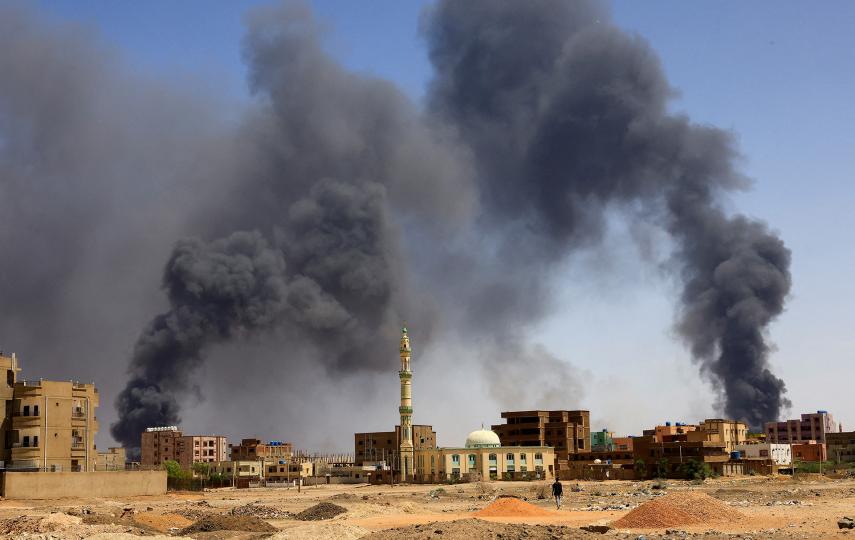
Sudan’s internet and mobile networks have been targeted deliberately and repeatedly by both sides of the conflict. In February 2024, RSF attacks on the Khartoum headquarters of Sudan’s three major telecom operators — Zain Sudan, Sudani, and MTN Sudan — knocked out connectivity for nearly 30 million people for close to a month, according to joint reporting from the Norwegian Refugee Council and other humanitarian organizations. Both the SAF and RSF have since destroyed fiber-optic cables and cell towers in efforts to deny the other side coordination capability, and the Sudanese Armed Forces have specifically ordered internet suspensions across RSF-held areas of Darfur and Kordofan. By November 2025, monitoring groups recorded at least four major nationwide shutdowns over the course of the year alone, cementing Sudan’s status as one of the most digitally disrupted environments in Africa. Even mundane events now trigger connectivity blackouts: the Internet Society’s Pulse project documented recurring shutdowns timed to national exam seasons in 2026, a pattern seen in several African states but layered here on top of war-driven disruptions.
As of the most recent DataReportal "Digital 2026" assessment, Sudan had 14.9 million internet users as of October 2025, an internet penetration rate of just 28.7% against a population of roughly 52.1 million — meaning more than seven in ten Sudanese remained offline. GSMA Intelligence counted 17.8 million cellular mobile connections at the end of 2025, of which about 73.3% were technically capable of broadband (3G/4G/5G) service, though actual data usage lags far behind that headline figure given affordability and network-availability constraints. Zain Group had committed $800 million to upgrade its Sudanese unit’s network and fiber infrastructure, but that investment was announced in December 2022, months before the war escalated, and subsequent reporting has not identified a comparable reconstruction commitment matched to 2026 conditions — leaving operators largely in patch-and-restore mode rather than expansion mode.
Starlink: Lifeline, Black Market, and Battlefield Tool
Into this vacuum has stepped Starlink, Elon Musk’s satellite internet service, which has grown to become Sudan’s second-largest internet service provider by market share according to reporting compiled by Geeska and other regional outlets — an extraordinary position for a service with no official license to operate in the country. Terminals have flowed into Sudan through informal and black-market channels, documented in detail by the digital-rights group SMEX, with civilians, humanitarian organizations, and businesses relying on the service to stay connected when terrestrial networks are down. The New Humanitarian and other outlets have reported that displaced Sudanese, dependent on the service for both communication and access to mobile banking, have publicly pleaded with Musk not to restrict or shut off the service, reflecting how central Starlink has become to basic survival infrastructure in a country where the state can no longer guarantee connectivity.
That same ubiquity has made Starlink a contested military asset. Reporting from New Lines Magazine and others describes the RSF using the terminals to coordinate drone strikes against Sudanese army positions, with the paramilitary group reportedly acquiring hundreds of terminals through dealers based in the United Arab Emirates. The result is a uniquely uncomfortable dynamic in which the same technology keeping millions of civilians financially and socially connected is simultaneously embedded directly into the conduct of the war — a dilemma that has made Starlink both indispensable and, for many Sudanese, a source of ambivalence rather than gratitude toward its provider.
Mobile Money as the Last Functioning Financial Rail
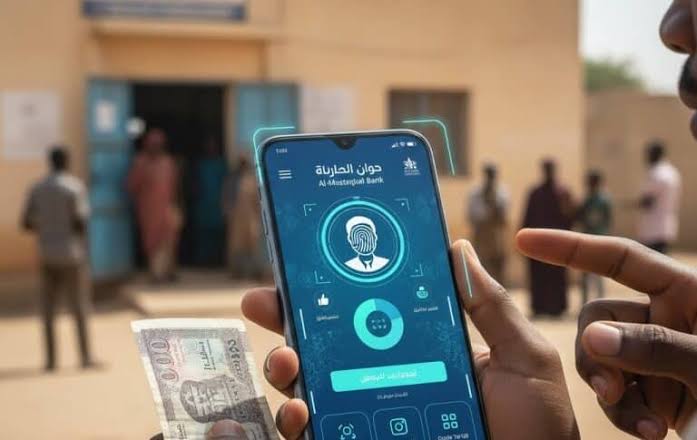
With cash physically scarce and much of the formal banking sector destroyed or inaccessible, mobile financial platforms have absorbed an enormous share of Sudan’s remaining economic activity. Bankak, the mobile banking app of the Bank of Khartoum, and Cashi, a standalone mobile wallet, have together seen growth described by industry sources as roughly 500% over the past two years of war. The Bank of Khartoum’s board chair has said Bankak app activations alone rose by about 85% since the fighting began in April 2023. Because roughly 85% of Sudan’s population lacks a formal bank account — against mobile phone penetration estimated at 77% — non-bank wallets such as MyCash and RittalPay have also gained ground, since they do not require the account relationships that Bankak and Ocash (operated by Omdurman National Bank) still formally require, even as the Bank of Khartoum has relaxed onboarding rules, allowing remote account opening and the use of expired identity documents to widen access.
The war has effectively partitioned Sudan’s monetary system along territorial lines, a fragmentation documented in the "Future Bank: Sudan’s Monetary Partition" analysis published via the Sudan Transparency and Policy Tracker in May 2026. Currency conversion has become a significant extractive cost for displaced and besieged populations: traders in RSF-held areas of North Darfur have reportedly charged commissions as high as 40% to convert digital Bankak balances into physical Sudanese pound banknotes, a levy that functions as a tax on the war’s most vulnerable people. In response, Sudanese authorities capped the commission traders may charge for converting Bankak digital balances into cash at 15%, effective May 23, 2026 — a regulatory intervention aimed squarely at reining in exploitative currency-conversion markets that had flourished amid the cash shortage.
Without functioning internet connectivity, this entire financial architecture seizes up: mobile banking, the primary functioning payment system left in the country, "grinds to a halt" when networks go down, according to humanitarian-sector reporting, forcing the economy toward barter and informal credit arrangements documented by outlets including The Arab Weekly. This tight coupling between connectivity and monetary function is precisely why telecom shutdowns — whether militarily motivated or administratively imposed during exam seasons — carry economic consequences far beyond the loss of communication itself.
Startups, Incubators, and a Fragile Innovation Ecosystem
Sudan’s pre-war technology and startup ecosystem has not disappeared, but it has scattered. TechCrunch reported in late 2024 that Savannah, a Khartoum-based startup incubator, resumed operations after being displaced by the fighting, relocating activity to the comparatively safer eastern provinces of Port Sudan and Kassala. Coverage from How We Made It In Africa and Wamda describes a founder community that has either paused operations, pivoted business models toward crisis-relevant services such as remittances and logistics, or emigrated entirely to Egypt, Kenya, or the Gulf states while attempting to keep Sudanese operations alive remotely. Analysts writing in outlets such as Sudan Horizon and the "How Fintech Is Rebuilding Sudan" series argue that the digital economy — and fintech specifically — represents one of the more plausible near-term paths to post-war reconstruction, precisely because mobile financial infrastructure has already demonstrated resilience and adoption at a scale the formal banking sector cannot currently match.
The structural obstacles remain severe. VoxDev’s analysis of rebuilding Sudan’s digital infrastructure amid conflict identifies weak and war-damaged telecommunications and electricity infrastructure, constrained investment capital, and the absence of modern data-protection and cybersecurity legislation as the binding constraints on turning wartime digital adoption into a durable post-war digital economy. The UN’s February 2026 launch of a $2.87 billion Sudan Humanitarian Needs and Response Plan underscores the scale of need still being addressed through emergency channels rather than long-term development financing, leaving Sudan’s digital and telecommunications reconstruction largely unfunded relative to the scale of wartime destruction.
Outlook
Sudan’s experience over the past three years complicates any simple narrative about African digital transformation. Adoption of mobile money and satellite connectivity has been extraordinarily fast — faster, in percentage terms, than almost anywhere else on the continent — but it has been driven by state collapse rather than deliberate policy, and it coexists with some of the worst connectivity statistics in Africa, a fragmented currency system, and technology that has been weaponized alongside its humanitarian use. Whether Sudan’s fintech resilience becomes the foundation of the "digital economy gateway to reconstruction" that some analysts describe, or simply a wartime coping mechanism that fades once (or if) the conflict ends, will depend on political developments in Khartoum and Port Sudan that are, as of mid-2026, still unresolved.
Published By | Tech Wiz