Written By | Torch Media Africa
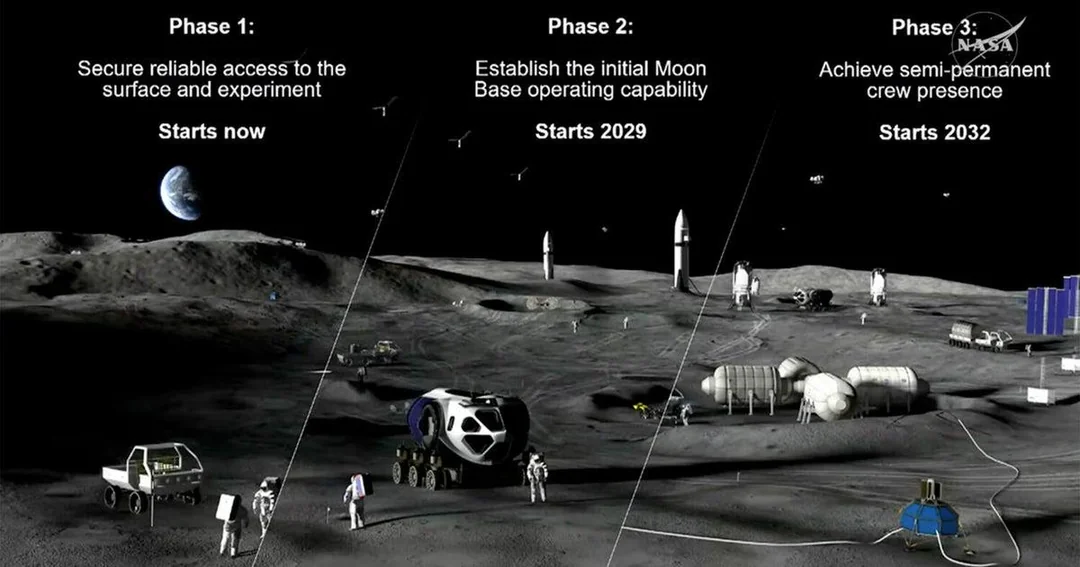
NASA just revealed hopping drones, astronaut buggies, and a nuclear reactor for a lunar outpost the size of a small county — and the clock to beat China is ticking
WASHINGTON, D.C.
Three hundred miles of frozen, radiation-blasted lunar wilderness is about to get an extreme makeover — and NASA isn't messing around.
On Tuesday, NASA Administrator Jared Isaacman laid out the most ambitious plan to colonize another world the U.S. has ever attempted: a permanent, nuclear-powered Moon Base sprawling across hundreds of square miles of the lunar south pole, patrolled by hopping robot drones, serviced by astronaut buggies, and engineered to outlast — and outmaneuver — China's own march to the same patch of frozen real estate.
"The Moon Base will be America's and humanity's first outpost on another celestial world," Isaacman said. "Every mission will be a learning opportunity as we return to the lunar surface, build the infrastructure to stay, and master the skills required to live in one of the most demanding environments imaginable."
The price tag: **$20 billion to start** — ballooning to as much as $30 billion by full operational capability around 2036.
The Blueprint: A Lunar Boomtown
This isn't a single habitat dome — it's a sprawling, distributed network of assets spread across hundreds of square miles near the Shackleton Connecting Ridge, a strip near the lunar south pole prized for near-constant sunlight and suspected water ice deposits.
The plan calls for 79 total launches, including 73 robotic and crewed landers, ferrying up ten Lunar Terrain Vehicles, a dozen "MoonFall" hopping drones, and four pressurized habitat modules. The enterprise will be anchored by a 20-kilowatt nuclear fission reactor — because solar panels alone can't survive a 14-Earth-day lunar night plunging to nearly minus 280°F.
The hopping drones are arguably the most sci-fi element. MoonFall units will detach from their carrier spacecraft, descend, and leapfrog across the terrain in short hops about a mile apart — scouting and mapping the base's perimeter over a single lunar day, identifying hazards and safe travel corridors before astronauts arrive.
Then there are the buggies. NASA has tapped Astrolab ($219 million), **Lunar Outpost** ($220 million), and Blue Origin ($188 million, with an option for $280.4 million more) to build and deliver the first Lunar Terrain Vehicles by as early as 2028. Blue Origin's uncrewed cargo lander is slated to touch down this fall. Firefly Aerospace also picked up early infrastructure work.
Total contracts awarded so far: nearly $1 billion — a down payment on a project NASA hopes will eventually put boots, wheels, and reactor cores permanently on the Moon.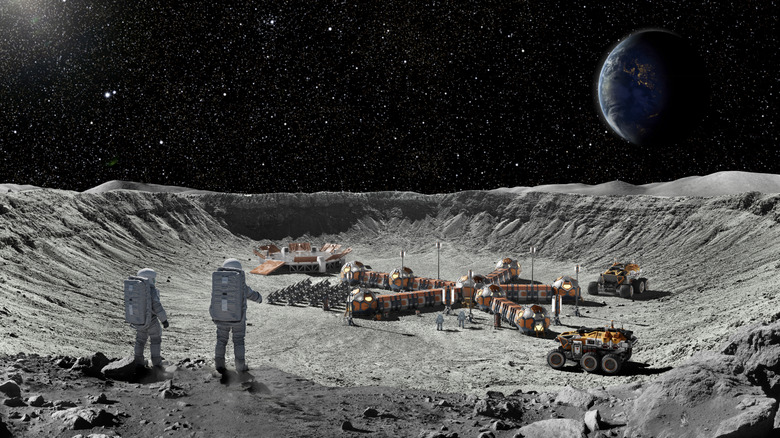
The Shadow of Beijing
Strip away the engineering specs, and the political subtext is impossible to miss: this is a race.China has been racing toward the same resource-rich lunar south pole in partnership with Russia, with an eye toward its own long-term presence. Beijing has publicly targeted a crewed landing by 2030 — two years behind NASA's 2028 target. But space-policy watchers warn China has a track record of compressing deadlines once a program gains momentum, recently moving its Tianwen-3 Mars mission up two years.
Whoever arrives first at the most resource-rich real estate could have outsized influence over how the Moon gets carved up — choosing where infrastructure goes, setting technical standards, and effectively writing the opening rules of a new era of lunar resource claims.
Isaacman was careful to thread the needle between urgency and restraint: "We do want to get there and explore [areas of great interest], and we want to be mindful of the Outer Space Treaty... We would expect that to be reciprocal."
The 2028 target lines up with the final year of President Trump's second term — and the administration has framed the enterprise explicitly as a dominance play against Beijing.
Expert Perspective: "Probably Not"
Not everyone is convinced the math adds up. Casey Dreier, chief of space policy at the Planetary Society, offered a blunt assessment of whether $20 billion will be enough: "Probably not."
The roughly seven-year timeline is aggressive bordering on reckless — requiring a launch cadence no spacefaring nation has ever attempted. NASA's Artemis program has already run years behind schedule and billions over budget. The Planetary Society estimates the U.S. will have spent roughly $107 billion (inflation-adjusted) on return-to-the-Moon efforts through 2026 alone — raising questions about whether the base's price tag is an opening bid rather than a final one.
Then there's Washington's appetite for funding. A proposed FY2027 budget would cut NASA's overall funding by roughly 23% — landing directly in the path of an agency simultaneously attempting the most complex lunar infrastructure project in its history.
What This Means for You
For the average American taxpayer, the Moon Base represents one of the largest sustained federal science investments of the decade — tens of billions flowing through NASA contracts to private aerospace firms, supporting thousands of engineering and manufacturing jobs across California, Colorado, Texas, Florida, and beyond.
A successful lunar foothold near water ice deposits would mark humanity's first real foray into living off-world for years rather than days — generating engineering lessons in radiation shielding, nuclear power, and autonomous robotics that will inform any eventual Mars mission. If the base falters, it could become the latest cautionary tale about the gap between Washington's lunar ambitions and its follow-through.
Geopolitically, whichever nation establishes the first durable presence near the lunar south pole will likely have an outsized hand in writing the rules — formal or otherwise — for who can mine what, where infrastructure can be built, and how disputes get resolved.
The Bottom Line
NASA's vision is breathtaking: a robotic and human settlement spanning hundreds of square miles, powered by a nuclear reactor, patrolled by hopping drones, and built in partnership with private companies racing against a geopolitical clock.
Whether it materializes on anything resembling the announced timeline is, by the admission of NASA's own outside watchdogs, very much an open question. But Tuesday's briefing was a clear signal: the agency is doubling down, contracts are flowing, and the first hardware — Blue Origin's cargo lander — could be on its way to the lunar surface this fall.
Whether America gets there first, on budget, and on schedule is the multibillion-dollar question that will play out over the rest of this decade — with China watching every move from across the same crater rim.
Sources: NASA, Planetary Society, Blue Origin, Astrolab, Lunar Outpost, Firefly Aerospace



