Written By |
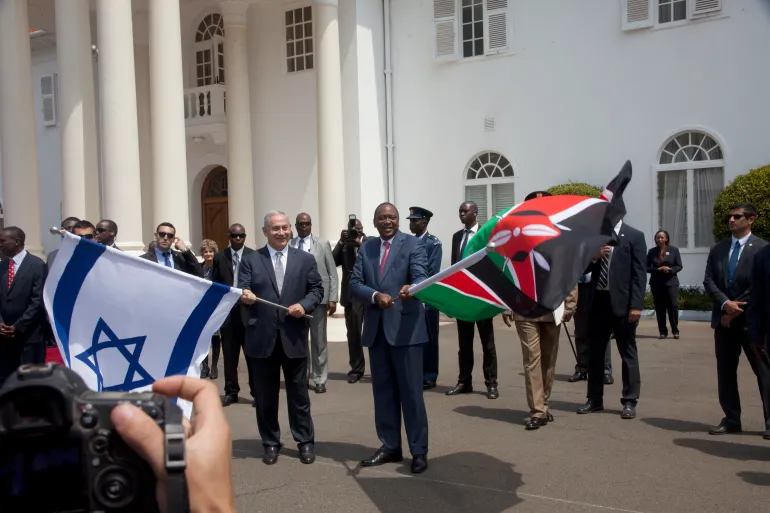
sraeli Prime Minister Benjamin Netanyahu, centre left, holding an Israeli flag next to Kenya's former President Uhuru Kenyatta, holding a Kenyan flag, in Nairobi, Kenya, in July 2016 [Photo: AP]
In late August, Israeli and Zambian officials gathered in Lusaka to reopen Israel’s embassy after more than five decades of severed ties. For Israel’s foreign affairs minister Gideon Saar, it was more than a ribbon-cutting. “Israel is returning to Zambia. Israel is returning to Africa,” Saar declared, hailing the move as a diplomatic triumph at a time when Israel is increasingly isolated over its devastating war in Gaza. Israeli media framed Zambia as Israel’s “next great Africa frontier.”
The embassy reopening is part of a wider charm offensive, experts say, as Israel courts African governments to offset its crumbling global image.
Israel’s campaign in Gaza has killed more than 66,000 Palestinians, with a UN panel describing the assault as “genocide.” South Africa, citing its own anti-apartheid struggle, has emerged as Israel’s fiercest critic on the continent, leading a genocide case against Tel Aviv at the International Court of Justice (ICJ).
By wooing Zambia, analysts argue, Israel is attempting to weaken Pretoria’s influence in the Southern African Development Community (SADC). “It’s a decades-old divide-and-rule strategy to erode support for South Africa,” said Faith Mabera of the University of the Witwatersrand.
Israel’s outreach has extended beyond Zambia. In August, Deputy Foreign Minister Sharren Haskel met her Nigerian counterpart in Abuja, though the Nigerian government—publicly pro-Palestinian—kept the talks quiet. Days later, Nigerian authorities arrested a Palestinian community leader, fueling speculation about ties to Israel’s visit. Haskel then traveled to South Sudan, one of Israel’s closest allies, promising aid even as leaked reports suggested controversial talks on relocating Palestinians from Gaza to the conflict-ridden country. Juba has denied the reports, but analysts warn any such move would trigger fierce domestic backlash.
Meanwhile, unconfirmed discussions have also surfaced about Somaliland accepting expelled Palestinians in exchange for diplomatic recognition from Israel and the United States—an idea rejected by many Somalilanders.
Israel’s relationship with Africa has swung between highs and lows. In the 1950s and 1960s, newly independent African states embraced Israel as a fellow nation breaking free of colonialism. But after the 1973 Arab-Israeli war, over 20 African countries abruptly cut ties, dealing Israel a severe diplomatic blow.
Since then, Israel has clawed its way back, reopening 11 embassies and cultivating security and trade ties. In 2021, it controversially secured observer status at the African Union (AU), though South Africa and Algeria continue to challenge it.
Still, Africa’s sympathy for Palestine remains a major obstacle. “South Africa’s freedom is incomplete without Palestine’s,” Nelson Mandela said in 1997—a sentiment that continues to shape African diplomacy.
Israel has leaned heavily on aid and security cooperation to court African states. Between 2009 and 2021, Israel’s aid agency Mashav spent $45.5m on agriculture, water, and healthcare projects in East Africa. Its arms industry has also found eager buyers: Uganda, Nigeria, Rwanda, and even South Africa have imported Israeli weapons despite their pro-Palestinian stance.
“By embedding itself in African security structures, Israel not only profits from instability but also gains partners less likely to challenge its occupation of Palestine,” South African analyst Reneva Fourie told Al Jazeera.
Israel’s efforts have yielded mixed results. While South Sudan and now Zambia appear firmly in its camp, many African states continue to vote against Israel at the UN, despite receiving aid.
Embarrassing setbacks underscore Israel’s weak standing: in April, its ambassador to Ethiopia was expelled from an AU event, while in 2023, the AU suspended Israel’s observer status after a high-profile row in Addis Ababa.
Still, Lusaka—struggling with debt and hungry for investment—has proven receptive. Israel has donated medical equipment and sponsored Zambian students for training programmes in the Naqab Desert.
But ordinary Africans remain a powerful counterweight. “Solidarity movements for Palestine have grown exponentially across the continent,” said Muhammad Desai of Africa4Palestine. “Governments enticed by Israel will be held accountable by their people. Ultimately, Israel’s efforts will fail.”
SOURCE: ALJAZEERA
CLICK TO READ ORIGINAL STORY



