Written By |
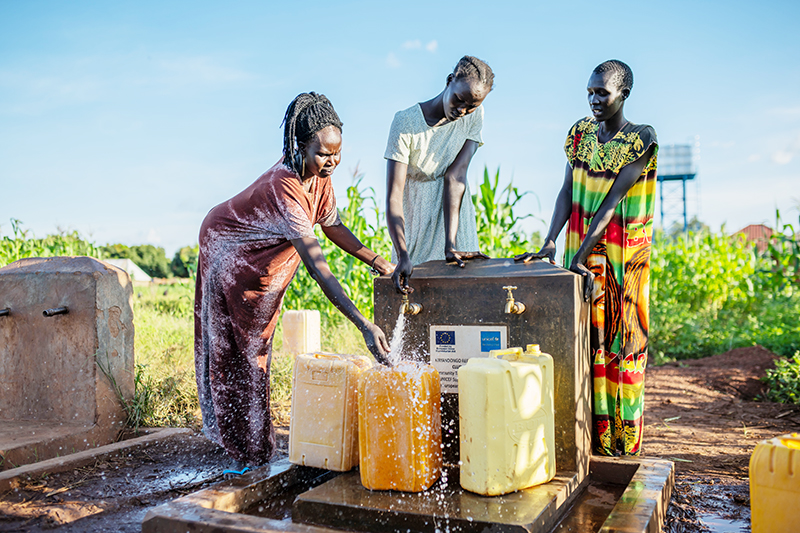
Residents collect piped-water from Kiryandongo Refugee settlemenet Cluster G, a story of hope for clean water to the Refugee Community. [File: Joshua Nahamya]
By Joshua Nahamya
KIRYANDONGO
Two new solar-hybrid piped water systems are transforming daily life for thousands of refugees in Kiryandongo Refugee Settlement, ending years of exhausting three-kilometre treks and long queues for water.
Funded by the European Union’s Civil Protection and Humanitarian Aid Operations (DG ECHO) and implemented by UNICEF in partnership with the Lutheran World Federation (LWF), the systems now provide safe, reliable water to approximately 165,000 refugees from South Sudan, Sudan, the Democratic Republic of Congo, and Kenya, along with neighbouring host communities.
Completed in just three months — between July and October 2025 — the innovative solar-diesel hybrid systems are already serving households in Clusters C and G.
“I used to spend almost the whole day walking three kilometres to the water point,” recalls 30-year-old Habib Ahmad, who arrived from Sudan in January 2025. “Now, I walk only a few metres. It takes me 10 or 15 minutes and I'm done. UNICEF and the European Union have solved our water problem. People were really suffering.”
Before the intervention, water availability in the settlement had dropped to a critically low nine litres per person per day — far below the humanitarian standard of 20 litres. The new systems are expected to immediately restore supply to at least 20 litres per person daily, replacing costly and unreliable water trucking that had been the main source since a major influx of refugees in 2023.
Eleven-year-old Laul Marol drinks clean water from a tap stand in Cluster 1, Kiryandongo Refugee settlement
How the System Works
The solar-hybrid model is designed for resilience and sustainability. Submersible pumps draw water from deep production wells, powered by 45 solar panels during the day and supported by diesel generators at night or during cloudy conditions.
The water is then conveyed through 2.6 km of transmission lines to two 108-cubic-metre hilltop reservoirs, before feeding 4.6 km of distribution pipes connected to 22 public standposts where residents access water free of charge. The increased flow has eliminated queues and significantly improved water, sanitation, and hygiene (WASH) conditions. “This project demonstrates the European Union’s commitment to greening its humanitarian aid, through sustainable, life-saving assistance to refugees and their host communities,” said Liam Kelly, Head of EU Humanitarian Aid in Uganda. “It is a good example of the nexus approach, where humanitarian and development actors work together to ensure a sustainable water supply.”
UNICEF Representative to Uganda, Dr. Robin Nandy, thanked the EU for its continued partnership, emphasising that clean water is a fundamental right.
“Our partnership with the European Union has been instrumental in providing much-needed, round-the-clock access to safe and clean water for refugees and host communities,” Dr. Nandy said. “Access to clean water is a fundamental right for children and their families. Now that the systems are complete, we are optimistic that refugees and host communities will no longer have to trek long hours in search of this basic service.”
Improved Health, Education and Dignity
The impact of the project extends beyond convenience. With shorter distances to collect water — a responsibility often shouldered by women and children — families can now devote more time to school, childcare, and income-generating activities. Easily accessible clean water is also expected to reduce the prevalence of water-borne diseases and encourage better hygiene practices such as handwashing, helping curb diarrhoea and skin infections. Over 4,000 learners at Canrom Primary School will also benefit through improved drinking water access, handwashing, and personal hygiene. Scenes of children eagerly playing and washing at the constantly flowing taps reflect a renewed sense of dignity, health, and hope across the settlement.
About UNICEF
UNICEF promotes the rights and well-being of every child. Working in 190 countries and territories, the organisation partners with governments and communities to deliver life-changing support, with a special focus on the most vulnerable and marginalised children.
About EU Civil Protection and Humanitarian Aid
The European Union and its Member States are the world’s leading donors of humanitarian aid. Through its Civil Protection and Humanitarian Aid Operations, the EU provides assistance to millions of people affected by conflict and disasters each year, delivering relief based solely on humanitarian needs.
Torch Media Africa



