Kampala
In a significant move that has sent ripples across the nation, the Uganda Communications Commission (UCC) has officially ordered the immediate and temporary suspension of public internet access and selected mobile services. The directive, dated January 13, 2026, comes just 48 hours before the highly anticipated general elections scheduled for January 15, citing the need to safeguard national security.
The announcement follows days of intense speculation and conflicting reports. Earlier in the week, government officials had attempted to quell rumors of an impending blackout. Dr. Aminah Zawedde, Permanent Secretary of the Ministry of ICT, had previously labeled such reports as “false, unfounded, and misleading,” asserting that the government remained committed to maintaining connectivity. However, the official letter released today, signed by UCC Executive Director Hon. Nyombi Thembo, confirms the sweeping restrictions.
The suspension, which takes effect today at 18:00hrs (6:00 PM), is comprehensive in its scope. According to the directive, “During this period, all non-essential public internet traffic must be blocked. Public internet traffic includes but not limited to social media platforms, web browsing, video streaming, personal email services, and messaging applications among others.” The order applies to all forms of connectivity, including Mobile Broadband, Fibre Optic, Leased Lines, and Satellite Internet Services.
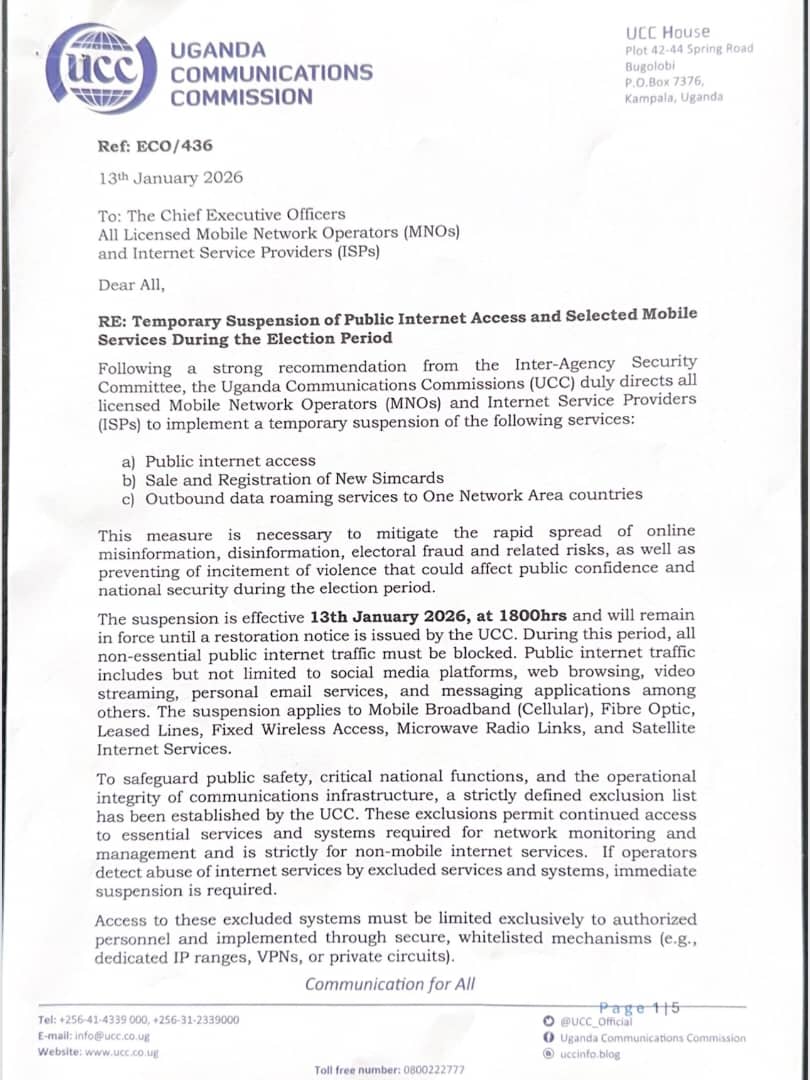
The UCC justified the move by pointing to recommendations from the Inter-Agency Security Committee. The directive states that the measure is “necessary to mitigate the rapid spread of online misinformation, disinformation, electoral fraud and related risks, as well as preventing of incitement of violence that could affect public confidence and national security during the election period.”
Beyond the total internet blackout for the public, the UCC has also halted the sale and registration of new SIM cards and suspended outbound data roaming services to “One Network Area” countries in the region. Furthermore, the commission has taken a hard line against digital workarounds, mandating that “operators shall further ensure that mobile VPN services are disabled on their networks.”
Recognizing the potential for total economic paralysis, the UCC established a strictly defined “Exclusion List” for essential services. These exclusions allow for continued connectivity for critical sectors such as healthcare, banking, aviation, and essential government functions. However, the protocol for these exceptions is rigid. “Access to these excluded systems must be limited exclusively to authorized personnel and implemented through secure, whitelisted mechanisms,” the directive reads, adding that “operators are prohibited from extending this list or allowing any form of public bypass.”
The consequences for non-compliance are severe. The commission warned that any operator failing to implement the instructions must “shut down their entire internet infrastructure for the duration of this suspension.”
While the government maintains these steps are vital for a peaceful election, the sudden reversal from earlier denials has left many citizens and businesses on high alert. The blackout will remain in force indefinitely, with the UCC stating it will last “until a restoration notice is issued.”
Torch Media Africa
Published By | News Editor