Written By | Entertainment Desk

Four years after a rare neurological disorder took her off the road, Dion opens a 26-night residency at Paris La Défense Arena.
PARIS
The last time most of the world saw Celine Dion sing, she was standing on the Eiffel Tower in the rain. It was July 2024, the opening ceremony of the Paris Olympics, and she delivered Edith Piaf's "Hymne à l'Amour" to a global audience of hundreds of millions. It lasted about four minutes. It was, by any reasonable measure, one of the most-watched vocal performances in history — and it was not a concert. It was a single song, in a controlled setting, from an artist whose body had spent two years refusing to cooperate.
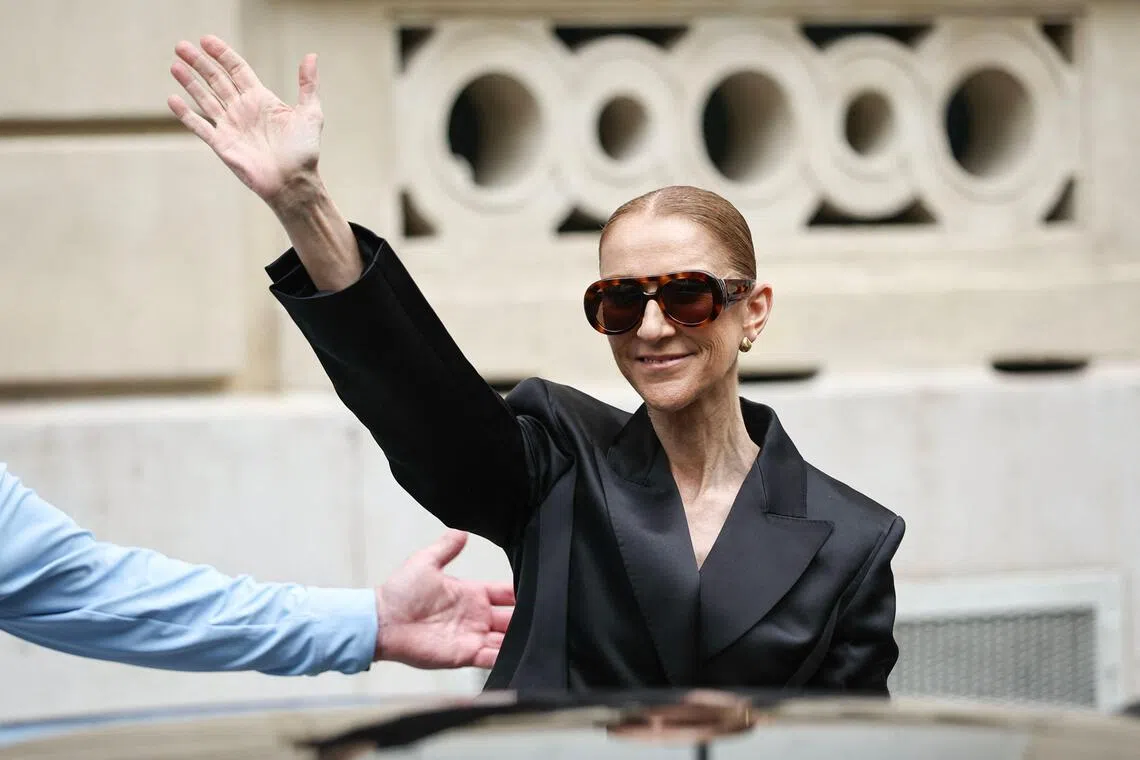
Tonight, at Paris La Défense Arena in Nanterre, Dion finds out whether she can still do the other thing: a full show, start to finish, in front of a paying crowd, with twenty-five more scheduled behind it.
What stiff-person syndrome took
Dion disclosed her diagnosis in December 2022, in a video that has since been watched tens of millions of times. Stiff-person syndrome is a rare neurological disorder — thought to be autoimmune — that causes progressive muscle rigidity and severe, unpredictable spasms. In Dion's case it affected the muscles she needs to sing: the diaphragm, the larynx, the whole apparatus that a career built on enormous, controlled, sustained notes depends on.
The practical consequences were brutal and public. The Courage World Tour, already interrupted by the pandemic, was cancelled outright in 2023. A Las Vegas residency ended. An artist who had performed more than a thousand shows at Caesars Palace and built a reputation as one of the most physically reliable performers in the business simply stopped appearing.
There is no cure. There are treatments that manage it, and Dion has been candid about the regime: immunotherapy, physical therapy, vocal therapy and, as she put it in a health update ahead of these shows, "new meds." She has also trained for tonight the way an athlete trains for a season — 90-minute Pilates sessions three times a week, and ballet classes with a local company on two more days. This is not a metaphor for recovery. It is a conditioning programme designed to give a 58-year-old woman with a neuromuscular disorder the physical margin to sing for two hours.
Nine million people wanted a ticket
The announcement came on 30 March 2026, in a video filmed beneath the Eiffel Tower — the same landmark, deliberately chosen. Dion described the residency as "the best birthday gift" she could imagine. What followed was one of the most extreme demand events in recent live-music history.
More than nine million fans registered for the ticket lottery. Every announced date sold out within hours. The run was originally scheduled at sixteen nights; six more were added almost immediately, and the engagement has since expanded to twenty-six concerts running through 29 May 2027. To put nine million in perspective: it is roughly the population of Austria, applying for seats in a building that holds around 40,000.
The venue choice is itself a statement. Paris La Défense Arena is the largest indoor arena in Europe, a modular concrete slab in the business district that has hosted a short list of artists capable of filling it for more than a night. Dion is now on that list, and she is doing it with a residency rather than a tour — a format that lets the production stay built, the crew stay put, and the artist sleep in the same bed. For a performer managing a chronic illness, that is not a commercial preference. It is a medical one.
Not a nostalgia act
The show has been designed by Willo Perron, the Montreal-born art director whose credits run through Rihanna, Drake and Kanye West — a choice that signals ambition rather than heritage. The setlist is built around the catalogue that made her, in both French and English, which for a Paris audience means something specific: this is the city and the language that made Dion a star in Europe a decade before "My Heart Will Go On" made her one everywhere else.
But she has also brought new material. In April 2026 she released "Dansons," her first new single in years, which quietly reframed the whole enterprise. A residency of greatest hits would have been an entirely acceptable ending. A residency with a new song in it is a beginning, or at least an argument for one.
What this means for the rest of us
There is a version of this story that is purely about celebrity, and it is the least interesting one. The more useful frame is what Dion's return says about working with a chronic, incurable, fluctuating illness — which is the situation of an enormous number of people who will never sell out an arena.
Almost everything Dion has done to make tonight possible is a version of advice given to ordinary patients with neuromuscular conditions: consistent low-impact conditioning, professional rehabilitation, a workload structured around energy rather than ambition, and the honesty to say publicly that the illness has not gone away. She has not claimed to be cured. She has claimed to be ready for tonight. Those are very different sentences, and the distinction matters for anyone negotiating a return to work after illness.
It also carries a warning that her own team has been careful not to bury: stiff-person syndrome is unpredictable, and twenty-six nights is a long commitment. The first show is not proof of the last one.
The room, at eight o'clock
What will actually happen tonight in Nanterre is unknowable until it does. The most likely outcome is a performer in her late fifties singing a catalogue she has sung ten thousand times, to a room that has been waiting four years and will forgive almost anything. The interesting question is not whether the audience will be moved — they will, within the first eight bars — but what Dion herself takes from it.
She has spent four years being a story about illness. From about 8 p.m. Paris time, she gets to go back to being a singer. On the evidence of the nine million people who queued for the chance to watch, that trade was never really in doubt.