Background
Sudan's civil war entered its fourth year this spring, the product of a power struggle that has its roots in the country's failed transition to civilian rule after the 2019 ouster of longtime dictator Omar al-Bashir. A power-sharing arrangement between military and civilian factions collapsed after a 2021 coup led by army chief General Abdel Fattah al-Burhan, which deepened rivalries within the security establishment itself, particularly between Burhan's Sudanese Armed Forces (SAF) and the Rapid Support Forces (RSF), a paramilitary force commanded by Mohamed Hamdan Dagalo, widely known as Hemedti. Hemedti's RSF traces its lineage to the Janjaweed militias that Bashir's government deployed against non-Arab populations in Darfur in the 2000s, a history that has shadowed the group's conduct throughout the current war.
The immediate trigger for the fighting that erupted on April 15, 2023, was a dispute over how quickly the RSF would be integrated into the regular armed forces, with the RSF favoring a ten-year timeline against the SAF's preference for a much faster, roughly two-year process. That disagreement, layered onto years of institutional distrust, exploded into open warfare in Khartoum and quickly spread across the country. The war has since produced one of the world's most severe humanitarian crises, marked by mass displacement, widespread reports of atrocities against civilians, and recurring warnings of famine conditions in besieged areas. Darfur has been especially hard hit; the RSF's capture of El Fasher, the capital of North Darfur and the last major city in the region that had remained outside its control, in late October 2025, was accompanied by extensive reporting of killings and abuses against civilians that human rights monitors and Western governments have described as constituting atrocities, with some invoking the language of genocide given the ethnic dimensions of the violence.

International efforts to end the war have centered on the so-called Quad, a mediation grouping comprising the United States, Egypt, Saudi Arabia and the United Arab Emirates, which announced a breakthrough framework roadmap in September 2025 aimed at securing a humanitarian truce and eventually a broader political settlement. In February 2026, U.S. presidential adviser Massad Boulos said the Quad had produced a peace document acceptable to both warring parties and outlined plans to raise 1.5 billion dollars in support for the country. That process has struggled to gain real traction, however, in part because Sudan's government has repeatedly accused the UAE, one of the Quad's own members, of providing continued support to the RSF, a charge Abu Dhabi denies but which has poisoned trust in the mediation format itself. Through the spring and summer, both the SAF and RSF continued to prioritize military advantage over negotiated compromise, leaving the diplomatic track largely stalled even as the humanitarian toll continued to mount.
Key Developments
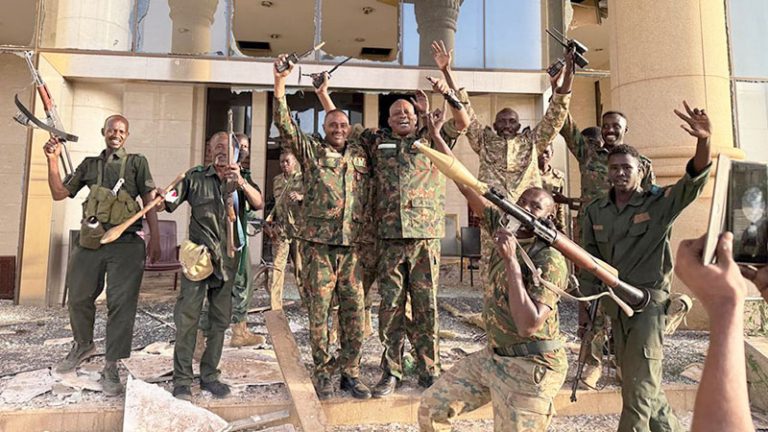
Over the past several weeks, the military balance on the ground has shifted markedly in the SAF's favor, particularly in North Kordofan state, a strategically vital region linking the central Nile valley to Sudan's west. Sudanese army forces spent July retaking a string of towns, including Bara, Jabrat al-Sheikh and Umm Sayala, before mounting a larger operation that, by mid-to-late August, secured full control over the Export Road, the key highway connecting Omdurman, just across the Nile from Khartoum, to El Obeid, the capital of North Kordofan. Control of that corridor, sometimes referred to locally as the Sadarat highway, both strengthens the army's logistics and supply position in the region and cuts into RSF freedom of movement between its Darfur strongholds and central Sudan, where it has sought to project power toward the Nile valley.
The territorial losses have coincided with a wave of defections from RSF ranks that analysts and regional media describe as unusually significant in both scale and seniority. Sudan's army has received several prominent defectors in recent weeks, including Major General al-Nour Ahmed Adam, known as al-Nour al-Qubba, and field commander Bishara al-Huwaira, followed most recently by senior field commander Ali Rizqallah, known as al-Safana. Alongside individual commanders, entire units have changed sides: one report described the arrival in Northern State of 318 fighters in what was characterized as the second-largest single group defection of the war so far, having traveled from North Darfur. General Burhan has personally received some of these defectors, a symbolically significant gesture intended to encourage further defections and to project the image of a military campaign gaining irreversible momentum.
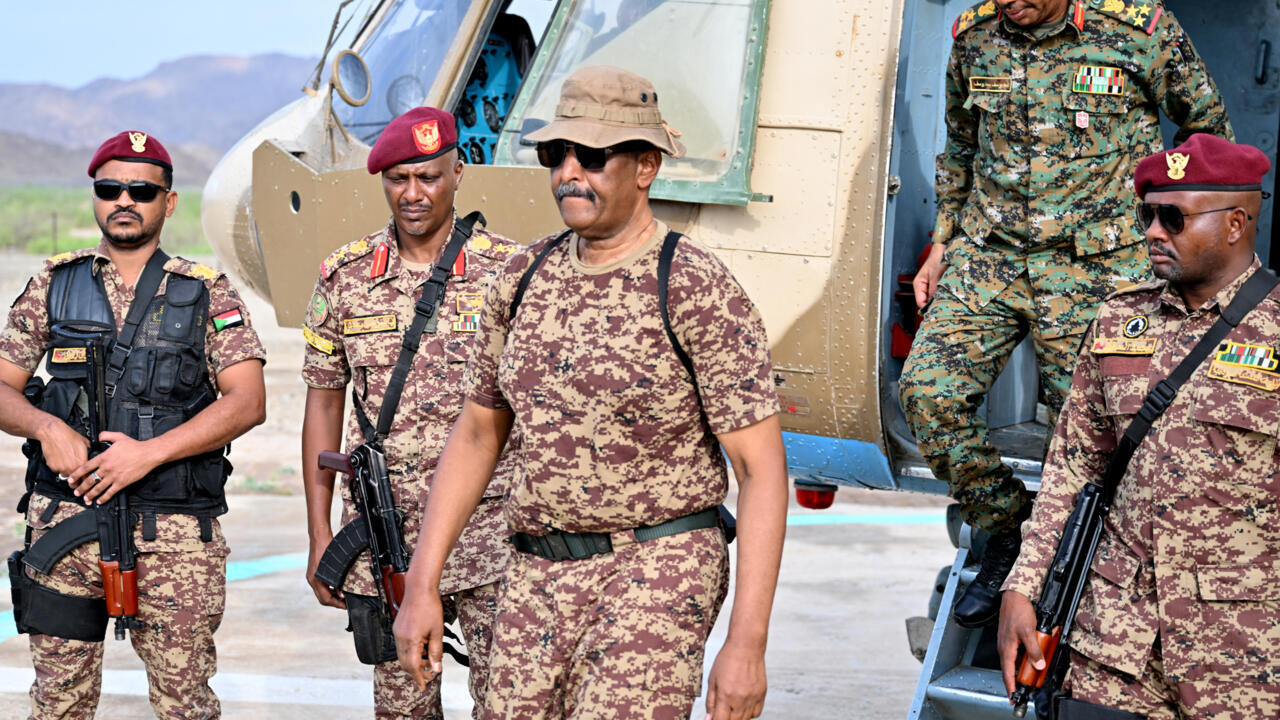
At the same time, Burhan has moved to open what Sudanese officials are describing as a political track running in parallel with continued military operations. Measures reported in recent days include an offer of temporary immunity for participants in an internal Sudanese dialogue process, a session of the African Union's Peace and Security Council convened in Khartoum, and the establishment of a bilateral coordination council between Khartoum and Riyadh. Burhan has been explicit that the political process is not intended to replace the military campaign but to run alongside it, a framing that suggests the army leadership believes continued battlefield pressure will strengthen its negotiating position rather than undercut the case for talks. The RSF, for its part, has not gone quiet: drone strikes attributed to the paramilitary force have continued to target towns and transit routes in North Kordofan, including Um Qirfa and Jabrat al-Sheikh, underscoring that even amid setbacks and defections the group retains meaningful strike capability.
Reactions
Regional analysts have offered a mixed and often cautious reading of these developments. Commentary published by Al Jazeera on August 26 posed the question directly, asking whether Sudan's battlefield is now shaping the terms of the country's next political phase, suggesting that continued SAF momentum could give Burhan and his allies greater latitude to determine who participates in any eventual political settlement and on what terms, potentially sidelining RSF-aligned political figures altogether. A companion opinion piece published the same day struck a more skeptical note, warning that even a decisive RSF defeat on the conventional battlefield would not end Sudan's war so much as fragment it, with the paramilitary force's constituent elements and allied militias likely to continue fighting in a more localized, decentralized fashion rather than formally surrendering.
The defections themselves have prompted debate over whether they reflect a genuine unraveling of RSF cohesion or a more limited, opportunistic response to battlefield setbacks in specific areas. Some regional commentary has framed the departures as evidence that a breakup phase may be underway within the RSF and its broader Tasis political-military alliance, while cautioning that Hemedti's core forces around Darfur and elsewhere remain intact and that the group has shown resilience and adaptability at earlier points in the war when it appeared to be under comparable pressure. Sudan's government has continued to press its objections to the UAE's role within the Quad mediation framework, a dispute that has done little to rebuild confidence in the international diplomatic process even as the military situation shifts.
Humanitarian organizations, for their part, have continued to warn that the changing battlefield dynamics offer little immediate relief to civilians. Displacement, food insecurity and restricted access for aid organizations remain acute across large parts of the country, particularly in Darfur and other contested regions, and the shifting front lines in North Kordofan have in some cases created new waves of displacement even as they force RSF units into retreat elsewhere.
What's Next
The immediate question is whether the SAF's momentum in North Kordofan will translate into further, deeper RSF fragmentation, or whether Hemedti's forces will stabilize the front and regroup, as they have managed to do at various points earlier in the war. Continued defections, particularly of senior commanders with meaningful troop followings, would further erode RSF cohesion and could accelerate the group's retreat toward its historical Darfur strongholds, but analysts caution against assuming a linear or rapid collapse given the group's demonstrated resilience and its continued access to external support and drone capabilities.
On the political track, Burhan's offer of temporary immunity and the broader internal dialogue process will be an early test of whether the army leadership is prepared to build an inclusive political settlement or intends to use its improving military position to marginalize RSF-linked actors from any future arrangement. The African Union's engagement through the Peace and Security Council session in Khartoum, alongside the new Khartoum-Riyadh coordination council, suggests an effort to build parallel channels of legitimacy and support beyond the stalled Quad process, though it remains unclear whether Egypt, Saudi Arabia, the United States and the UAE can realign around a common approach given Khartoum's persistent objections to Abu Dhabi's role.
For millions of Sudanese civilians, the practical stakes of these developments are immediate and severe. Even under an optimistic scenario in which SAF gains continue and RSF cohesion erodes further, most observers expect a transition period marked by localized violence, contested control in newly retaken areas, and continued humanitarian need, rather than a clean end to hostilities. Whether the current military momentum ultimately produces a genuine opening for a broader peace process, or simply shifts the character of a war that has already displaced millions and killed tens of thousands, is likely to become clearer over the coming weeks as the political track Burhan has initiated either gains real substance or stalls alongside the diplomatic efforts that preceded it.
Published By | News Editor