WASHINGTON, D.C.
For the roughly 308,000 Americans living with a spinal cord injury, the distance between a wheelchair and a kitchen counter can feel like the distance to the moon. Reaching a top shelf, hugging a friend at eye level, standing to look someone in the face — these are the small, unglamorous freedoms able-bodied people never think twice about. Now, for the first time, the U.S. Food and Drug Administration has cleared a robotic exoskeleton that promises to hand those freedoms back — and it's designed to be worn not in a hospital gym, but in your own living room.
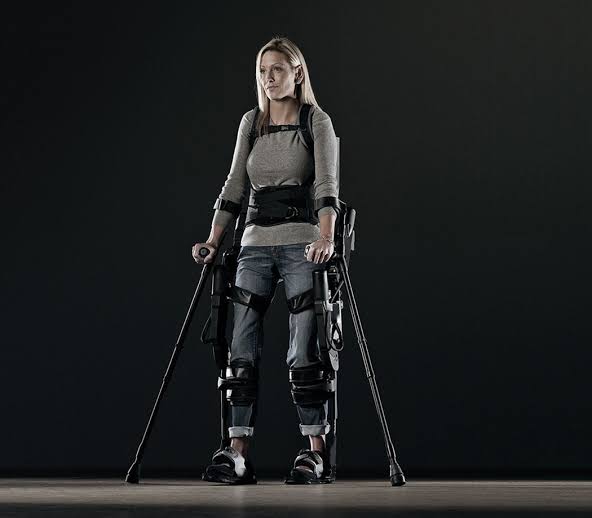
The device is called Eve, built by the French robotics company Wandercraft, and on August 11 the FDA gave it clearance as the world's first self-balancing personal exoskeleton approved for unsupervised — well, companion-supervised — use at home. Translation: no crutches, no walker, no second robotic arm bracing the user upright. Eve balances on its own, using onboard sensors and motors to mimic the shifting, correcting rhythm of a human gait, while the user steers it with a simple remote control.
"Eve is designed to complement, not replace, the wheelchair by expanding opportunities to stand, walk, bend, turn, use their hands and participate in everyday activities while upright," the company said in its clearance announcement. It's a small but pointed distinction — this isn't a device meant to get people out of their wheelchairs for good. It's meant to give them a second option, for the hours of the day when standing on two feet matters more than rolling on four wheels.

THE MACHINE BEHIND THE MIRACLE
Wandercraft isn't a newcomer chasing a viral headline. The company has spent nearly a decade building exoskeletons, and its earlier device, Atalante X, has already been used in rehab centers and research hospitals around the world to help patients relearn to walk under close clinical supervision. Eve is the graduation project — the first Wandercraft exoskeleton engineered to leave the clinic and move into ordinary homes.
The clearance wasn't handed out on faith. It was backed by a three-site clinical trial in which participants with a range of spinal cord injury severities — some with limited hand function, some with more complete paralysis — learned to use Eve alongside a trained companion. The trial measured hard functional benchmarks: walking performance, the ability to complete real activities of daily living, and safety metrics for a device that, by definition, straps a person into a standing robot and lets them move around unassisted by human hands.
The results, according to Wandercraft and outlets covering the clearance, went beyond simple mobility. Participants reported improvements in overall health status, psychological well-being, physical endurance during daily tasks, reduced lower-limb spasticity, and better sitting balance even when they were back in their wheelchairs. That last point matters more than it might seem — spending time upright, bearing weight through the legs and spine, is something doctors have long believed benefits circulation, bone density, digestion, and pressure-sore prevention in wheelchair users. Eve, in theory, offers a way to get some of that benefit as a daily habit rather than an occasional clinical exercise.
"FDA clearance of Eve marks one of the most important moments in Wandercraft's history and a significant step for the people, families, clinicians, researchers and partners who helped make it possible," said Matthieu Masselin, Wandercraft's co-founder and CEO, in a statement following the clearance.
Masselin described the vision behind pairing Eve with Atalante X as a full continuum of care: "Together, Atalante X and Eve may offer eligible users a pathway from walking during rehabilitation to upright mobility at home, whether making coffee at the kitchen counter, reaching for a book or spending time with friends on the patio." It's the kind of quietly devastating detail that tends to get lost in press releases about robotics — not "restoring locomotion" in the abstract, but making coffee. Reaching a book. Sitting with friends at eye level instead of looking up at them from a chair.
HOW IT ACTUALLY WORKS — AND WHO CAN GET ONE
Eve isn't something a person can simply buy and strap on. Under the FDA clearance, it must be prescribed by a licensed healthcare practitioner, and before a patient ever takes a step in it, they go through a formal process: a clinical assessment to determine eligibility, a personalized fitting to match the device to their body and injury level, and hands-on training. That training isn't a quick tutorial — it includes five separate two-hour sessions with a "specially trained companion," the person who will need to be present whenever Eve is in use.
That companion requirement is one of the clearance's more important guardrails. Eve is cleared for use on level indoor surfaces and adjacent outdoor areas, but always under the supervision of someone trained specifically to assist. This isn't a device you send a paralyzed relative off to use solo on day one; it's a supervised mobility tool, at least for now, with the expectation — the company hopes — that future iterations or expanded clearances loosen those restrictions as real-world data accumulates.
Wandercraft says Eve will officially launch commercially in the United States on September 17, 2026, with an unveiling event planned at the Cure healthcare innovation campus in New York City, done in partnership with the United Spinal Association — a nonprofit that has spent decades advocating for wheelchair users and people living with spinal cord injuries and disorders.
WHO PAYS FOR IT
Personal exoskeletons are not cheap technology, and Wandercraft has been careful to frame Eve's arrival alongside a conversation about access, not just capability. Since 2024, Medicare has covered eligible personal exoskeletons under its Durable Medical Equipment, Prosthetics, Orthotics and Supplies (DMEPOS) program — the same benefit category that covers wheelchairs, prosthetic limbs, and other adaptive equipment — under a specific billing code, K1007. Wandercraft has said it expects Eve to become eligible for Medicare reimbursement within 60 to 90 days of its commercial launch.
The company also says it plans to work with private insurers and other funding sources to widen the path to access beyond Medicare beneficiaries, though as of this week, specific out-of-pocket pricing for Eve has not been publicly disclosed. Given that comparable clinical-grade exoskeletons have historically carried price tags well into six figures, the reimbursement pathway is likely to be the deciding factor in whether Eve becomes a rare novelty or a genuinely accessible piece of adaptive technology.
Wandercraft isn't going into this launch short on cash, either. The company raised $75 million in a Series D funding round last year, on top of $45 million in Series C funding secured in 2022 — capital that has gone toward both its medical exoskeleton work and a parallel humanoid robotics program.
WHAT EXPERTS AND ADVOCATES ARE SAYING
The clearance has drawn attention across the medical device and disability advocacy worlds, in part because "personal use" exoskeletons — as opposed to clinic-only rehabilitation devices — represent a meaningfully different regulatory and practical bar. Devices used only in a hospital gym, with physical therapists standing by, don't have to contend with uneven home flooring, real furniture, pets underfoot, or the simple fact that daily life doesn't pause for a supervised session.
Outlets covering the medical device industry noted that Eve is being positioned as the first exoskeleton cleared specifically for use in the home, expanding robotic mobility assistance beyond hospital walls and rehabilitation centers for the first time. That distinction — hospital tool versus home appliance — is the crux of why this clearance is being treated as a milestone rather than an incremental update. Assistive technology has spent decades confined to clinical settings partly because regulators, insurers, and manufacturers have been cautious about liability and safety once a device leaves a controlled environment. Eve's clearance suggests that caution is starting to loosen, at least for a device with a real clinical trial and a mandatory companion-training program behind it.
WHAT THIS MEANS FOR YOU
If you or someone you love is one of the roughly 302,000 to 383,000 Americans living with a spinal cord injury, Eve represents a genuinely new category of option — not a replacement for a wheelchair, but a second mode of living alongside it. The practical hurdles are real: a prescription is required, a lengthy training process is mandatory, a trained companion must be present during use, and pricing and full insurance coverage details are still being finalized. This is not a walk-in-and-buy-it product, at least not yet.
But for a community that has watched robotic exoskeletons remain locked inside research labs and rehab clinics for the better part of two decades, the shift to a home-use, FDA-cleared device — with an actual commercial launch date on the calendar — is a meaningful inflection point. Disability advocates have long argued that mobility technology too often stalls in the "promising early trial" phase for years without ever reaching consumers. Eve's September 17 launch, paired with an expected Medicare reimbursement pathway, suggests this device might actually make it into people's homes rather than staying a headline about the future of robotics.
For now, the practical next step for anyone interested is a conversation with a treating physician about eligibility — spinal cord injury level, hand function for operating the remote, and overall health will all factor into candidacy. Wandercraft has said it will work through clinics and rehabilitation partners to identify and onboard early users ahead of and following the commercial launch.
THE BIGGER PICTURE
Eve's clearance lands at a moment when robotics and healthcare are converging faster than at almost any point in recent memory — from surgical robots to AI-assisted diagnostics to, now, wearable machines that restore a fundamental human capability many people spend their whole lives taking for granted. It's easy to be cynical about "revolutionary" health tech headlines; plenty of promising devices never make it past a splashy press release. But a completed clinical trial, an actual FDA clearance, a firm commercial launch date, and a Medicare reimbursement code already sitting on the books put Eve in a different category than vaporware.
Whether Eve becomes a common sight in American homes or remains a rare, high-cost tool for the fortunate few will likely come down to the unglamorous machinery of insurance reimbursement and pricing over the next year. But for the first time, the FDA has said, in effect, that a robot can help someone stand up in their own kitchen — safely, repeatedly, and without a hospital in sight. For a community that has waited a long time for that sentence to be true, September 17 can't come soon enough.
Published By | Features Editor