Economic & Social Transformation Series
Few African economies stand as close to a structural turning point as Namibia does in mid-2026. For decades, this sparsely populated nation of roughly three million people has depended on diamonds, a partnership with De Beers, and revenue transfers from the Southern African Customs Union (SACU) to sustain one of the continent's higher per-capita income levels. That model is now visibly fraying: the global diamond market is undergoing a structural shift, growth has slowed, and fiscal buffers are thinning. Yet at the same moment, two of the largest resource development stories in Africa — the Orange Basin offshore oil discoveries and the Hyphen green hydrogen project — are converging on final decisions that could redefine the country's economic trajectory for a generation.

A Diamond Economy Under Strain
The near-term numbers tell a sobering story. Namibia's real GDP growth slowed to 1.7 percent in 2025, according to World Bank estimates, reflecting weak diamond demand and the lingering effects of the severe 2024 drought, which left nearly half the population facing acute food insecurity. The Bank of Namibia has lowered its 2026 growth forecast to 2.6 percent from an earlier 3.8 percent, citing weak performance in mining — especially metals and diamonds — as the main driver. First-quarter 2026 GDP growth came in at just 2.0 percent, with the mining decline and slowing household demand revealing cracks beneath the surface.
The IMF, for its part, has projected growth of around 3.75 percent for 2025 and 2026 on the back of improved weather and agricultural recovery, but its March 2026 Article IV mission struck a more cautious tone, warning that risks are rising and urging Namibia to accelerate structural reforms.
The diamond downturn is not a cyclical blip. Lab-grown stones and shifting consumer preferences have permanently altered the market that long anchored Namibia's export earnings. The IMF's 2025 consultation explicitly flagged "a structural shift in the global diamond market" among the economy's principal challenges. Stronger uranium and gold exports partially offset the diamond slide in 2025 — Namibia remains one of the world's top uranium producers — but they have not been enough to restore momentum.
The Fiscal Squeeze
The slowdown is feeding directly into public finances. Namibia's fiscal deficit, which the IMF expected to widen from 2.4 percent of GDP in FY2023/24 to 3.0 percent in FY2024/25, has deteriorated much further: local analysts project the FY2025/26 shortfall at up to N$20 billion, or roughly 6 percent of GDP — driven principally by a sharp drop in SACU revenue transfers.
Public debt is forecast to rise to approximately N$177 billion** in FY2025/26 — about **60 percent of GDP** — and the IMF warns that on current trends debt will keep climbing without determined fiscal consolidation. There was one symbolic bright spot in May 2026, when Namibia cleared its outstanding IMF obligations with a final **$23.9 million payment, a milestone for a country that drew emergency financing during the pandemic. But the broader message from the Fund's 2026 mission was blunt: growth is slowing, risks are rising, and reform needs to speed up.
Venus and the Orange Basin: A Once-in-a-Generation Prize
Against this difficult backdrop, the deepwater Orange Basin has emerged as the most consequential economic development in Namibia's post-independence history.
TotalEnergies' Venus discovery — the largest sub-Saharan African oil find on record, with an estimated 5.1 billion barrels of oil in place — is moving toward a final investment decision (FID) targeted for the fourth quarter of 2026. In April 2026, the government entered formal negotiations with TotalEnergies, and the petroleum commissioner has publicly said Namibia expects the decision by late 2026.
The development plan centers on a floating production, storage, and offloading vessel processing approximately 150,000 barrels per day, with first oil targeted between 2029 and 2030. TotalEnergies CEO Patrick Pouyanné has set the commercial threshold plainly: the project must hold production costs below $20 per barrel to proceed.
The consortium pairs TotalEnergies as operator with a 35.25 percent stake, QatarEnergy at 35.25 percent, Portugal's Galp at 10 percent, and NAMCOR, the national oil company, at 10 percent.
Government estimates of the prize are striking: state revenues of between N$127 billion and N$229 billion over 25 years — figures that would transform a budget currently straining under a N$20 billion deficit. Nor is Venus alone. Galp's Mopane complex, named Wood Mackenzie's "2025 Discovery of the Year," drew TotalEnergies into a 40 percent operating stake in December 2025.
Industry observers now describe a multi-project oil province taking shape, with FID timelines aligning across 2026 and 2027, including BW Energy's Kudu project decision also expected in late 2026. If Namibia successfully develops the Orange Basin at scale, analysts suggest the transformation could be the most significant in Southern Africa since Botswana's diamond development era.

Betting on Green Hydrogen
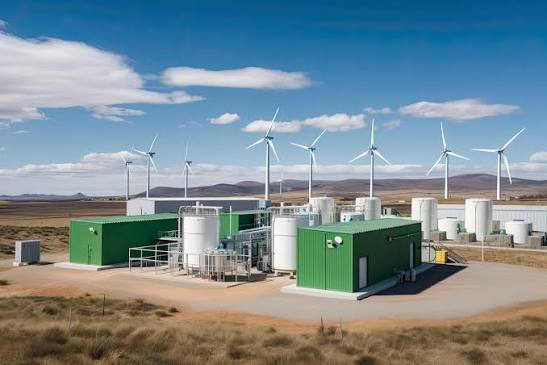
Namibia is simultaneously pursuing a very different energy future on land. The $10 billion Hyphen Hydrogen Energy project in the Tsau ǁKhaeb National Park near Lüderitz — a joint venture in which the Namibian state holds a 24 percent interest — aims to harness some of the world's best combined solar and wind resources to produce green hydrogen and ammonia for export.
At full scale, Hyphen plans 5 to 6 gigawatts of renewable generation and 3 gigawatts of electrolyser capacity producing 300,000 tonnes of green hydrogen per year, cutting an estimated 5 to 6 million tonnes of annual CO2 emissions. The first 2-gigawatt phase, costed at $4.4 billion, targets initial production of around 125,000 tonnes, with feasibility work running through the end of 2026.
The project's bankability received a meaningful boost in December 2025, when the African Development Bank approved a $10 million loan through its Sustainable Energy Fund for Africa. In May 2026, the government publicly signaled "total commitment" to Hyphen as a strategic engine of Namibia's industrial future.
Skeptics note that global green hydrogen markets remain immature and that offtake agreements, not feasibility studies, will determine whether Hyphen is built. But the strategic logic — pairing near-term oil revenues with a long-term decarbonized export industry — gives Namibia an energy diversification story few African economies can match.
The Social Deficit
The urgency behind these mega-projects is ultimately social:
- Unemployment stood at 36.9 percent in the 2023 labour force survey
- Youth unemployment at a staggering 54.8 percent
- The number of Namibians below the national poverty line more than doubled from 410,518 to 852,317 between 2017 and 2023
- The poverty rate rose from 19.7 percent to 28.2 percent — women and children bearing the brunt
- Namibia remains one of the world's most unequal societies by income distribution
President Netumbo Nandi-Ndaitwah, who took office on 21 March 2025 as Africa's second directly elected female head of state, has made employment the centerpiece of her administration, pledging 500,000 new jobs with a focus on agriculture, fishing, creative industries, and sport alongside the extractive boom. The test of her presidency — and of the Venus and Hyphen decisions expected within months — will be whether resource wealth translates into broad-based livelihoods rather than an enclave economy.
Managing the Windfall
Namibia enters its resource moment with real institutional advantages: a stable multiparty democracy, relatively strong public financial management, and the cautionary and instructive examples of its neighbors.
The policy agenda now taking shape includes:
- Strengthening the sovereign wealth framework ahead of first oil
- Local content rules that build domestic capability without deterring investment
- The fiscal consolidation the IMF has repeatedly urged, so that oil revenues fund development rather than debt service
The window between now and first production in 2029-2030 is, in effect, Namibia's preparation period. Countries rarely get to choose the timing of their transformation. Namibia's has arrived — squeezed between a fading diamond age and an uncertain but potentially historic energy future — and the decisions of the next eighteen months will echo for decades.
Sources: IMF, World Bank, African Development Bank, Ecofin Agency, bne IntelliNews, World Oil, Hyphen Hydrogen Energy, Fuel Cells Works, The Brief (Namibia), Further Africa, The Namibian, African Energy Chamber
Published By | Business News Editor