Miami, Florida
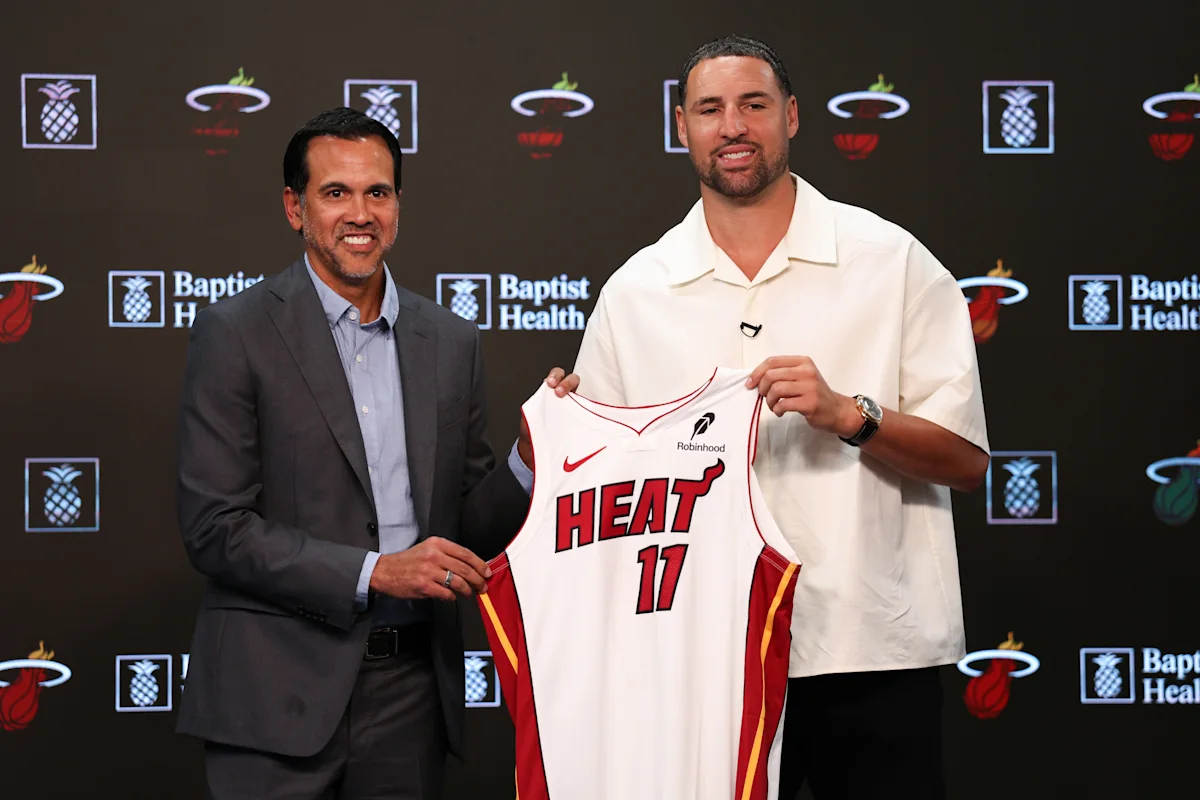
Klay Thompson stood at a podium inside the Miami Heat's downtown practice facility on Tuesday, a white No. 11 jersey draped over his shoulders, and used a word he hasn't reached for often in a Hall of Fame-track career: redemption.
"It's kind of a redemption season for me," Thompson told reporters at his introductory press conference, "to show I can still make an impact on winning and do it consistently." It was a striking admission from a five-time All-Star who spent a decade as one of the greatest shooters basketball has ever seen, won four championships in Golden State's dynasty years, and is now, at 36, fighting to prove he still belongs on a contender.
A Costly Escape From Dallas
The move didn't come cheap. Thompson was owed $17.5 million in the final season of his contract with the Dallas Mavericks, a team that stumbled to a 26-56 record last season and showed little sign of turning things around quickly. Rather than ride out a lost year, Thompson approached the Mavericks front office and told them directly that he wanted out — specifically, that he wanted to play for a contender one more time.
Dallas obliged, announcing a buyout that let Thompson walk in exchange for giving up a substantial chunk of his own money. By the time he cleared waivers and signed in Miami, Thompson had left roughly $10 million on the table. His new contract with the Heat is a two-year deal worth about $11.5 million, with a player option for the second season and a 15 percent trade kicker built in — a modest, team-friendly deal for a player who once commanded max money in the Bay Area.
It's a rare thing in modern professional sports: a veteran star voluntarily taking a steep pay cut, mid-career, purely to chase a specific kind of basketball. Thompson's camp has framed it as simple math. He has already made generational wealth. What he doesn't have, at this stage, is time.
Why Miami, Why Now
The timing is not a coincidence. The Heat made Thompson their top offseason target immediately after pulling off a blockbuster trade for Giannis Antetokounmpo, instantly transforming Miami from a scrappy play-in contender into a team with legitimate title aspirations. Thompson's shooting — he remains one of the most dangerous movement shooters in NBA history even as his athleticism has declined — slots neatly alongside a two-way superstar who needs floor spacing more than another ball-handler.
For Pat Riley's organization, long defined by its "Heat Culture" mantra of accountability and conditioning, Thompson represents exactly the kind of player the front office loves to court: a proven champion willing to sacrifice ego and salary for a role. Thompson leaned into that reputation at his introduction, praising the franchise's discipline and noting a personal thread that predates his own career — his father, Mychal Thompson, has long argued that a Miami-area high school program he associates with is among the best in Florida history. Being closer to family carries extra weight for Thompson now, too: he has spoken about wanting to be nearer relatives based in the Bahamas, a short flight from South Florida rather than a cross-country trip from Dallas or the Bay Area.
"I still have a lot to prove. I know what I'm capable of, and I want to show this league I can still help a team win at a very high level." — Klay Thompson, at his Heat introductory press conference
The Numbers Behind the Narrative
Statistically, Thompson's last two seasons have been a study in gradual decline mixed with flashes of the old magic — nights where he still catches fire from three and looks every bit the player who once scored 60 points in 29 minutes. What's changed is consistency, the very word he used to describe his own mission in Miami. Analysts who have watched his recent tape argue the fit with the Heat's system, which prizes ball movement and early offense, could be more forgiving than the more stagnant, isolation-heavy stretches he found himself in in Dallas.
The Heat now enter training camp with a revamped core built around Antetokounmpo, a deep rotation, and a future Hall of Famer on a bargain contract whose sole job is to make defenses pay for helping off him. It's the kind of role-player-with-a-résumé signing that has defined championship rosters across the league for years — see veteran shooters who took pay cuts to chase rings with contenders in recent seasons.
What It Means for Fans
For Heat fans, the Thompson deal is a signal of intent: this front office is not rebuilding, it's all-in, and it's willing to use its remaining cap flexibility to surround a new superstar with proven winners rather than unproven prospects. For NBA fans generally, it's another data point in a league increasingly shaped by aging stars chasing legacy over leverage, prioritizing a shot at one more banner over one more contract.
For Mavericks fans, the story reads differently — a reminder that the roster once again finds itself shedding a recognizable name as it leans into a longer-term rebuild, even as questions persist about how that rebuild is being managed.
The Bottom Line
Whether Thompson's redemption season actually delivers a fifth championship ring remains to be seen; Miami still has real competition in a loaded Eastern Conference, and a 36-year-old body doesn't get younger because the motivation is right. But for a player whose career has already secured his place in basketball history, this signing was never really about the money. It was about writing one more chapter on his own terms — in a city, and with a team, that wanted him specifically for who he still is, not just who he used to be.
Published By | Sports Editor